




Canadian Carriers Looking to Extended Tractor and Combo Lengths
The Canadian Trucking Alliance (CTA) is proposing changes to Canada's vehicle length rules to accommodate longer tractor wheelbases and longer over-all lengths for B-train combinations
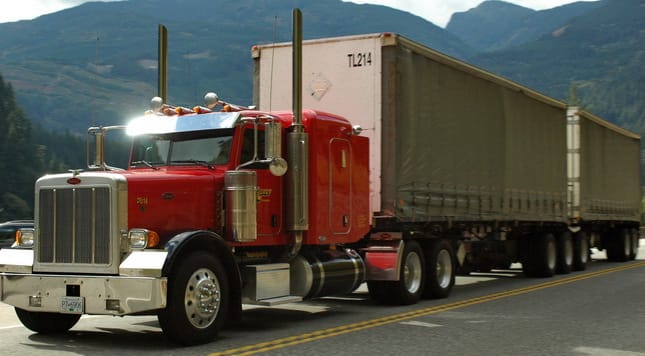
Canadian length restrictions limit tractor wheelbases and fleet flexibility.
The Canadian Trucking Alliance (CTA) is proposing changes to Canada's vehicle length rules to accommodate longer tractor wheelbases and longer over-all lengths for B-train combinations.
CTA says the longer tractors would make more room for the installation of GHG-saving add-on devices such as auxiliary power units, while adding to fleet flexibility in dispatching power equipment.
Canada's vehicle length restrictions limit tractor wheelbases to 6.2 meters (244 in.). CTA would like to see the limit increased to 7.2 meters (283 in.).
"It's difficult to accommodate much additional frame equipment such as APUs, toolboxes, and chain hangers in an envelop as tight as [244 in.]," said Geoff Wood, CTA vice president of operations and safety. "The additional equipment required for EPA 2010 compliance has taken up some of the space where that other equipment was once installed."
Recognizing that extending the power unit length would impact turning geometry, CTA is advocating the so-called Quebec model, where the inter-axle distance between the drive axles and the trailer tandems is shortened by a corresponding amount. According to Wood, the turning radius and off-track in a corner would remain substantially the same.
CTA is also urging the National Vehicle Weights and Dimensions Task Force in Canada to amend the National Memorandum of Understanding on truck configurations to accommodate larger sleeper berths on B-train combinations. Currently, B-train combinations in Canada are limited to 25 meters overall (82 ft) length. But that imposes strict limits on the tractor length. Most B-train combinations operate at a 20-meter (65.5 ft) box length -- the effective length of the two trailers. That leaves little room out front for a tractor with a wheelbase much longer than 230 inches.
CTA is asking overall length restrictions to be relaxed allowing tractors as long as 6.2 meters.
"The changes CTA is proposing for B-trains -- which are a very productive configuration used in many sectors of the industry across Canada -- and tractor wheelbase, which is also an issue for many fleets, are two areas where we feel more flexibility would be desirable," says CTA's chief executive officer, David Bradley. "In order to ensure those drivers who use sleeper berths have the maximum of comfort, and carriers and owner-operators will have more flexibility in determining which fuel economy-GHG reduction options they wish to implement going forward, we thing the length increase is a reasonable request."
The current truck weights and dimensions regulations have and continue to serve the industry well, Bradley notes, "But like anything else they need to be tweaked in order to modernize them from time to time."
For more information on this issue please watch this video.
More Drivers

Truck Drivers Need More Than Another Alert
Fleets have more visibility into truck health, safety events, and driver activity than ever. The next challenge is turning all that information into useful guidance for the person who has to decide what to do next.
Read More →
FMCSA Removes 110 Truck Driver Training Schools from Certified ELDT List
Federal regulators also are targeting more than 160 additional training providers and launching a nationwide audit of third-party CDL skills testers as part of a broader crackdown on trucking fraud.
Read More →
Hours of Service Pilot Programs: FMCSA Readies for 2027 Rollout
Two pilot programs could eventually reshape hours-of-service rules, giving truck drivers options to pause their 14-hour clock or use longer split sleeper rest periods.
Read More →
Medical Cards, English Proficiency Reshape Roadcheck Violations
Medical-card violations jumped to the top of the driver out-of-service list during CVSA’s 2026 International Roadcheck, while English-language proficiency violations appeared among the leading violations for the first time.
Read More →
Driver Trust Can Make or Break the Success of Fleet Safety Technology
New Teletrac Navman research suggests that onboarding, transparency about driver data, and positive feedback can play a significant role in how commercial drivers respond to safety and coaching technology.
Read More →
EEOC Sues KLLM Over Alleged Sex Discrimination in Driver Training
KLLM is facing a federal sex-discrimination lawsuit over policies the EEOC alleges put female truck driver trainees at a disadvantage.
Read More →
FMCSA Moves to Codify English Language Requirements for Commercial Drivers
By changing regulations on English-language proficiency requirements for commercial drivers, rather than relying on a guidance memo, the FMCSA said future administrations won't be able to walk back the Trump administration's stricter enforcement with just a memo.
Read More →
Drivers Put Western Star Trucks to the Test at Star Nation Experience
Watch to get an inside look at the Western Star trucks, technology, and community behind the Star Nation Experience 2026!
Read More →
Trump Administration Looks to Put More Veterans Behind the Wheel
The Freedom Haulers program pulls together existing and expanded programs at several federal agencies to recruit veterans to drive commercial heavy-duty trucks and cut the red tape for them to get a CDL, training, and employment.
Read More →
Putting Mack’s Command Steer to the Test
A test drive of Mack’s Command Steer active steering system evaluates how it can make truck driving easier and less tiring.
Read More →