




Calstart Roadmap Would Speed Commercial EV Charging Infrastructure
A new study commissioned by Calstart details how utilities, industry, and government can work together to build the infrastructure needed to help transition trucking to a zero-emissions industry.

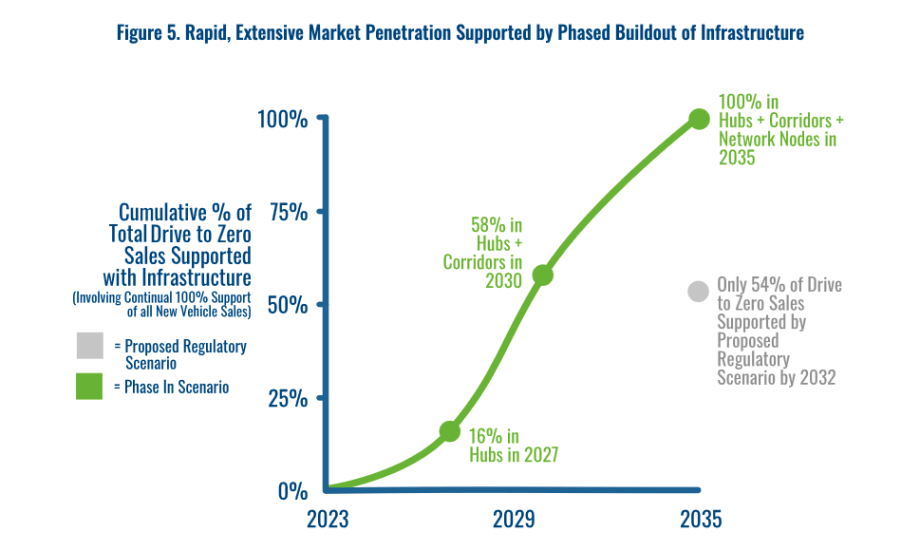
Source: Calstart
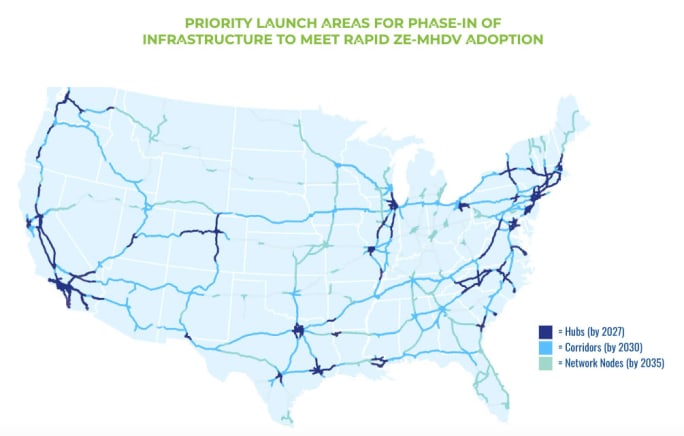
Calstart's charging infrastructure strategy would focus on specific areas.
Source: Calstart
Charging infrastructure issues continue to plague the widespread adoption of zero-emission, battery-electric commercial trucks. But a new report issued by Calstart says establishing electric infrastructure in a timely manner to meet those needs is possible.
Calstart is a non-profit environmental advocacy organization that works with member companies and agencies to help North America’s transportation industry transform to new technology that cuts air pollution, oil imports and curbs climate change.
In the report, “Phasing in U.S. Charging Infrastructure,” Calstart analysts said commercial vehicle infrastructure development can be managed through market-driven, overlapping, and concurrent growth of an integrated transportation-energy system. The report calls for prioritizing development in favorable launch areas first and using innovative deployment strategies that can accommodate capacity constraints during buildout.
From a very high level, this phase-in strategy enables:
Faster deployment by focusing on priority launch areas: This will allow more zero-emission commercial trucks to be supported in less time than in linear, unphased growth scenarios.
Cost-effective implementation: Costs can be shifted forward and less important areas left to future deployment, while total energy demand can be supplied through targeted upgrades and management strategies, sharing arrangements, public charging, and other onsite optimizations—reducing per-vehicle infrastructure costs.
A clear vision that helps utilities, government, and investors target actions to integrate grid modernization and electric truck adoption, as well as maximize co-benefits.
Coordination that leverages public funds and unleashes private investment.
A 6-Step Charging Infrastructure Strategy
To assess the feasibility of infrastructure buildout at a national scale, Calstart projected the infrastructure necessary to deliver the electricity needed to meet the zero-emission adoption rates for commercial vehicles in 2027, 2030, and 2035, as set by the Global Memorandum of Understanding on Zero-Emission Medium- and Heavy-Duty Vehicles. The report focuses on electric infrastructure and leaves the deployment of other zero-emission refueling infrastructure for future studies.
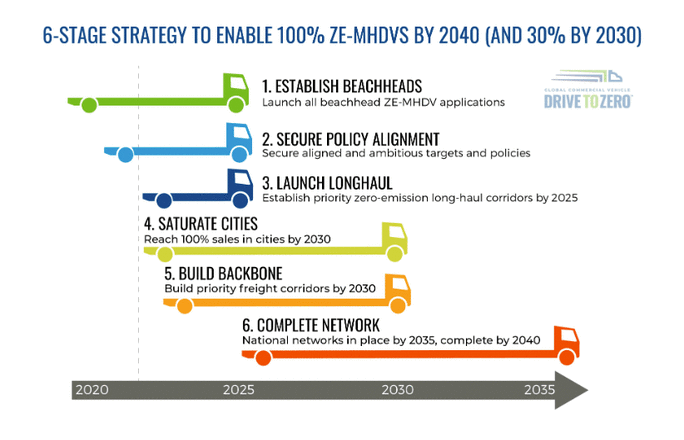
Calstart has outlined a six-stage strategy for developing commercial EV charging infrastructure.
Source: Calstart
Calstart advocates for electric infrastructure deployment concentrating first around return-to-base depot infrastructure and in regional recharging hubs within key areas supporting regional operations. This would be followed by development in key corridors enabling regional hub-to-hub operations. And then, finally, in built-out networks connecting corridors to each other and to other critical infrastructure along the larger surface transportation network.
This assessment breaks up the activity needed to reach full sales penetration into six overlapping stages, with smart infrastructure phasing as a critical, enabling component of five of the stages:
Establish “beachhead” areas where zero-emission commercial vehicles are being used.
Secure policy alignment for ambitious targets and policies.
Establish priority zero-emissions long-haul corridors by 2025.
Saturate cities to achieve 100% new zero-emission commercial vehicle sales by 2030.
Build priority freight corridors by 2030.
Complete a national electric infrastructure network by 2040.
The report also looked at areas with clear, publicly stated interest in green transportation policies, coupled with growing sales in zero-emission commercial vehicles. Using those criteria, Calstart identified the most likely candidates for priority freight corridors as being:
West Coast (I-5 in California, Washington, Oregon)
East Coast (I-95 in New Jersey, New York)
The Texas Triangle (I-10, I-35, I-45)
Southwest (I-10 in Arizona, New Mexico)
Rocky Mountains (I-70, I-25 in Colorado, Wyoming, Utah)
The Midwest (I-80 from Ohio through Illinois)
The report identified high-activity ZEV “clusters” in logistics and warehousing centers such as the San Bernardino Valley in California. But it also includes areas outside of major ports, including those in Oakland, the Puget Sound, and major East Coast ports such as those in Georgia, Virginia, New Jersey, and New York. Major logistics centers and hubs supported by intermodal travel appear as well in this analysis, particularly Chicago and Atlanta.
Major Action Required by All Stakeholders
In essence, Calstart advocates for focusing initial electric infrastructure investment and development first in freight depot hubs.
Once those areas are built out, develop would begin on “connective corridors.” These are essentially regional-haul routes between freight hubs that would enable point-to-point electric truck operations with guaranteed charging infrastructure on both ends.
The final step would be the build-out of a national electric infrastructure network allowing interregional trucking operations.
Based on this assessment, the report said, aggressive penetration rates for zero-emission commercial vehicles can be accommodated by a buildout of energy delivery infrastructure if a phase-in method and strategy is taken seriously for this deployment.
To accomplish these goals, Calstart recommends major coordinative actions among stakeholders in the transition to support electric infrastructure buildout. These actions include:
Conduct road mapping and anticipate emerging demand.
Develop competitive utility rate structures.
Create favorable utility investment regulatory frameworks.
Calstart said this list can be extended to include the following:
Forecast high-level energy needs using a phase-in approach sensitive to the anticipated distribution of energy needs in specific priority launch areas.
Coordinate investments around priority launch areas that will accommodate vehicles first, designating them with specific prioritization factors including industry clustering, investment leverage potential, supportive policy, and energy system development potential and costs
Encourage practices and policies to support coordination around higher charger utilization.
Plan rapidly for grid modernization around transportation and energy system integration.
More Fuel Smarts

How Volvo Updated Its D13 for EPA 2027 [Watch]
Volvo’s updated D13 promises lower emissions without sacrificing performance or fuel economy. Take a closer look at what changed inside the engine in this HDT Spotlight video.
Read More →
Diesel Price Spike Shortens Payback for Natural Gas Trucks, Report Says
Energy Vision estimates fleets could recover the higher purchase price of an RNG-fueled Class 8 tractor in 1.3 to 2.8 years under current fuel-price scenarios.
Read More →
Calstart Becomes Catalyst Mobility, Reflecting Broader Focus
Calstart is now Catalyst Mobility, reflecting the nonprofit’s growing national role in clean transportation, including zero-emission trucks, infrastructure and incentive programs.
Read More →

Record Diesel Prices Squeeze Trucking Fleets
Average U.S. diesel prices have climbed to nearly $6 a gallon, surpassing the 2022 record as tight refinery capacity and Middle East disruptions keep fuel costs elevated.
Read More →
How Fuel Delivery Shapes Engine Performance
Fuel delivery depends on more than what happens at the injector. For fleet, maintenance and technical professionals, looking at the full path from pump to injector can provide useful context for understanding engine performance.
Read More →
East Coast Port Launches $45M Electric Truck Push
The Port Authority of New York and New Jersey announced millions in incentives for zero-emission drayage trucks, yard tractors, and new charging hubs near the port.
Read More →
California Bill Could Shed Light on Electric Truck Prices
Why do battery-electric Class 8 trucks remain so expensive? A California bill headed to Gov. Gavin Newsom would give fleets and state agencies more visibility into what manufacturers charge.
Read More →
Detroit Opens Orders for EPA 2027 Engines
Detroit isn’t starting from scratch to meet EPA 2027 diesel emissions standards. Its Gen 6 DD13 and DD15 engines keep much of today’s platform while updating the fuel and aftertreatment systems.
Read More →
Zero-Emission Truck Corridor Planned for West Coast
California, Oregon, Washington, British Columbia and Baja California are coordinating plans for truck charging and hydrogen fueling from Canada to Mexico.
Read More →
A Closer Look at Kenworth’s Electric T880E Vocational Truck [Video]
Learn more about Kenworth's T880E battery-electric vocational truck at the Paccar Technical Center, including its range, applications, upfitting considerations, and PTO options, in this HDT Spotlight video.
Read More →