




California Requiring Zero-Emissions Forklifts
Fleets operating in California must phase out the use of large spark-ignited forklifts, according to a new regulation from the California Air Resources Board.

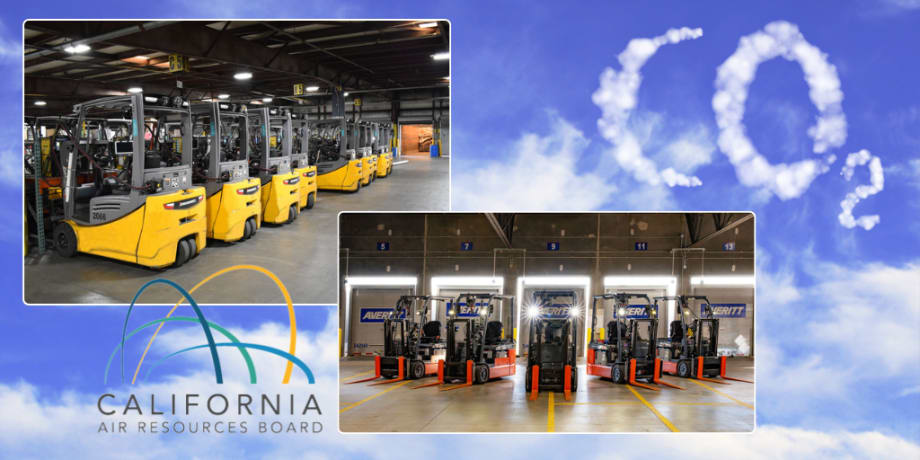
Many large fleets already have been adopting electric forklifts, even outside of California, such as HDT Top Green Fleets A. Duie Pyle and Averitt Express.
Photo: HDT Graphic
Fleets operating in California must phase out the use of large spark-ignited forklifts and use zero-emissions forklifts, according to a new regulation from the California Air Resources Board.
Under the rule, approved June 27, manufacturers cannot produce or sell Class IV and Class V LSI forklifts — categories that largely operate on propane, gasoline and natural gas — for use in California beginning in 2026.
The rule also phases out the use of spark-ignited forklifts by large fleets, defined as 26 units or more, starting in 2028. The phase-out schedule is by model year and designed so that no forklift is required to be phased out before it is 10 years old.
Smaller fleets will phase out use of spark-ignited forklifts starting in 2029.
CARB acknowledged that there are higher upfront cost for zero-emission forklifts but said fuel savings over time mean savings for most fleets.
Targeted forklifts affected by the regulation include:
All Class IV forklifts
Class V forklifts with rated capacity of 12,000 pounds or less
This rule addresses more than 89,000 spark-ignited forklifts currently operating in the state.
The regulation includes compliance extensions for delays with infrastructure construction, infrastructure site electrification, zero-emission forklift delivery, and operational issues if a zero-emission forklift cannot meet an operator’s needs.

CARB's zero-emission forklift requirements will be phased in by model year and fleet size.
From a CARB presentation
Timeline for Phase-Out of Spark-Ignited Forklifts
Starting in 2026 except in limited circumstances:
Manufacturers cannot produce or sell Targeted Forklifts in California
Fleet operators cannot acquire Targeted Forklifts
Starting in 2028 and extending to 2038:
Existing Targeted Forklifts phased-out by model year (MY)
Phase-out schedule designed so that no forklift phased out before 10 years old
Less stringent provisions for small fleets
For the first compliance date only, the new rule will limit required turnover to:
50% of forklifts for large fleets
25% of forklifts for small fleets
CARB emphasized that fleet operators need to contact their electric utility provider no later than March 31, 2026, to initiate discussions regarding potential electrical-service installation or necessary upgrades.
ZEV Forklift Technology
Forklifts are well-suited for widespread adoption of zero-emission technology, and about half of forklift sales in California today are zero-emission, according to CARB. Zero-emission forklifts are already widely used in indoor applications like warehouses.
New technology emerging for zero-emission forklifts include lithium-ion ZEFs (higher energy density and longer lifespan) and fuel cell models that allow for quick refueling.
More Fuel Smarts

How Volvo Updated Its D13 for EPA 2027 [Watch]
Volvo’s updated D13 promises lower emissions without sacrificing performance or fuel economy. Take a closer look at what changed inside the engine in this HDT Spotlight video.
Read More →
Diesel Price Spike Shortens Payback for Natural Gas Trucks, Report Says
Energy Vision estimates fleets could recover the higher purchase price of an RNG-fueled Class 8 tractor in 1.3 to 2.8 years under current fuel-price scenarios.
Read More →
Calstart Becomes Catalyst Mobility, Reflecting Broader Focus
Calstart is now Catalyst Mobility, reflecting the nonprofit’s growing national role in clean transportation, including zero-emission trucks, infrastructure and incentive programs.
Read More →

Record Diesel Prices Squeeze Trucking Fleets
Average U.S. diesel prices have climbed to nearly $6 a gallon, surpassing the 2022 record as tight refinery capacity and Middle East disruptions keep fuel costs elevated.
Read More →
How Fuel Delivery Shapes Engine Performance
Fuel delivery depends on more than what happens at the injector. For fleet, maintenance and technical professionals, looking at the full path from pump to injector can provide useful context for understanding engine performance.
Read More →
East Coast Port Launches $45M Electric Truck Push
The Port Authority of New York and New Jersey announced millions in incentives for zero-emission drayage trucks, yard tractors, and new charging hubs near the port.
Read More →
California Bill Could Shed Light on Electric Truck Prices
Why do battery-electric Class 8 trucks remain so expensive? A California bill headed to Gov. Gavin Newsom would give fleets and state agencies more visibility into what manufacturers charge.
Read More →
Detroit Opens Orders for EPA 2027 Engines
Detroit isn’t starting from scratch to meet EPA 2027 diesel emissions standards. Its Gen 6 DD13 and DD15 engines keep much of today’s platform while updating the fuel and aftertreatment systems.
Read More →
Zero-Emission Truck Corridor Planned for West Coast
California, Oregon, Washington, British Columbia and Baja California are coordinating plans for truck charging and hydrogen fueling from Canada to Mexico.
Read More →
A Closer Look at Kenworth’s Electric T880E Vocational Truck [Video]
Learn more about Kenworth's T880E battery-electric vocational truck at the Paccar Technical Center, including its range, applications, upfitting considerations, and PTO options, in this HDT Spotlight video.
Read More →