




Bridgestone Kodiak Investment to Enable Smart Tire Tech in Autonomous Trucks
What happens if an autonomous truck gets a flat tire? Kodiak and Bridgestone are working together to use technology to help keep that from being a problem.

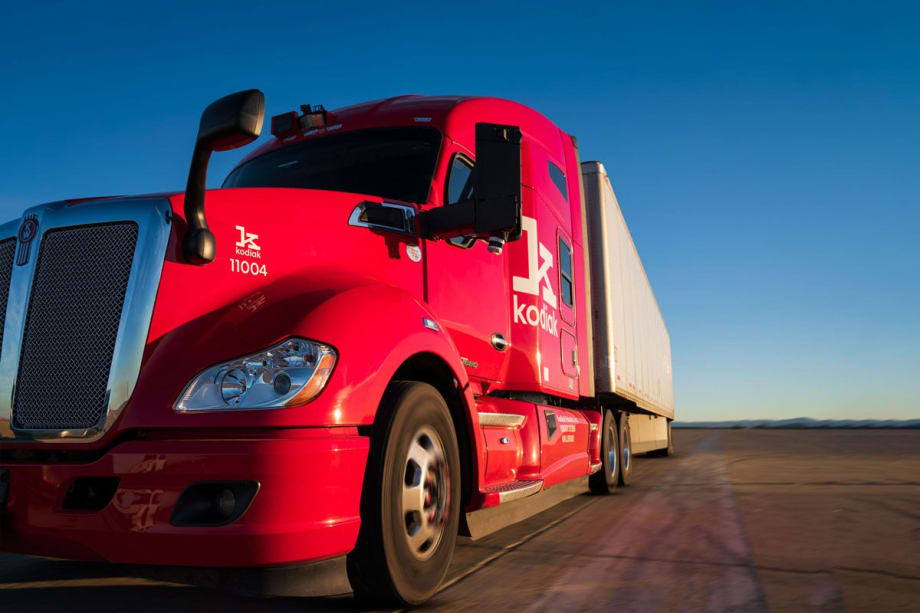
If you're going to have a fully self-driving truck, you have to think about how to prevent tire-related breakdowns.
Photo: Kodiak Robotics
What happens if an autonomous truck gets a flat tire? Kodiak and Bridgestone are working together to use technology to help keep that from being a problem.
Bridgestone Americas is taking a minority investment in Kodiak Robotics, which will allow the integration of Bridgestone’s smart-sensing tire technologies and fleet solutions into Kodiak’s Level 4 autonomous trucks.
The companies will also pilot future autonomous and smart tire technologies.
“Advancements in tire-centric technologies are critical to unlocking greater innovation in mobility, while also delivering significant sustainability benefits,” said Paolo Ferrari, president and CEO of Bridgestone Americas, in the June 16 announcement. “This investment will enable Bridgestone and Kodiak to work together to co-develop advanced mobility solutions with speed and precision that will revolutionize commercial trucking.”
Why Autonomous Trucks Need Smart Tire Tech
Kodiak and Bridgestone will work together to advance self-driving trucking technology, from tires and sensors to predictive maintenance, explained Don Burnette, Kodiak co-founder and CEO.
He told HDT that Kodiak is using Bridgestone’s smart tire technology, including tire-mounted sensors and tire pressure monitoring systems, to give it real-time insights on the performance of the tires on its autonomous trucks.
This will also give the company “a deep understanding of how those tires will operate in the future, including being able to predict when breakdowns will occur before they do,” Burnette said in an email. “This will help ensure that our self-driving trucks can deliver on their promise of near 24/7 operations at peak safety and efficiency.”
For example, Burnette explained, smart tire technologies can collect data and track if weight is evenly distributed among the truck wheels and axles.
“Weight distribution plays a critical role in vehicle dynamics, controllability, maneuverability and thus safety and vehicle performance. Tire-mounted sensors also give us an understanding of the real-time state of the tires so we avoid a fault before it happens.”
Smart tire technology also will enable lifetime vehicle monitoring, he said, which wasn’t previously possible.
Learning How Autonomous Driving Affects Tire Wear
“Thanks to Kodiak’s autonomous system, we can use data points from every driving function, like speed, throttle, braking and acceleration, in combination with Bridgestone’s sensors, to better understand the impact driving has on tire wear. As a result, we can build much more accurate, predictive maintenance models that can help ensure the tires on our trucks are always operating as they should.”
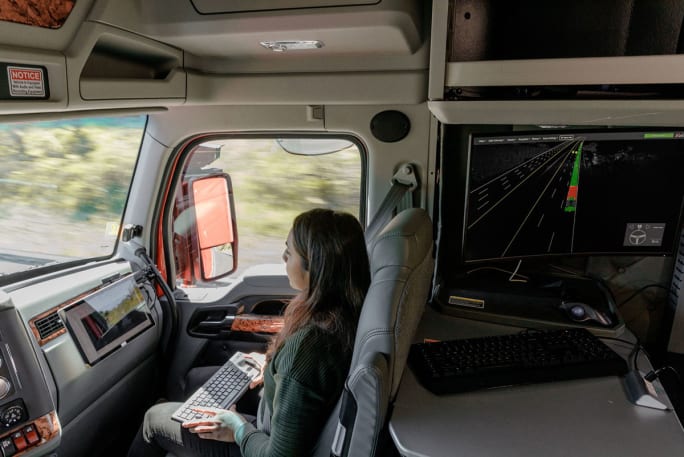
“Thanks to Kodiak’s autonomous system, we can use data points from every driving function, like speed, throttle, braking and acceleration, in combination with Bridgestone’s sensors, to better understand the impact driving has on tire wear," said Don Burnette, Kodiak co-founder and CEO.
Photo: Kodiak Robotics
Kodiak can also use the data to optimize autonomous driving operations so it creates less wear on tires. At the same time, Bridgestone can optimize its tires for near 24/7 autonomous operations, as well as improved performance for tires on manually driven tractors.
Kodiak moves freight autonomously for its customers using its fleet of SAE level 4 self-driving long-haul trucks in the state of Texas with a safety driver on board. With plans to deploy driverless trucks in the next few years, it said in its announcement, “full vehicle intelligence is a major key to unlocking safe, efficient and sustainable autonomy for Kodiak and its customers.”
Bridgestone Chief Technology Officer and Group President, Solutions Businesses, Nizar Trigui, will become a member of Kodiak’s board of directors as an observer.
More Equipment

How Volvo Updated Its D13 for EPA 2027 [Watch]
Volvo’s updated D13 promises lower emissions without sacrificing performance or fuel economy. Take a closer look at what changed inside the engine in this HDT Spotlight video.
Read More →
Michelin Tire Improves Efficiency and Durability for Regional Fleets
The Michelin X Multi Energy D2 is a regional haul drive tire engineered to help fleets improve fuel efficiency, durability and traction in demanding stop-and-go operations.
Read More →
ZF Expands Commercial Vehicle Push in North America
ZF is expanding its North American commercial-vehicle presence with new transmission applications, electrification, trailer technology and autonomous-driving systems.
Read More →
Tesla Wants a Self-Driving Semi. Are Cameras Enough?
Could Tesla’s camera-only autonomous driving technology work on an 80,000-pound Semi? In this commentary, HDT's Deborah Lockridge takes a look at Tesla, Cybercab, and how autonomous trucks see the road.
Read More →
Kodiak: Driverless Long-Haul Truck Launch on Track for 2026
Kodiak AI says its driverless long-haul safety case is 93% complete and it remains on track to begin commercial operations by year-end 2026.
Read More →
What DOT’s Automated Vehicle Strategy Means for Trucking
The U.S. Department of Transportation issued a new automated-vehicle strategy that outlines plans for driverless-truck regulations, cross-state freight corridors, and federal safety standards.
Read More →
East Coast Port Launches $45M Electric Truck Push
The Port Authority of New York and New Jersey announced millions in incentives for zero-emission drayage trucks, yard tractors, and new charging hubs near the port.
Read More →
PlusAI Going Public to Fund Autonomous Truck Launch
A SPAC deal could provide PlusAI with up to $300 million as it works toward a 2027 commercial launch of factory-built autonomous trucks.
Read More →
NHTSA Moves to Rewrite Truck Fuel-Economy Rules
The National Highway Traffic Safety Administration says it lacks authority to regulate medium- and heavy-duty truck engines separately from complete vehicles, but the existing standards have not yet been eliminated.
Read More →
Detroit Opens Orders for EPA 2027 Engines
Detroit isn’t starting from scratch to meet EPA 2027 diesel emissions standards. Its Gen 6 DD13 and DD15 engines keep much of today’s platform while updating the fuel and aftertreatment systems.
Read More →