




Brakes Top Roadcheck Out of Service Violations
During International Roadcheck, commercial vehicle enforcement personnel put nearly a fifth of the vehicles inspected out of service for serious violations, most commonly for problems with their brakes.

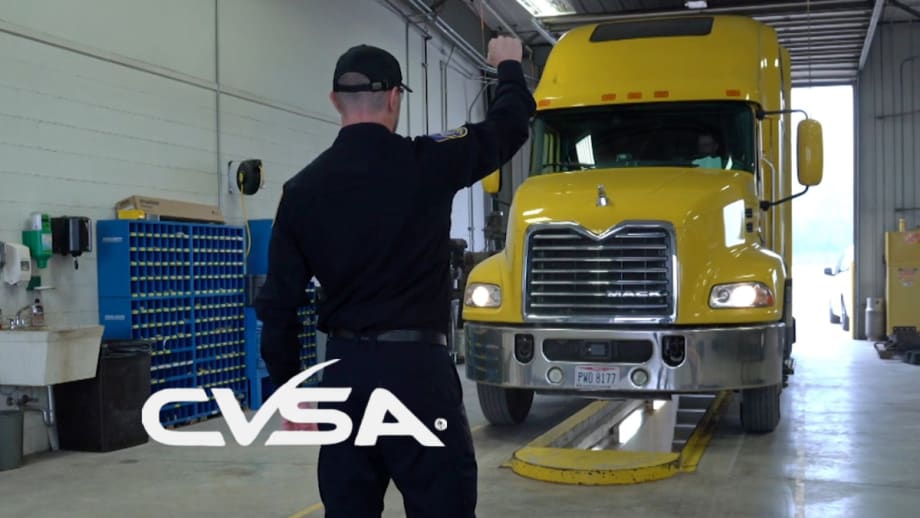
Commercial Vehicle Safety Alliance inspectors affixed 16,521 CVSA decals to power units, trailers and motorcoaches/buses during International Roadcheck.
Photo: CVSA
During the one-week commercial vehicle inspection blitz known as International Roadcheck, enforcement personnel put nearly a fifth of the vehicles inspected out of service for serious violations.
The Commercial Vehicle Safety Alliance’s (CVSA) 72-hour International Roadcheck inspection, enforcement and data-gathering initiative was held May 13-15. Enforcement officials across North America conducted more than 56,000 inspections.
Out of service means those drivers and/or vehicles were restricted from further travel until all out-of-service violations were resolved. The vehicle out-of-service rate for the 2025 International Roadcheck was 18.1% and the driver out-of-service rate was 5.9%.
That’s an improvement on the vehicle side from the 2024 Roadcheck results, where the total overall vehicle out-of-service rate was 23%. But it’s worse than the 2024 driver out-of-service rate, which was 4.8%.
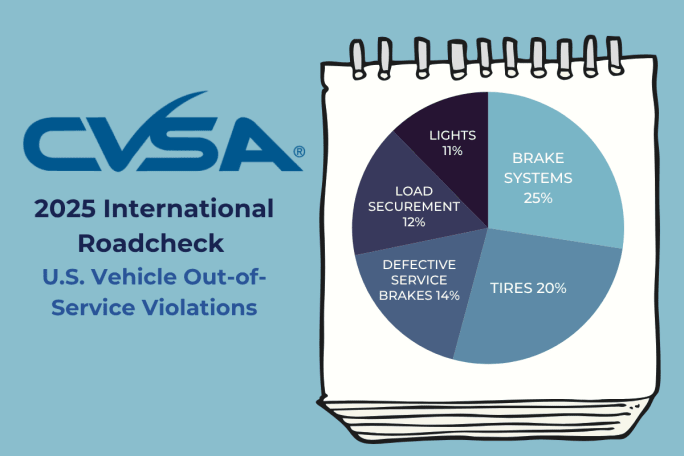
24% of the out-of-service violations during Roadcheck were due to brake systems.
HDT Graphic/CVSA Data
Brakes Top Out-of-Service Violations
The top vehicle out-of-service violation in North America was for brakes. Inspectors identified 3,304 out-of-service brake system violations, which made up more than 24% of all vehicle out-of-service violations.
In addition, the third most-cited (2,257) vehicle out-of-service violation was for 20% defective brakes, which is when 20% or more of the vehicle’s (or combination of vehicles) brakes have an out-of-service condition.
That means combined, there were 5,561 brake-related out-of-service violations (brake systems and 20% defective brakes), for a combined 41% of out-of-service vehicle violations.
That’s North America numbers, but the trend was similar looking at U.S. violations alone, with 24% of the OOS violations due to brake systems and another 15% due to 20% defective brakes, for about 39% of OOS violations.
Defective service brakes and other brake violations in 2024 combined to make up nearly 43% of out-of-service vehicle violations in the U.S.
Tires were number two on the list of OOS violations, making up 23% of the OOS violations in the U.S. That’s very similar to last year’s stat of 22%.
Lights were 14% and cargo securement 11%. These two are slightly higher than the 24 Roadcheck results, at 12% and 9%, respectively.
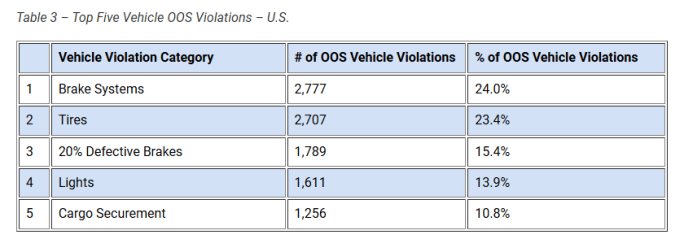
Tires were number two on the list of OOS violations, making up 23% of the OOS violations in the U.S. That’s very similar to last year’s stat of 22%.
Source: CVSA
Drivers Out of Service for Hours of Service, No CDLs
The biggest reason for drivers being placed out of service was hours of service violations, making up nearly 32% of U.S. driver OOS violations during Roadcheck.
That didn’t include “false logs,” which made up another 9% of OOS driver violations, for a total of 41% of OOS driver violations related to hours of service and log book regulations.
No commercial driver’s license was second, at nearly 26%, and another 5% for a suspended license, adding up to 31%.
And no medical card was nearly 16%.
These numbers are very similar to the 2024 Roadcheck results, with the exception of the “no medical card” violation, which was under 12% in 2024.
Examples of driver out-of-service violations, according to the CVSA’s North American Standard Out-of-Service Criteria, include hours-of-service infractions, licensing issues, driving under the influence of drugs or alcohol, falsified logbooks or supporting documents, etc.
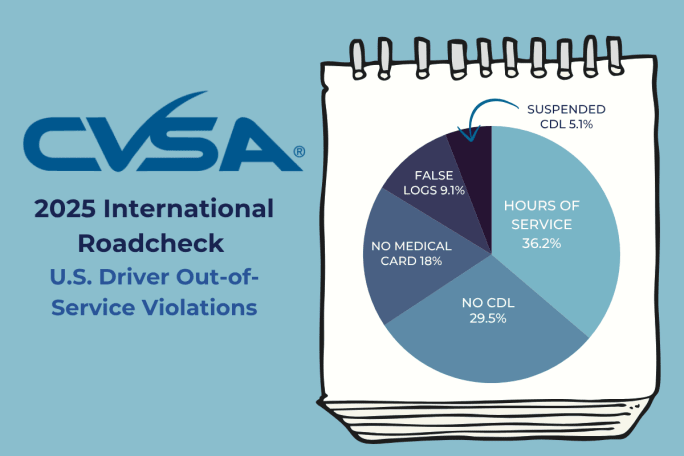
The biggest reason for drivers being placed out of service was hours of service violations.
HDT Graphic/CVSA Data
Roacheck's Special Focus Areas for 2025
Each year, International Roadcheck places special emphasis on a driver violation category and a vehicle violation. This year, the vehicle focus was tires and the driver focus was false records of duty status (RODS), or hours of service logs.
Tire Violations
Inspectors identified 2,899 tire-related out-of-service vehicle violations, the second most-cited out-of-service vehicle violation, after brake systems.
Tire violations accounted for 21.4% of all vehicle out-of-service violations. Examples of tire violations include flat tires, insufficient tread depth, severe cuts exposing cord ply or other damage resulting in bulges, improper repairs, or tires not rated for the load being carried or not rated for highway use, etc.
According to the Federal Motor Carrier Safety Administration roadside inspection violation data for 2025, “Tires – All others, leaking or inflation less than 50% of the maximum inflation pressure” was the fourth most-cited violation, accounting for 65,184 vehicle violations nationwide, as of Aug. 29.
Falsifying Driver Logs
Ten percent (332) of all driver out-of-service violations were for false logs/RODS. According to FMCSA’s 2025 roadside inspection violation data, there were 6,823 “False report of driver’s record of duty status” driver violations nationwide as of Aug. 29.
More Safety & Compliance

FMCSA Pauses Biennial-Update Enforcement Amid Motus Transition
Carriers whose updates were due on or after June 1 have more time, while FMCSA works to stabilize its new registration system and warns of phishing sites impersonating its new carrier registration system, Motus.
Read More →
ZF Expands Commercial Vehicle Push in North America
ZF is expanding its North American commercial-vehicle presence with new transmission applications, electrification, trailer technology and autonomous-driving systems.
Read More →
Truck Drivers Need More Than Another Alert
Fleets have more visibility into truck health, safety events, and driver activity than ever. The next challenge is turning all that information into useful guidance for the person who has to decide what to do next.
Read More →
Tesla Wants a Self-Driving Semi. Are Cameras Enough?
Could Tesla’s camera-only autonomous driving technology work on an 80,000-pound Semi? In this commentary, HDT's Deborah Lockridge takes a look at Tesla, Cybercab, and how autonomous trucks see the road.
Read More →
What DOT’s Automated Vehicle Strategy Means for Trucking
The U.S. Department of Transportation issued a new automated-vehicle strategy that outlines plans for driverless-truck regulations, cross-state freight corridors, and federal safety standards.
Read More →
NYC Expands Speed, Pedestrian Safety Tech Across Fleet
New York City is expanding intelligent speed assistance and pedestrian-alert systems across its municipal fleet, moving the technologies from pilot programs into vehicle procurement and retrofit requirements.
Read More →
FMCSA Removes 110 Truck Driver Training Schools from Certified ELDT List
Federal regulators also are targeting more than 160 additional training providers and launching a nationwide audit of third-party CDL skills testers as part of a broader crackdown on trucking fraud.
Read More →
Beyond DOT Compliance: What Makes a Trucking Fleet Truly Safe?
A trucking fleet can follow every rule and still make unsafe decisions. The real test comes when safety conflicts with freight, productivity, or cost.
Read More →
Hours of Service Pilot Programs: FMCSA Readies for 2027 Rollout
Two pilot programs could eventually reshape hours-of-service rules, giving truck drivers options to pause their 14-hour clock or use longer split sleeper rest periods.
Read More →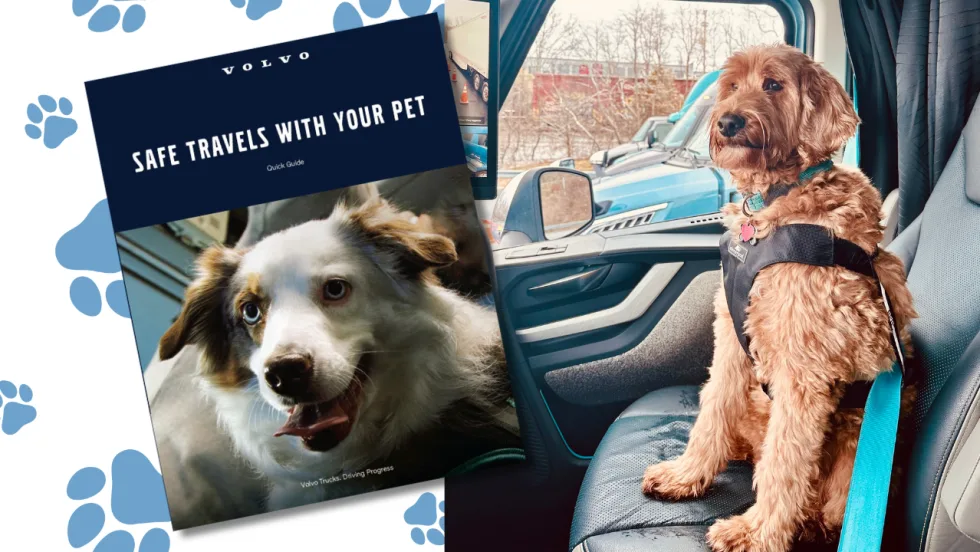
New Guide Offers Pet Safety Tips for Truck Drivers
Hundreds of thousands of pets travel in truck cabs. A new safety guide from Volvo Trucks and the Center for Pet Safety offers practical advice for truck drivers who bring dogs and cats along for the ride.
Read More →