




Biden Administration Withdraws Letter on Sleeper Berth Pay
Do fleets have to pay drivers for more than eight hours in the sleeper? The answer just got murkier.

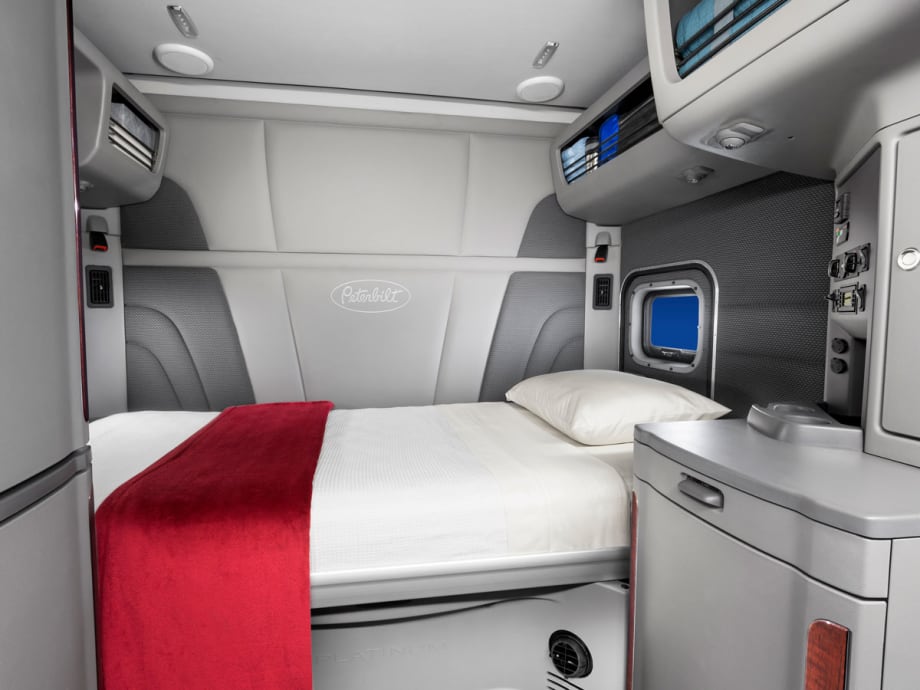
The Department of Labor has changed its guidance again about paying drivers for sleeper berth time.
File Photo (Peterbilt)
A 2019 Department of Labor Opinion Letter clarifying whether truck drivers must be paid for time in the sleeper berth has been withdrawn by the DOL’s Wage and Hour Division under the Biden administration.
The Biden administration has reinstated two prior Opinion Letters that “opined on the existence of limits related to when and how much sleeper berth time can be non-compensable,” according to an alert from the transportation attorneys at Scopelitis, Garvin, Light, Hanson & Feary.
Under the guidance that has been reinstated, WHD interpreted the regulations to mean that while sleeping time “may be excluded from hours worked where ‘adequate facilities’ were furnished, only up to eight hours of sleeping time may be excluded in a trip 24 hours or longer, and no sleeping time may be excluded for trips under 24 hours.”
That 2019 letter that was withdrawn said that the time when drivers are relieved of all duties and permitted to sleep in the sleeper berth is “presumptively non-compensable,” saying the earlier interpretation was “unnecessarily burdensome for employers.”
Opinion Letters are used to officially address issues related to the Fair Labor Standards Act by speaking to how a given law applies in specific circumstances presented by the entity that requested the letter.
In announcing the withdrawal of the letter, the department said the 2019 opinion was “inconsistent with long-standing WHD interpretations regarding the compensability of time spent in a trucker’s sleeper berth” and that it never spelled out why it was moving away from previous guidelines.
“The extent to which sleeper berth time is compensable remains a frequently litigated issue in federal courts all over the country,” said the Scopelitis attorneys, who advised fleets to pay careful attention to the details of hours of work policies.
For instance, last year, Arkansas-based PAM Transportation Services agreed to pay $16.5 million to settle a class action lawsuit alleging that it violated the Fair Labor Standards Act and the Arkansas Minimum Wage Law. Although there were other issues involved in the case, including pay during orientation and allegedly illegal deductions, the lawsuit also said drivers should be paid for time in the sleeper berth over eight hours.
It said the plaintiffs “regularly worked more than 16 hours per day” because they were required to, among other things, “remain inside the truck when stopped to log time in the sleeper berth.” The suit contended that “the maximum amount of time an employer may dock an employee who is on duty for more than 24 hours for time spent in a sleeper berth is eight hours per day. The remaining amount of time (16 hours per day) is work time and must be paid, less bona fide meal periods.”
More Drivers

Truck Drivers Need More Than Another Alert
Fleets have more visibility into truck health, safety events, and driver activity than ever. The next challenge is turning all that information into useful guidance for the person who has to decide what to do next.
Read More →
FMCSA Removes 110 Truck Driver Training Schools from Certified ELDT List
Federal regulators also are targeting more than 160 additional training providers and launching a nationwide audit of third-party CDL skills testers as part of a broader crackdown on trucking fraud.
Read More →
Hours of Service Pilot Programs: FMCSA Readies for 2027 Rollout
Two pilot programs could eventually reshape hours-of-service rules, giving truck drivers options to pause their 14-hour clock or use longer split sleeper rest periods.
Read More →
Medical Cards, English Proficiency Reshape Roadcheck Violations
Medical-card violations jumped to the top of the driver out-of-service list during CVSA’s 2026 International Roadcheck, while English-language proficiency violations appeared among the leading violations for the first time.
Read More →
Driver Trust Can Make or Break the Success of Fleet Safety Technology
New Teletrac Navman research suggests that onboarding, transparency about driver data, and positive feedback can play a significant role in how commercial drivers respond to safety and coaching technology.
Read More →
EEOC Sues KLLM Over Alleged Sex Discrimination in Driver Training
KLLM is facing a federal sex-discrimination lawsuit over policies the EEOC alleges put female truck driver trainees at a disadvantage.
Read More →
FMCSA Moves to Codify English Language Requirements for Commercial Drivers
By changing regulations on English-language proficiency requirements for commercial drivers, rather than relying on a guidance memo, the FMCSA said future administrations won't be able to walk back the Trump administration's stricter enforcement with just a memo.
Read More →
Drivers Put Western Star Trucks to the Test at Star Nation Experience
Watch to get an inside look at the Western Star trucks, technology, and community behind the Star Nation Experience 2026!
Read More →
Trump Administration Looks to Put More Veterans Behind the Wheel
The Freedom Haulers program pulls together existing and expanded programs at several federal agencies to recruit veterans to drive commercial heavy-duty trucks and cut the red tape for them to get a CDL, training, and employment.
Read More →
Putting Mack’s Command Steer to the Test
A test drive of Mack’s Command Steer active steering system evaluates how it can make truck driving easier and less tiring.
Read More →