




Automatic Emergency Braking on DOT Agenda
The U.S. Department of Transportation included automatic emergency braking for both light- and heavy-duty vehicles on its regulatory agenda, which identifies actions the DOT plans to take during the next year and beyond.

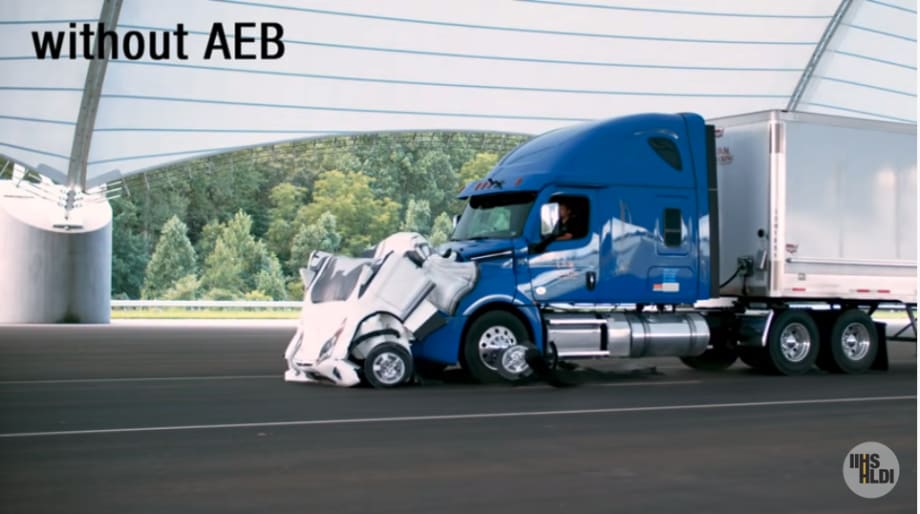
In an Insurance Institute for Highway Safety test of automatic emergency braking, a truck without AEB plowed right through a test "car."
Screen shot from video of IIHS AEB testing
The U.S. Department of Transportation included automatic emergency braking for both light- and heavy-duty vehicles on its regulatory agenda, which identifies actions the DOT plans to take during the next year and beyond.
In the June 11 announcement of its Spring Regulatory Agenda, the department said the document illustrates its “commitment to safety for transportation workers and the traveling public, fighting climate change, advancing equity, and building our economy back better.”
On the agenda is for the National Highway Traffic Safety Administration to require heavy and light vehicles to include automatic emergency braking.
NHTSA had proposed a regulation on automatic emergency braking in 2015, following a petition from safety organizations Truck Safety Coalition, the Center for Auto Safety, Advocates for Highway and Auto Safety, and Road Safe America. The American Trucking Associations in 2015 offered its support of the regulation.
But the regulation went nowhere during the Trump administration, although a 2018 report from FMCSA looked at how the voluntary adoption of such systems in commercial motor vehicles could be accelerated.
According to the Associated Press, NHTSA said it has been studying use of the electronic systems and plans to publish a proposed rule in the Federal Register in April of next year.
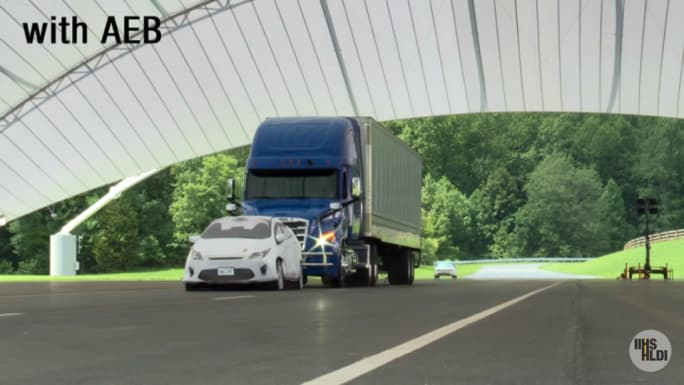
In an Insurance Institute for Highway Safety test of automatic emergency braking, a truck with AEB came to an emergency stop behind the test "car," lights flashing and horn sounding, without the truck driver touching the brake pedal.
Screen shot from video of IIHS AEB testing
More Pressure for AEB
The DOT isn't the only place we're seeing increasing demand for this technology to be more widespread.
Last fall, the Insurance Institute for Highway Safety reported that equipping large trucks with forward collision warning and automatic emergency braking systems could eliminate more than two out of five crashes in which a truck rear-ends another vehicle. Trucks equipped with forward collision warning had 22% fewer crashes and trucks with AEB had 12% fewer crashes than those without either technology.
The National Transportation Safety Board, in its Most Wanted List published earlier this year, called for the government to complete standards for collision-warning and automatic emergency braking systems in commercial vehicles and require this technology in all highway vehicles and all new school buses.
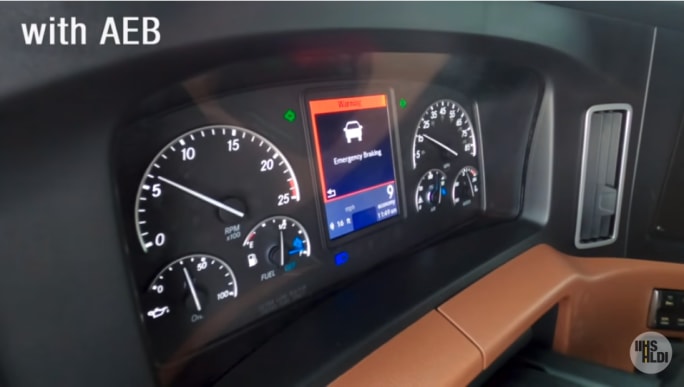
Automatic emergency braking kicked in when the driver did not respond to forward collision avoidance warnings in this IIHS test.
Screen shot from video of IIHS AEB testing
At the same time, the issue of automatic emergency braking has come up as part of the back-and-forth on Capitol Hill on infrastructure funding. Earlier this month, the Truck Safety Coalition sent a letter to House Transportation and Infrastructure Committee leaders calling for automatic emergency braking to be required on all new vehicles weighing over 10,000 pounds.
“This provision was part of the Moving Forward Act (H.R. 2, 116th Congress) but has been severely weakened by only applying to Class 7 and 8 trucks in the INVEST in America Act,” the letter said, saying that “limiting the installation of AEB to Class 7 and 8 trucks will potentially exclude more than half a million new vehicles every year.”
The DOT’s new regulatory agenda also addresses autonomous vehicles. It aims to establish “rigorous testing standards” for autonomous vehicles and establish a national incident database for crashes involving automated vehicles, as well as “create a safe, predictable environment for autonomous vehicle evolution.”
Any proposals would only be made into final regulations after opportunities for public review and comment.
Check out the IIHS video of its AEB testing:
More Safety & Compliance

From One Generation to the Next: How Mentorship Builds Safer Truck Drivers
After three decades in trucking, Harold Perry shares what he's learned about driver safety, mentorship, and helping the next generation build confidence behind the wheel.
Read More →
FMCSA Pauses Biennial-Update Enforcement Amid Motus Transition
Carriers whose updates were due on or after June 1 have more time, while FMCSA works to stabilize its new registration system and warns of phishing sites impersonating its new carrier registration system, Motus.
Read More →
ZF Expands Commercial Vehicle Push in North America
ZF is expanding its North American commercial-vehicle presence with new transmission applications, electrification, trailer technology and autonomous-driving systems.
Read More →
Truck Drivers Need More Than Another Alert
Fleets have more visibility into truck health, safety events, and driver activity than ever. The next challenge is turning all that information into useful guidance for the person who has to decide what to do next.
Read More →
Tesla Wants a Self-Driving Semi. Are Cameras Enough?
Could Tesla’s camera-only autonomous driving technology work on an 80,000-pound Semi? In this commentary, HDT's Deborah Lockridge takes a look at Tesla, Cybercab, and how autonomous trucks see the road.
Read More →
What DOT’s Automated Vehicle Strategy Means for Trucking
The U.S. Department of Transportation issued a new automated-vehicle strategy that outlines plans for driverless-truck regulations, cross-state freight corridors, and federal safety standards.
Read More →
NYC Expands Speed, Pedestrian Safety Tech Across Fleet
New York City is expanding intelligent speed assistance and pedestrian-alert systems across its municipal fleet, moving the technologies from pilot programs into vehicle procurement and retrofit requirements.
Read More →
FMCSA Removes 110 Truck Driver Training Schools from Certified ELDT List
Federal regulators also are targeting more than 160 additional training providers and launching a nationwide audit of third-party CDL skills testers as part of a broader crackdown on trucking fraud.
Read More →
Beyond DOT Compliance: What Makes a Trucking Fleet Truly Safe?
A trucking fleet can follow every rule and still make unsafe decisions. The real test comes when safety conflicts with freight, productivity, or cost.
Read More →
Hours of Service Pilot Programs: FMCSA Readies for 2027 Rollout
Two pilot programs could eventually reshape hours-of-service rules, giving truck drivers options to pause their 14-hour clock or use longer split sleeper rest periods.
Read More →