




Autocar Upgrades ADAS for Refuse Truck Safety
Autocar's new ADAM (Advanced Driver Assist Module) is the latest in what the company says is the first fully OEM-integrated advanced driver assistance system engineered for the refuse and recycling industry.

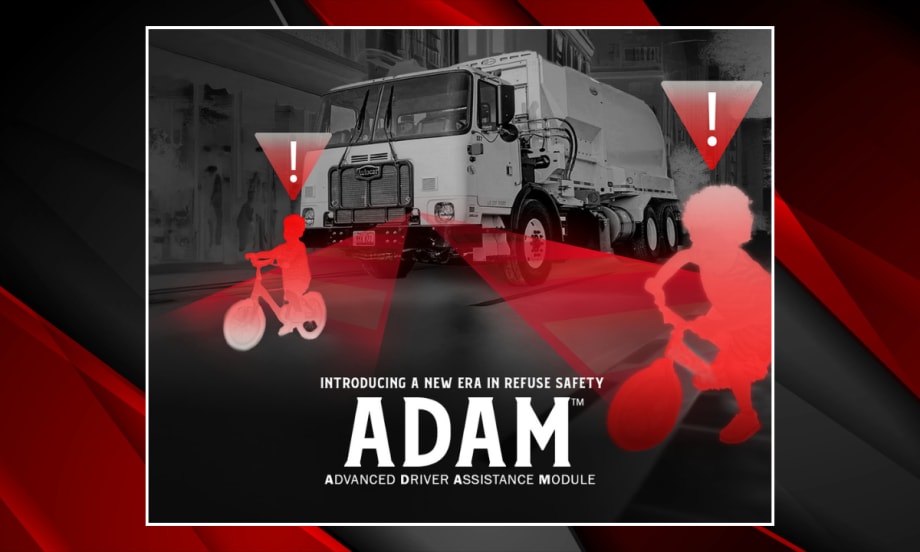
Autocar says its ADAM advanced safety technology is designed specifically for refuse trucks.
Image: Autocar/HDT
Autocar's new ADAM (Advanced Driver Assist Module) is the latest in what the company says is the first fully OEM-integrated advanced driver assistance system engineered for the refuse and recycling industry.
Refuse operations can be hazardous to both operators and pedestrians, especially given a working environment that includes crowded urban streets, blind intersections, and busy residential areas, Autocar says.
The mission of ADAM is to automate and provide as much coverage as possible to make it safer for operators and easier for them to protect themselves and others.
In addition to Autocar’s current suite of safety features, like a distraction-free dashboard, ADAM offers the following upgraded features:
Complete OEM Integration
By directly integrating into the truck’s infrastructure, ADAM removes the need for aftermarket installations. This ensures maximum system compatibility and avoids destructive installation methods such as cutting into brake lines and splicing into electrical harnesses.
Designed to Enhance Existing Systems
ADAM is designed to work with a vehicle’s antilock braking system and pneumatic braking equipment.
Instead of bypassing these safety features, like other options in the market, ADAM uses them to more effectively avoid collisions with people and property, according to Autocar.
As a result, the truck has an autonomous braking system that will not only warn about people in the danger zone, but also will stop the truck if the operator does not — and do so faster than human reaction times.
Built Specifically for Refuse Trucks
ADAM is engineered specifically for refuse truck operations.
For example, Autocar programmed the software to calculate how long it takes a refuse truck to brake given the truck’s speed and particular weight and any relevant road conditions.
This capability allows for an even greater safety margin of error, whether the truck is moving forwards or in reverse, and better protects both workers and the community.
Key Features of Autocar's ADAS for Refuse Trucks:
Autonomous Reverse Braking: Automatically brakes the truck while in reverse if the sensors detect something — or someone — in the way.
Forward Collision Warning and Automatic Braking: Detects hazards and applies brakes automatically, optimized for stop-and-go operation.
360° Pedestrian and Cyclist Detection: Identifies vulnerable road users, warning operators instantly and applying the brakes if a collision is imminent.
Enhanced Blind Spot Detection: Monitors surroundings with four side radar sensors, providing real-time alerts.
Roadway Departure: Alerts the operator that the vehicle is leaving the road and slows the truck to a halt if the operator does not take action.
Traffic Sign Recognition: Identifies and visually communicates sign information to operator in real time.
All information is transmitted visually to the operator via Autocar’s distraction-free dashboard that allows the operator to stay aware without sacrificing focus.
“Our customers don’t have the luxury of working in predictable environments," said Andrew Taitz, chairman of GVW Group, LLC, the holding company of Autocar. "They’re operating on busy streets, chaotic job sites, and extreme conditions that demand more than a one-size-fits-all safety system.
“Severe-duty industries should not have to compromise on safety. That’s why we developed ADAM. It’s not just another ADAS — it’s a purpose-built, severe-duty safety solution that protects our operators and the communities they serve.”
More Safety & Compliance

FMCSA Pauses Biennial-Update Enforcement Amid Motus Transition
Carriers whose updates were due on or after June 1 have more time, while FMCSA works to stabilize its new registration system and warns of phishing sites impersonating its new carrier registration system, Motus.
Read More →
ZF Expands Commercial Vehicle Push in North America
ZF is expanding its North American commercial-vehicle presence with new transmission applications, electrification, trailer technology and autonomous-driving systems.
Read More →
Truck Drivers Need More Than Another Alert
Fleets have more visibility into truck health, safety events, and driver activity than ever. The next challenge is turning all that information into useful guidance for the person who has to decide what to do next.
Read More →
Tesla Wants a Self-Driving Semi. Are Cameras Enough?
Could Tesla’s camera-only autonomous driving technology work on an 80,000-pound Semi? In this commentary, HDT's Deborah Lockridge takes a look at Tesla, Cybercab, and how autonomous trucks see the road.
Read More →
What DOT’s Automated Vehicle Strategy Means for Trucking
The U.S. Department of Transportation issued a new automated-vehicle strategy that outlines plans for driverless-truck regulations, cross-state freight corridors, and federal safety standards.
Read More →
NYC Expands Speed, Pedestrian Safety Tech Across Fleet
New York City is expanding intelligent speed assistance and pedestrian-alert systems across its municipal fleet, moving the technologies from pilot programs into vehicle procurement and retrofit requirements.
Read More →
FMCSA Removes 110 Truck Driver Training Schools from Certified ELDT List
Federal regulators also are targeting more than 160 additional training providers and launching a nationwide audit of third-party CDL skills testers as part of a broader crackdown on trucking fraud.
Read More →
Beyond DOT Compliance: What Makes a Trucking Fleet Truly Safe?
A trucking fleet can follow every rule and still make unsafe decisions. The real test comes when safety conflicts with freight, productivity, or cost.
Read More →
Hours of Service Pilot Programs: FMCSA Readies for 2027 Rollout
Two pilot programs could eventually reshape hours-of-service rules, giving truck drivers options to pause their 14-hour clock or use longer split sleeper rest periods.
Read More →
New Guide Offers Pet Safety Tips for Truck Drivers
Hundreds of thousands of pets travel in truck cabs. A new safety guide from Volvo Trucks and the Center for Pet Safety offers practical advice for truck drivers who bring dogs and cats along for the ride.
Read More →