




ATRI: Zero-Emissions Trucks Still Generate Significant Emissions
While zero-emission trucks release no direct tailpipe emissions during operation, they are still responsible for generating greenhouse gases during production.

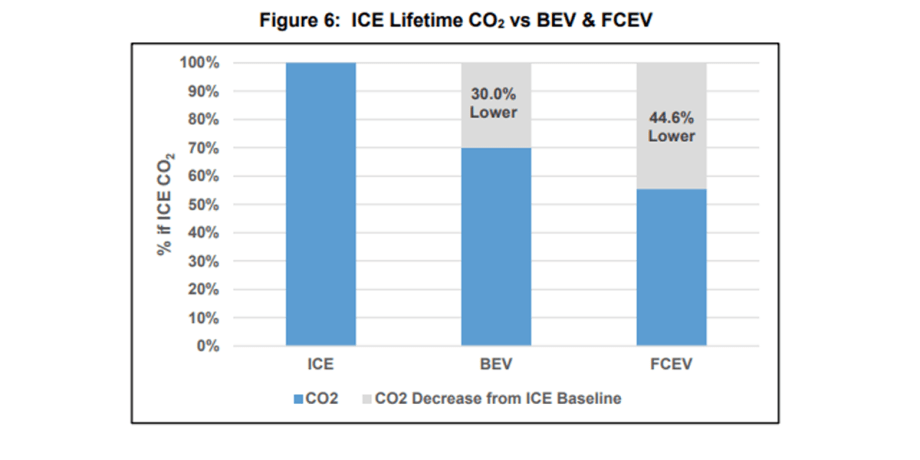
battery-electric vehicles emit 30% lower carbon dioxide emissions across the vehicle lifetime (from production to operation) compared to trucks running on internal combustion engines.
Graph: ATRI
While zero-emission trucks release no direct tailpipe emissions during operation, they are still responsible for generating greenhouse gases during the production of fuels like electricity and hydrogen, and through the production and disposal of the vehicles and lithium-ion batteries.
In a study, the American Transportation Research Institute found the process of extracting the materials used in lithium-ion batteries for battery-electric vehicles creates a significant amount of emissions. Lithium-ion battery production generates more than six times the carbon of diesel truck production, ATRI officials said in a press release.
The total carbon dioxide emissions created through the production of a battery-electric vehicle is far higher than those produced during production of a fuel-cell-electric vehicle (24% of a battery-electric vehicle’s carbon dioxide emissions) or of an internal combustion engine vehicle (nearly 16% of a battery-electric vehicle’s carbon dioxide emissions).

Lithium-ion battery production generates more than six times the carbon of diesel truck production.
Graph: ATRI
Still, battery-electric vehicles emit 30% lower carbon dioxide emissions across the vehicle lifetime (from production to operation) compared to trucks running on internal combustion engines.
ICE vehicles are associated with almost double the operations-related carbon dioxide emissions when compared to battery-electric vehicles (which are about 57% of an ICE’s operations carbon dioxide) or fuel-cell-electric vehicles (which are about 53% of an ICE’s operations carbon dioxide).
ATRI’s research concluded that hydrogen fuel cell trucks are ultimately the most environmentally friendly truck type, although the technology is not presently feasible for long-haul operations.
The research analysis of the impact of zero-emission vehicles — which utilized outputs from the Argonne National Lab’s GREET Model and was a top priority of ATRI’s Research Advisory Committee —utilized federal and industry-sourced data to identify and compare full life-cycle carbon dioxide emissions for a range of truck types, including a baseline diesel truck, battery-electric trucks and hydrogen-fuel-cell trucks.
“ATRI’s research highlights that several of the leading zero-emission approaches being advocated today still need additional research to fully understand how the different technologies can be best developed and utilized to maximize carbon reduction,” said Hugh Ekberg, President and CEO of CRST.
The most realistic approach to decreasing carbon dioxide in ICE vehicles is through alternative fuels such as biodiesel, renewable diesel and natural gas, ATRI found.
For example, renewable diesel could decrease carbon dioxide emissions to nearly 33% of a standard diesel engine without requiring new infrastructure or truck equipment. And hydrogen sourced from solar-power electricity could enable hydrogen-fuel-cell trucks to emit nearly 9% of the baseline diesel carbon dioxide.
More Fuel Smarts

How Volvo Updated Its D13 for EPA 2027 [Watch]
Volvo’s updated D13 promises lower emissions without sacrificing performance or fuel economy. Take a closer look at what changed inside the engine in this HDT Spotlight video.
Read More →
Diesel Price Spike Shortens Payback for Natural Gas Trucks, Report Says
Energy Vision estimates fleets could recover the higher purchase price of an RNG-fueled Class 8 tractor in 1.3 to 2.8 years under current fuel-price scenarios.
Read More →
Calstart Becomes Catalyst Mobility, Reflecting Broader Focus
Calstart is now Catalyst Mobility, reflecting the nonprofit’s growing national role in clean transportation, including zero-emission trucks, infrastructure and incentive programs.
Read More →

Record Diesel Prices Squeeze Trucking Fleets
Average U.S. diesel prices have climbed to nearly $6 a gallon, surpassing the 2022 record as tight refinery capacity and Middle East disruptions keep fuel costs elevated.
Read More →
How Fuel Delivery Shapes Engine Performance
Fuel delivery depends on more than what happens at the injector. For fleet, maintenance and technical professionals, looking at the full path from pump to injector can provide useful context for understanding engine performance.
Read More →
East Coast Port Launches $45M Electric Truck Push
The Port Authority of New York and New Jersey announced millions in incentives for zero-emission drayage trucks, yard tractors, and new charging hubs near the port.
Read More →
California Bill Could Shed Light on Electric Truck Prices
Why do battery-electric Class 8 trucks remain so expensive? A California bill headed to Gov. Gavin Newsom would give fleets and state agencies more visibility into what manufacturers charge.
Read More →
Detroit Opens Orders for EPA 2027 Engines
Detroit isn’t starting from scratch to meet EPA 2027 diesel emissions standards. Its Gen 6 DD13 and DD15 engines keep much of today’s platform while updating the fuel and aftertreatment systems.
Read More →
Zero-Emission Truck Corridor Planned for West Coast
California, Oregon, Washington, British Columbia and Baja California are coordinating plans for truck charging and hydrogen fueling from Canada to Mexico.
Read More →
A Closer Look at Kenworth’s Electric T880E Vocational Truck [Video]
Learn more about Kenworth's T880E battery-electric vocational truck at the Paccar Technical Center, including its range, applications, upfitting considerations, and PTO options, in this HDT Spotlight video.
Read More →