




ATD Study: EPA Grossly Underestimated Emissions Systems Costs
A report released yesterday by The National Automobile Dealers Association and American Truck Dealers questions the Environmental Protection Agency's cost analysis of 2004-2010 emissions control mandates. Data collected by ATD shows EPA's cost estimates were off by a factor of between two and five
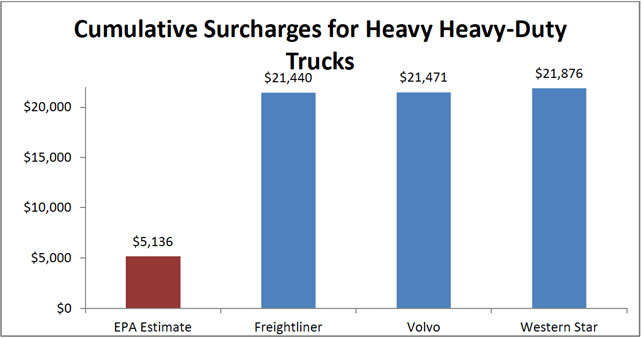
EPA's projected total 2004-2010 heavy-duty compliance costs compared to actual total surcharges for three OEMs.
A report released yesterday by The National Automobile Dealers Association and American Truck Dealers questions the Environmental Protection Agency's cost analysis of 2004-2010 emissions control mandates. Data collected by ATD shows EPA's cost estimates were off by a factor of between two and five.
As a result, ATD says, last decade's emissions mandates resulted in substantially higher prices for commercial vehicles, which depressed vehicle sales and created massive disruptions in normal business cycles, as well as delaying the environmental benefits that the EPA originally sought.
"While EPA can mandate what truck and engine makers have to build, they can't dictate what customers will buy," said Dave Westcott, vice-chair of NADA, and President of Westcott Automotive in Burlington, N.C. Westcott was speaking on a conference call following the release of the study.
Called, A Look Back at EPA's Cost and Other Impact Projections for MY2004-2010 Heavy-Duty Truck Emissions Standards, the study sounds a stern warning about EPA's cost projections on the upcoming fuel economy standards for heavy and light vehicles -- which extend out to the 2017 to 2025 timeframe. It also calls into question EPA's and the National Highway Traffic Safety Administration's ability to make long-term cost projections on technology that has not yet been commercialized.
"Rushing to set new standards [several years in advance] will forego the opportunity to learn how customers react to the aggressive new standards that are just now being put into place," Westcott says.
The study notes that when the EPA implemented its 2004-2010 rules for heavy trucks, it failed to predict and account for what truck and engine manufacturers had to accomplish to comply with those rules, and how the market would react.
Many informed prospective new truck purchasers rushed to pre-buy trucks with pre-compliant technologies to avoid the effects of EPA's mandates. A surge of orders came in for pre-2004 equipment, after which orders slumped significantly. Also, in 2006, orders surged for pre-2007 equipment, and then fell off precipitously. And again in the 2009 time-frame, orders poured in for pre-2010 equipped trucks. In each instance, the marketplace anticipated and sought to avoid the higher prices and poorer performance of compliant technologies.
Among the unintended consequences of rushing technology to market, and failing to predict the market's -- correct -- response to unproven and ultimately unreliable technology, was a delay in getting cleaner engines into service.
"The primary goals of these mandates were to reduce the environmental impact of trucks, but because the new technologies that EPA intended to reduce truck emissions never made it to market, the emissions benefits were significantly delayed," noted Dick Witcher, CEO of Minuteman Trucks of Walpole, Mass, and chair of ATD. "Setting emissions standards too far in advance is dangerous for any regulatory agency. The variables are simply too difficult to predict with any accuracy. Goals need to be set in smaller increments of time and in more manageable steps that provide flexibility to incorporate new [and emerging] technologies."
The report shows EPA's projected compliance costs for 2004, 2007 and 2010 emissions rules -- when compared to the actual costs derived from OEM invoices -- were off by an average of from two to five times the agency's original estimate.
This was the first time anyone has looked at the spread between cost estimates and actual costs. When these are examined together, the report finds that truck prices spiked by more than $21,000 while EPA had estimated a $5,000 increase," says study author and chief researcher, Esteban Plaza-Jennings.
Most truck OEs listed line items for emissions compliance costs on the actual invoices. For example, some Western Star invoices listed an Emissions Escalator of about $4,200. Some Volvo invoices listed 2007 EPA surcharges of $7,500. And a dealer bulletin issued by Peterbilt stated, "Effective with the January 1, 2010 price level, a surcharge will be added to the invoice for chassis built with EPA 2010 aftertreatment equipment." That surcharge amounted to more than $9,200.
"Not only were trucks much more expensive than EPA forecast, they had significant reliability and operating problems, far exceeding anything EPA expected to occur," Esteban concluded.
One of the stronger lessons learned from the study, was that technology-forcing standards do nothing for the environment until the vehicles are bought and put into service.
"The lessons learned from this report apply directly to the proposed MY 2017-2025 fuel economy regulations for light-duty vehicles," ADT and NADA say. "That rulemaking, combined with previous Obama administration fuel economy mandates, will raise the average price of a [light] vehicle by $3,000, according to EPA and NHTSA estimates. When faced with unreasonable federal regulatory mandates that increase motor vehicle costs, buyers of light-duty vehicles - similar to what commercial truck buyers experienced - will seek out less expensive alternatives in the marketplace."
The same can probably be said for the 2014 and 2018 heavy-truck fuel economy standards. The MY-2014-standard trucks, which will start hitting the street in mid-to-late 2013, are projected by EPA to cost an additional $6,000.
Back in 2009, the National Academy of Sciences in conjunction with the Transportation Research Board, released a 414-page report called Technologies and Approaches to Reducing the Fuel Consumption of Medium- and Heavy-Duty Vehicles. It outlined existing and emerging technologies that could contribute to the fuel-use-reduction objective. Estimates provided by the NAS on the cost of some of the advanced technology that could be required to meet the 2018 standard were a staggering $84,600. Not that any one truck would see such an upcharge, the NAS estimate was just a summary of the potential cost of the technology.
We have to hope EPA has its cost-forecasting game hat on straight this time around.
More Drivers

When Language Stops the Truck: The Return of ELP Out-of-Service Orders
English language proficiency rules for commercial drivers aren’t new, but renewed out-of-service enforcement has raised the stakes. Here’s what carriers need to know before a driver reaches a roadside inspection.
Read More →
Samsara Launches Custom AI Agent Builder
Agent Studio lets fleets create AI tools for hours-of-service monitoring, reporting and driver support, including agents that communicate by phone.
Read More →
Trucker Path Expands Reserved Parking Network
Trucker Path has added close to 6,000 more truck parking spaces to its Trucker Path Reserved Parking Network with the addition of Safe Truck Parking.
Read More →
EEOC Sues Texas Trucking Company Over Driver Age Limits
The agency says Trancasa USA rejected applicants over 65 and applied tougher driving-record standards to those over 60.
Read More →
Nussbaum, Roehl Announce Second Driver Pay Increase This Year
This year has seen a swath of major truck driver pay increases as freight capacity has tightened.
Read More →
From One Generation to the Next: How Mentorship Builds Safer Truck Drivers
After three decades in trucking, Harold Perry shares what he's learned about driver safety, mentorship, and helping the next generation build confidence behind the wheel.
Read More →
Truck Drivers Need More Than Another Alert
Fleets have more visibility into truck health, safety events, and driver activity than ever. The next challenge is turning all that information into useful guidance for the person who has to decide what to do next.
Read More →
FMCSA Removes 110 Truck Driver Training Schools from Certified ELDT List
Federal regulators also are targeting more than 160 additional training providers and launching a nationwide audit of third-party CDL skills testers as part of a broader crackdown on trucking fraud.
Read More →
Hours of Service Pilot Programs: FMCSA Readies for 2027 Rollout
Two pilot programs could eventually reshape hours-of-service rules, giving truck drivers options to pause their 14-hour clock or use longer split sleeper rest periods.
Read More →
Medical Cards, English Proficiency Reshape Roadcheck Violations
Medical-card violations jumped to the top of the driver out-of-service list during CVSA’s 2026 International Roadcheck, while English-language proficiency violations appeared among the leading violations for the first time.
Read More →