




ATA Outlines Truck Safety Initiatives
The head of the nation’s largest trucking group today asked the governors of 25 states to push for adoption of primary safety belt laws in their respective states.
The head of the nation’s largest trucking group today asked the governors of 25 states to push for adoption of primary safety belt laws in their respective states.
Such regulations, in force in the remaining states, would allow police officers to stop and issue traffic citations to motorists failing to wear their safety belt while operating a vehicle.
Speaking at the 2005 International Truck and Bus Safety and Security Symposium in Alexandria, Va., Bill Graves, president and CEO of the American Trucking Associations, said states with primary laws have safety belt usage rates about 10 percentage points better than states with secondary enforcement laws.
Prompting ATA’s new universal primary safety belt policy is a recent U.S. Department of Transportation survey that shows truck drivers with just a 48 percent safety belt usage rate, the lowest among highway users.
“We are very concerned that the safety belt usage rate of truck drivers falls well short of the nationwide average among passenger vehicle drivers,” Graves told the governors. “I’m writing to ask your assistance to help bring about positive change.”
“America’s motor carriers and their professional truck drivers are committed to operating safely and saving lives on our highways, but we obviously have some work to do within our own industry. As we partner with the USDOT Commercial Motor Vehicle Safety Belt Partnership, we still need strong visible enforcement and education programs out on our highways to promote and enforce safety belt usage.”
Graves said ATA has also asked U.S. Secretary of Transportation Norman Y. Mineta to allow the states to increase the amount of federal truck safety funds spent on non-truck traffic enforcement.
In a letter to Secretary Mineta, he said, “recent research and analysis has found that in 77 percent of fatal crashes and 68 percent of non-fatal crashes involving a truck, the first harmful event was the collision between another vehicle in transport and the truck. Further research into these serious car-truck crashes has clearly indicated that the unintentional but unsafe actions of the passenger vehicle driver either causes or plays a significant contributing role in about 75 percent of the crashes.”
Graves said the states’ increased focus of Motor Carrier Safety Assistance Program funds on traffic violations and unsafe operating behaviors of passenger vehicle drivers in and around trucks will reduce truck-involved crashes. “Additionally,” he continued, “greater focus on this part of the problem will serve to promote public awareness of safe driving habits around large trucks.”
“This is in no way an attempt to lay all highway safety problems on other drivers,” said Graves. “The current system of roadside truck inspections will continue as will our industry’s daily efforts to keep highways safe by assuring that we have the safest professional drivers behind the wheels of the best equipment on the road. We’re not interested in casting blame; we’re more interested in sharing the road safely.”
“Lifting this spending limitation, and allowing the states and FMCSA to determine how much of the MCSAP enforcement resources should be directed at this significant part of the truck-involved crash problem, will save many lives and prevent countless serious injuries,” Graves concluded.
The primary safety belt request and support for increased traffic violation enforcement funding were highlights of the ATA trucking industry safety package presented at the truck and bus safety symposium. Other proactive truck safety initiatives put forth included:
• The American Transportation Research Institute’s groundbreaking crash predictor study that evaluates and links past driver traffic violations with their likelihood of being involved in a crash, providing trucking companies invaluable safety-related information on their current and prospective drivers. The ATRI study also shows what education programs are best to address potential or current driver behavior problems.
• ATA’s tacit support of a federal regulation requiring the use of electronic on-board recorders for documenting compliance with hours-of-service rules, as long as EOBR use demonstrably improves safety performance and compliance, along with other conditions.
• An ATRI report on highway work zone designs and their appropriateness for accommodating large trucks, including lane and pavement width and median crossovers. The report calls for a uniform work zone crash reporting system to better understand the overrepresentation of large trucks in work zone crashes in order to develop measures for reducing their frequency and severity.
More Drivers
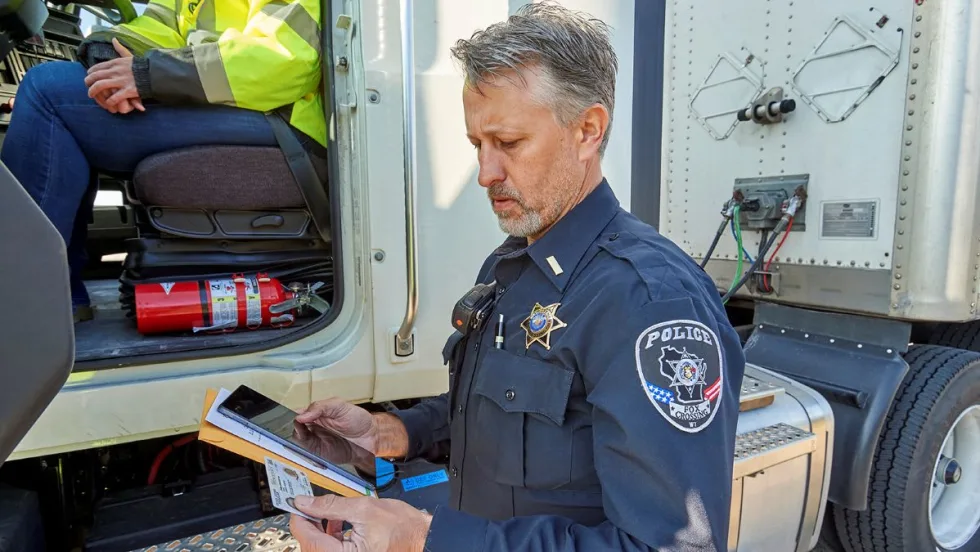
When Language Stops the Truck: The Return of ELP Out-of-Service Orders
English language proficiency rules for commercial drivers aren’t new, but renewed out-of-service enforcement has raised the stakes. Here’s what carriers need to know before a driver reaches a roadside inspection.
Read More →
Samsara Launches Custom AI Agent Builder
Agent Studio lets fleets create AI tools for hours-of-service monitoring, reporting and driver support, including agents that communicate by phone.
Read More →
Trucker Path Expands Reserved Parking Network
Trucker Path has added close to 6,000 more truck parking spaces to its Trucker Path Reserved Parking Network with the addition of Safe Truck Parking.
Read More →
EEOC Sues Texas Trucking Company Over Driver Age Limits
The agency says Trancasa USA rejected applicants over 65 and applied tougher driving-record standards to those over 60.
Read More →
Nussbaum, Roehl Announce Second Driver Pay Increase This Year
This year has seen a swath of major truck driver pay increases as freight capacity has tightened.
Read More →
From One Generation to the Next: How Mentorship Builds Safer Truck Drivers
After three decades in trucking, Harold Perry shares what he's learned about driver safety, mentorship, and helping the next generation build confidence behind the wheel.
Read More →
Truck Drivers Need More Than Another Alert
Fleets have more visibility into truck health, safety events, and driver activity than ever. The next challenge is turning all that information into useful guidance for the person who has to decide what to do next.
Read More →
FMCSA Removes 110 Truck Driver Training Schools from Certified ELDT List
Federal regulators also are targeting more than 160 additional training providers and launching a nationwide audit of third-party CDL skills testers as part of a broader crackdown on trucking fraud.
Read More →
Hours of Service Pilot Programs: FMCSA Readies for 2027 Rollout
Two pilot programs could eventually reshape hours-of-service rules, giving truck drivers options to pause their 14-hour clock or use longer split sleeper rest periods.
Read More →
Medical Cards, English Proficiency Reshape Roadcheck Violations
Medical-card violations jumped to the top of the driver out-of-service list during CVSA’s 2026 International Roadcheck, while English-language proficiency violations appeared among the leading violations for the first time.
Read More →