




ATA MC&E: Economy Improves, Driver Shortage Continues
SAN DIEGO -- American Trucking Associations Chief Economist Bob Costello discussed the current freight levels, highlighting the fact that the ATA truck tonnage index hit a record high in August, before posing questions to this year's economic panel.

ATA Chief Economist Bob Costello, center, was joined by (left to right) John Felmy of the American Petroleum Institute, Jack Kleinhenz of the National Retail Federation and Chad Moutray of the National Association of Manufacturers, to discuss the current status of the economy and its effect on the industry. Photo by Evan Lockridge
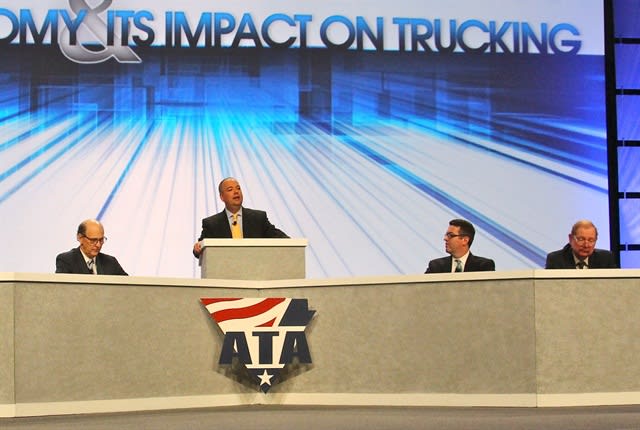
ATA Chief Economist Bob Costello, center, was joined by (left to right) John Felmy of the American Petroleum Institute, Jack Kleinhenz of the National Retail Federation and Chad Moutray of the National Association of Manufacturers, to discuss the current status of the economy and its effect on the industry. Photo by Evan Lockridge
SAN DIEGO -- Before posing questions to this year’s panel on the current economic status of the industry, American Trucking Associations Chief Economist Bob Costello discussed the current freight levels, highlighting the fact that the ATA truck tonnage index hit a record high this past August.
Leading off the session at ATA's annual Management Conference & Exhibition, Costello said the industry saw an overall 1.5% growth in truckload for-hire freight loads and 3.1% increase in LTL in 2013. Growth was stalled by the polar vortex in the first quarter of 2014, resulting in a 0.3% drop in truckload. But, as Costello pointed out, there was a 3.7% growth year over year in the second quarter.
“We will take that all day long,” said Costello, adding that LTL jumped to from 4.9% in the first quarter to 8.4% in the second quarter. “I think demand is solid.”
Turning to panelist Jack Kleinhenz of the National Retail Federation to give attendees on overview of the retail market, Costello asked whether spending was going to accelerate this year over 2013.
“We had a mild summer in terms of spending, so disposable income is going to be available for the rest of the year as we go into the holiday season,” explained Kleinhenz. He added that consumer sentiment has increased since the start of 2014, according to the University of Michigan Consumer Sentiment Index, while online purchases also continue to increase.
For panelist Chad Moutray of the National Association of Manufacturers, a survey that his group has been partnering on with Industry Week magazine shows the economy is definitely bouncing back.
“As you can see, 87% of our members are either somewhat or very positive about their own company’s outlook,” said Moutray, pointing to a slide on the results of the survey. “That’s a pretty strong figure.”
John Felmy, chief economist at the American Petroleum Institute, started by showing data on the increase in U.S. production of both crude oil and natural gas, which have seen measurable jumps in the last few years.
“Crude oil has turned around dramatically over the last few years to an increase of 3 million barrels a day,” said Felmy. “What’s most important about the increase in fuel production in the U.S. is that it has almost exactly offset the decline in production in other parts of the world.”
While each speaker spoke about the increases in their respective industries, there continues to be an overall issue when it comes to recruiting and retaining drivers. While there was a 2.6% increase in the number of overall for-hire truckload tractors, that number stayed flat in 2013 and has dropped 3.5% this year to date.
“What’s happening is, you can’t find that drivers, so companies are dropping the number of trucks they are running,” said Costello.
Kleinhenz pointed to factors that influence consumption, including disposable income.
“Income growth is very important and dependent on job growth,” he added.
Costello also highlighted the increase in driver turnover, which hit a high of 102% in the second quarter of this year for large truckload fleets, the highest since 2012.
A major cause of the driver shortage is the number of older drivers retiring, Costello said. “We need to attract 96,000 drivers every year because of retirement."
More Drivers
Platform Science Adds Dispatch and Safety Tools
Four additions to PS Fleet help fleets monitor loads, manage driver coaching, share truck locations and adjust video system settings.
Read More →
When Language Stops the Truck: The Return of ELP Out-of-Service Orders
English language proficiency rules for commercial drivers aren’t new, but renewed out-of-service enforcement has raised the stakes. Here’s what carriers need to know before a driver reaches a roadside inspection.
Read More →
Samsara Launches Custom AI Agent Builder
Agent Studio lets fleets create AI tools for hours-of-service monitoring, reporting and driver support, including agents that communicate by phone.
Read More →
Trucker Path Expands Reserved Parking Network
Trucker Path has added close to 6,000 more truck parking spaces to its Trucker Path Reserved Parking Network with the addition of Safe Truck Parking.
Read More →
EEOC Sues Texas Trucking Company Over Driver Age Limits
The agency says Trancasa USA rejected applicants over 65 and applied tougher driving-record standards to those over 60.
Read More →
Nussbaum, Roehl Announce Second Driver Pay Increase This Year
This year has seen a swath of major truck driver pay increases as freight capacity has tightened.
Read More →
From One Generation to the Next: How Mentorship Builds Safer Truck Drivers
After three decades in trucking, Harold Perry shares what he's learned about driver safety, mentorship, and helping the next generation build confidence behind the wheel.
Read More →
Truck Drivers Need More Than Another Alert
Fleets have more visibility into truck health, safety events, and driver activity than ever. The next challenge is turning all that information into useful guidance for the person who has to decide what to do next.
Read More →
FMCSA Removes 110 Truck Driver Training Schools from Certified ELDT List
Federal regulators also are targeting more than 160 additional training providers and launching a nationwide audit of third-party CDL skills testers as part of a broader crackdown on trucking fraud.
Read More →
Hours of Service Pilot Programs: FMCSA Readies for 2027 Rollout
Two pilot programs could eventually reshape hours-of-service rules, giving truck drivers options to pause their 14-hour clock or use longer split sleeper rest periods.
Read More →