




ATA Executing Full-Court Press to Pass GOP Tax Plan
The American Trucking Associations appears committed to leaving no stone unturned in its quest to see the tax-reform plan introduced on Capitol Hill on Nov. 2 passed into law and signed by President Trump.


ATA's Spear Photo: Evan Lockridge
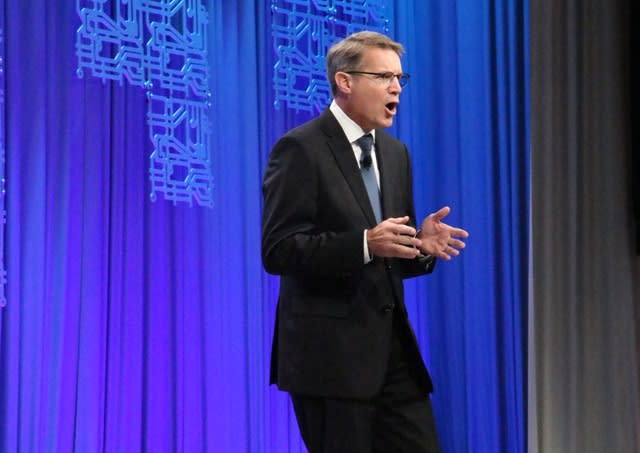
ATA's SpearPhoto: Evan Lockridge
The American Trucking Associations appears committed to leaving no stone unturned in its quest to see the tax-reform plan introduced on Capitol Hill on Nov. 2 passed into law and signed by President Trump.
In a Nov. 6 message to the trucking lobby’s members as well as in a Nov. 2 letter sent to every member of the House and Senate, ATA President and CEO Chris Spear “makes it clear” that “early enactment of significant federal tax reform is critical for the U.S. trucking industry and for the nation’s economy in general.”
In his letter to Congress, Spear succinctly explains why passage of the GOP’s Tax Cuts and Jobs Act is ATA’s highest legislative priority. He said the bill embodies “three basic principles,” lowering tax rates on business income, broadening the tax base to render it more equitable, and significantly simplifying the enormously complex tax code, that “will all benefit motor carriers.”
He added that lowering the corporate rate will “free up cash to invest in newer, safer, cleaner, and more efficient equipment, while also helping carriers pay drivers more and make necessary investments in workforce development. Broadening the tax base to allow such rate reductions will eliminate special tax breaks enjoyed by industries that are more heavily dominated by large business entities than trucking. Tax simplification will alleviate the very considerable burden of compliance the current tax code imposes on small businesses.”
In his message to ATA members, Spear emphasized that as desirable as the tax package is to trucking stakeholders, it is a “lengthy and detailed” piece of legislation so its provisions “could apply to businesses (i.e. size) differently.” That’s why he urged “ATA members to work with their legal or accounting teams for advice in assessing the likely effects of the proposal on their businesses.”
Spear also advised that ATA staff has met with the Senate Leadership and Finance Committee staff about moving tax reform forward. “The meeting was requested by the Senate Majority Leader’s tax staff and was attended by roughly two dozen supportive associations and interested businesses and lobbyists,” he stated.
According to Spear, the meeting revealed “important pieces of information,” the significance of which he described as such:
“There are five steps to get a final tax reform bill to the President’s desk, and Senate and House Leadership intend to have three of the five completed by Thanksgiving: House Ways and Means Committee markup, House Floor final passage, and Senate Finance Committee markup. (The final two steps will be Senate Floor passage and “Conferencing” the bills.)”
“Permanence, especially for the corporate rate is the goal for the Senate, but the Senate budget reconciliation rules are different than what the House faces. Revenue raisers will be a part of that process, as they have been in the House, to a different degree.”
“All those who support this tax reform effort who are willing should let Members of Congress know, particularly in their District and State offices. CEOs and managers who have growth plans that are tied to tax reform are welcome, as are employees who are aware of how resulting growth and relieving the tax burden directly impact them.”
“The Senate floor vote should come after Thanksgiving, and advocacy and education will be important throughout the process.”
Spear added that along with lobbying Members of Congress, “ATA will be working with our State Executives and many of you to help amplify how vital this issue is to our industry and to the economy… and we are here to help as you may wish to do local or state media or advocacy.”
More Fleet Management

Color Match Smarter: Tools That Restore & Perform
For fleet managers and collision repair professionals keeping heavy-duty trucks on the road, getting the color right the first time isn't just about appearance — it's about efficiency, turnaround time, and bottom-line results. Discover how today's digital color tools are transforming the repair process from guesswork to precision.
Read More →
FMCSA Pauses Biennial-Update Enforcement Amid Motus Transition
Carriers whose updates were due on or after June 1 have more time, while FMCSA works to stabilize its new registration system and warns of phishing sites impersonating its new carrier registration system, Motus.
Read More →
2026 Blueprint for Countering Smarter Supply Chain Theft
Cargo theft is no longer just the cost of doing business. It's a multi-billion-dollar criminal enterprise exploiting vulnerabilities across your fleet, drivers, and supply chain.
Read More →


How Telematics Improves Visibility, Control, and Performance in Refrigerated Fleets
Explore how telematics help refrigerated fleets improve visibility, uptime, efficiency, compliance, and cargo protection across connected cold chain operations.
Read More →
What the U.S.-Canada Trade War Means for Trucking
Escalating U.S.-Canada tariffs could disrupt cross-border freight, reduce truck volumes, raise costs, and create new uncertainty for carriers on both sides of the border.
Read More →
What Are Trucking’s Top Concerns for 2026?
The American Transportation Research Institute wants to know what's worrying trucking fleet managers, drivers, and other stakeholders in its annual Industry Issues survey.
Read More →
American Trucking Associations Looks for a New Leader
ATA President and CEO Chris Spear abruptly left his job at the association on August 21, at a pivotal time for the trucking industry.
Read More →
Public Wi-Fi Cybersecurity Risks: How Truck Drivers and Fleets Can Protect Their Data
Public Wi-Fi can expose truck drivers and fleets to credential theft, malware, and other cyber threats. Here’s how to reduce the risk on the road.
Read More →
For Nicky Cupp, Fleet Innovation Starts With Frustration
HDT Truck Fleet Innovator Nicky Cupp turns everyday pain points at Fraley & Schilling into opportunities for better technology and smarter processes.
Read More →
Adam Buttgenbach’s Approach to Electric Trucks: Start With Where They Fit
HDT Truck Fleet Innovator Adam Buttgenbach helped PepsiCo build one of North America’s largest EV fleets by focusing on where electric trucks make operational sense.
Read More →