




API Economist Warns of Potential of Bad Energy Policy
CINCINNATI -- The general public doesn't know much about the oil industry - and a lot of what they think they know is wrong, said John Felmy, chief economist for the American Petroleum Institute, Sunday during an educational session at the National Private Truck Council annual meeting. And that lack of knowledge, he says, can lead to misguided public policy
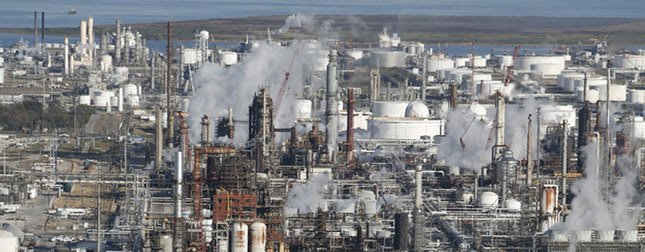
Texas City refinery complex. U.S. refineries are producing record amounts of gasoline. (Photo courtesy BP)
CINCINNATI -- The general public doesn't know much about the oil industry - and a lot of what they think they know is wrong, said John Felmy, chief economist for the American Petroleum Institute, Sunday during an educational session at the National Private Truck Council annual meeting. And that lack of knowledge, he says, can lead to misguided public policy.
For instance, Felmy says, in a survey of people who said they were knowledgeable about the petroleum industry, only 11 percent could correctly identify the largest supplier of oil to the U.S. - Canada. "If people don't know the facts and they're talking to their elected representatives, you can have very bad policies developed based on misunderstandings." It's that kind of bad policy, he said, that led to gas rationing in the '70s.
People often point to the huge profits reported by major oil companies. When fuel prices are high, that leads to calls for taxing oil companies more heavily. However, Felmy said, according to the U.S. Energy Information Administration, if you divide up what goes into the cost of a gallon of gasoline, the crude oil makes up 62 percent of that, 21 percent is refining and retailing, and 17 percent is taxes. In fact, he said, only 4.3 percent of that dollar last year was profits - far less than many other industries, such as 5.5 percent for all manufacturing industries and 27.7 percent for the pharmaceutical industry.
Felmy also said that critics often bring up the fact that the industry has built no new refineries since 1986, and accusations that the industry is purposely trying to keep the keep supplies of fuel low to drive prices up. Yet, Felmy said, in March the industry produced an all-time record amount of gasoline. "The refinery system is squeezing more and more out of the bottom of the barrel," he said, and in the case of gasoline, they are also adding more ethanol to meet government mandates. In addition, he said, the industry has been expanding existing refineries, which is much more efficient then building new ones - the equivalent, he said, of a new refinery every year since the mid '90s.
Despite calls to regulate speculation in oil markets, Felmy said the primary driver of high gasoline and diesel prices is supply and demand. He showed how gasoline and diesel prices move practically in lockstep with crude oil prices. "Since the middle of February, we've seen crude oil prices rise from $71 to $86 a barrel, an increase of 36 cents per gallon," he said. "At the same time, we've seen the cost of gasoline and diesel go up about 25 cents a gallon."
ALTERNATIVE FUELS
Felmy said the petroleum industry is already the largest investor in alternative fuels. "We're looking for the next energy source, but it takes a long time," he said, noting that oil was discovered in the U.S. in 1859, but it took 90 years before oil surpassed coal as an energy source. He also touted the large investment in "clean diesel," the ultra low sulfur diesel fuel that has been part of the elimination of soot and smell from today's new diesel engines.
Solar, wind and geothermal energy creation, which are being pushed in Washington, D.C., Felmy said, are all well and good, but they are not going to do much to reduce our dependence on petroleum products, he said. That's because 71 percent of the petroleum is used in transportation, which depends on petroleum for 95 percent of its fuel. Solar, wind and geothermal produce electricity, but that doesn't do much good for transportation, he said. "Until we have a fleet of electric cars, you're not going to see that as a mechanism of reducing oil use," he said. "We need energy policies that are going to use ALL of these things."
Felmy said that even though we will see significant growth in biodiesel, ethanol and other green liquid fuels, by 2035, we'll still use more oil than we do today. Natural gas, he said, is an option that could be used to convert some trucks off of petroleum, thanks to recent huge discoveries of shale gas in the U.S., as is being pushed by energy magnate T. Boone Pickens through his Pickens Plan.
GOVERNMENT ACTIONS
The oil industry is against the Waxman-Markey climate change bill that passed the House last summer but has not passed the Senate. Felmy said the bill put nearly the entire burden on the oil industry and oil consumers. He also questioned the greenhouse gas emissions targets in that bill, noting that an 83 percent reduction would take us down to below levels seen in the 19th century.
He also said the Obama administration's FY2010 budget proposal would mean a more than $80 billion tax increase on the American oil and gas industry. Putting more burdens on the industry, he said, could drive struggling refineries out of business, result in less investment in looking for new sources of oil and energy, and actually result in less oil being produced domestically and increased dependence on foreign oil.
"We think going forward we're going to need more oil. So if we're going to need more oil, why don't we product more here?" Felmy said. "Every dollar we produce here means we're not sending a dollar somewhere else," and that could improve the trade deficit, generate jobs, and generate revenue for the U.S. Treasury.
Felmy said while the Obama administration recently took steps to open some parts of the U.S. to offshore drilling, they also closed the door on other potentially oil-rich areas.
The API is also concerned about proposals in the Northeast to mandate ultra-low sulfur heating oil. "You're talking about suddenly throwing the Northeast into a situation where you could suddenly have a surge in demand," and the industry just does not have the refining capacity to meet that much need for ultra-low-sulfur fuel - and home heating oil is very similar to diesel fuel. "The last thing you want is a major spike in demand for diesel in the winter."
The American Petroleum Institute represents all aspects of the U.S. petroleum and natural gas industry. You may be most familiar with it from the API "donut" used to identify engine oils meeting standards set to make sure the oils work properly in vehicle engines.
More Drivers

When Language Stops the Truck: The Return of ELP Out-of-Service Orders
English language proficiency rules for commercial drivers aren’t new, but renewed out-of-service enforcement has raised the stakes. Here’s what carriers need to know before a driver reaches a roadside inspection.
Read More →
Samsara Launches Custom AI Agent Builder
Agent Studio lets fleets create AI tools for hours-of-service monitoring, reporting and driver support, including agents that communicate by phone.
Read More →
Trucker Path Expands Reserved Parking Network
Trucker Path has added close to 6,000 more truck parking spaces to its Trucker Path Reserved Parking Network with the addition of Safe Truck Parking.
Read More →
EEOC Sues Texas Trucking Company Over Driver Age Limits
The agency says Trancasa USA rejected applicants over 65 and applied tougher driving-record standards to those over 60.
Read More →
Nussbaum, Roehl Announce Second Driver Pay Increase This Year
This year has seen a swath of major truck driver pay increases as freight capacity has tightened.
Read More →
From One Generation to the Next: How Mentorship Builds Safer Truck Drivers
After three decades in trucking, Harold Perry shares what he's learned about driver safety, mentorship, and helping the next generation build confidence behind the wheel.
Read More →
Truck Drivers Need More Than Another Alert
Fleets have more visibility into truck health, safety events, and driver activity than ever. The next challenge is turning all that information into useful guidance for the person who has to decide what to do next.
Read More →
FMCSA Removes 110 Truck Driver Training Schools from Certified ELDT List
Federal regulators also are targeting more than 160 additional training providers and launching a nationwide audit of third-party CDL skills testers as part of a broader crackdown on trucking fraud.
Read More →
Hours of Service Pilot Programs: FMCSA Readies for 2027 Rollout
Two pilot programs could eventually reshape hours-of-service rules, giving truck drivers options to pause their 14-hour clock or use longer split sleeper rest periods.
Read More →
Medical Cards, English Proficiency Reshape Roadcheck Violations
Medical-card violations jumped to the top of the driver out-of-service list during CVSA’s 2026 International Roadcheck, while English-language proficiency violations appeared among the leading violations for the first time.
Read More →