




Analyst: Natural Gas Makes Sense For Trucking Industry
While passenger cars may be well-suited to hybrid and electric technology, natural gas makes more sense for the trucking industry, and would be taking off among fleets, were it not for the econom
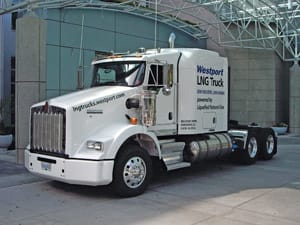
Woodburn says natural gas-powered vehicles, such as this one, make sense for the trucking industry. This Kenworth is equipped with the Westport LNG Fuel System.
While passenger cars may be well-suited to hybrid and electric technology, natural gas makes more sense for the trucking industry, and would be taking off among fleets, were it not for the economy
, according to David Woodburn, a sell-side research analyst for ThinkEquity.
As part of its Oil & Gas Production and Distribution Report, the Wall Street Transcript conducted several interviews with industry executives, including Woodburn, who was drilled on the topic of natural gas.
"I think people kind of laugh at the idea of natural gas for vehicles here in the U.S. because it might take decades to install the infrastructure to match that for diesel, let alone gasoline," Woodburn said. "But the passenger market is not really where you'd want to start anyway. The smart thing is to focus on high-volume fuel users that utilize a single or require few refueling stations."
Woodburn doesn't believe hybrid and electric vehicles will catch on with fleets because of the weight of the battery, which can reduce the carrying capacity by 10 or 20 percent, he said.
He points to a number of incentives in place to encourage adoption of natural gas, including an excise tax credit for the fuel itself of 50 cents a gallon equivalent. Federal tax credits are also available to fund the purchase of natural gas or alternative fuel vehicles. Woodburn also discusses the NAT GAS legislation, which was introduced in the House in April and in the Senate in the summer. This legislation, he said, would extend these tax credits and boost these incentives.
"So natural gas is actually getting a lot of attention in Washington," he said. "With climate legislation stalled right now, you could see some of these natural gas incentives in an energy bill or a transportation bill."
Woodburn said climate change and the issue of alternative fuels are not exactly priorities for Washington these days, with health care at the top of everyone's agenda.
"However, the natural gas industry is working hard on a promoting natural gas as cleaner and cheaper than coal and oil, and domestically sourced as well," he added.
More Drivers

Platform Science Adds Dispatch and Safety Tools
Four additions to PS Fleet help fleets monitor loads, manage driver coaching, share truck locations and adjust video system settings.
Read More →
When Language Stops the Truck: The Return of ELP Out-of-Service Orders
English language proficiency rules for commercial drivers aren’t new, but renewed out-of-service enforcement has raised the stakes. Here’s what carriers need to know before a driver reaches a roadside inspection.
Read More →
Samsara Launches Custom AI Agent Builder
Agent Studio lets fleets create AI tools for hours-of-service monitoring, reporting and driver support, including agents that communicate by phone.
Read More →
Trucker Path Expands Reserved Parking Network
Trucker Path has added close to 6,000 more truck parking spaces to its Trucker Path Reserved Parking Network with the addition of Safe Truck Parking.
Read More →
EEOC Sues Texas Trucking Company Over Driver Age Limits
The agency says Trancasa USA rejected applicants over 65 and applied tougher driving-record standards to those over 60.
Read More →
Nussbaum, Roehl Announce Second Driver Pay Increase This Year
This year has seen a swath of major truck driver pay increases as freight capacity has tightened.
Read More →
From One Generation to the Next: How Mentorship Builds Safer Truck Drivers
After three decades in trucking, Harold Perry shares what he's learned about driver safety, mentorship, and helping the next generation build confidence behind the wheel.
Read More →
Truck Drivers Need More Than Another Alert
Fleets have more visibility into truck health, safety events, and driver activity than ever. The next challenge is turning all that information into useful guidance for the person who has to decide what to do next.
Read More →
FMCSA Removes 110 Truck Driver Training Schools from Certified ELDT List
Federal regulators also are targeting more than 160 additional training providers and launching a nationwide audit of third-party CDL skills testers as part of a broader crackdown on trucking fraud.
Read More →
Hours of Service Pilot Programs: FMCSA Readies for 2027 Rollout
Two pilot programs could eventually reshape hours-of-service rules, giving truck drivers options to pause their 14-hour clock or use longer split sleeper rest periods.
Read More →