




Amazon Order Drives Renewable Natural Gas Development
The latest effort from Clean Energy and BP has the estimated potential to convert the methane produced from dairy waste into more than 7 million gallons of RNG annually.

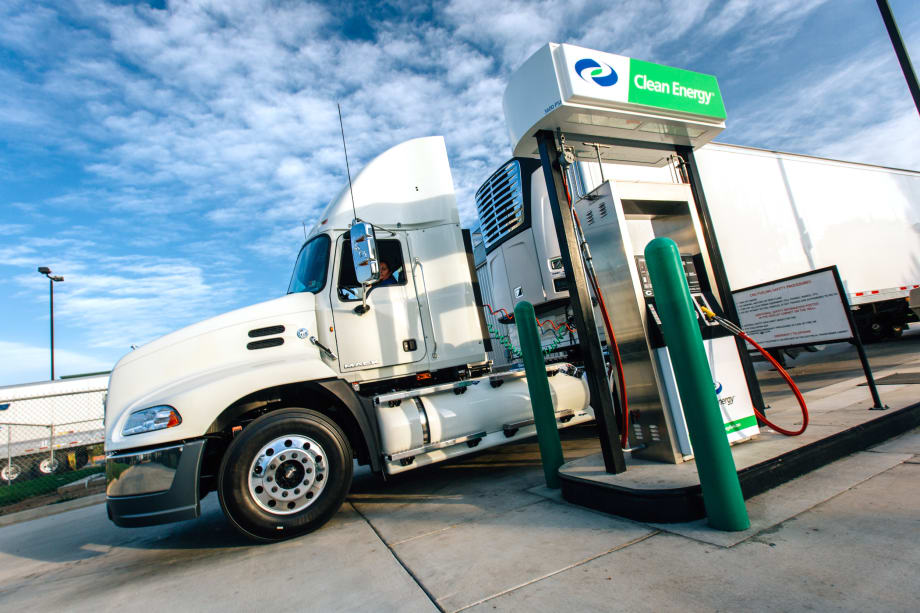
Renewable natural gas when used as a transportation fuel has lower GHG emissions on a lifecycle basis than conventional diesel.
Photo: Clean Energy
Clean Energy Fuels Corp. and BP announced that their renewable natural gas joint venture will build on previously announced plans to finance and develop new projects at dairy farms, starting in the Midwest.
“The demand for RNG is rapidly growing, highlighted by our recent announcement to fuel a new fleet of Amazon heavy-duty trucks deploying across the country,” said Clay Corbus, senior vice president and co-head of renewable fuels at Clean Energy. “Our joint venture with BP to develop new supplies is critical to keeping up with this demand.”
In February, Reuters reported that Amazon had ordered hundreds of trucks that run on compressed natural gas as it tests ways to shift its U.S. fleet away from heavier-polluting trucks. “Amazon is excited about introducing new sustainable solutions for freight transportation and is working on testing a number of new vehicle types including electric, CNG and others,” the company said in a statement.
In April, Clean Energy signed an agreement with Amazon to provide low- and negative-carbon renewable natural gas, to be provided at 27 existing Clean Energy fueling stations and another 19 non-exclusive new or upgraded Clean Energy-owned stations that Clean Energy expected to be constructed by the end of the year.
This latest announcement involves RNG from dairy farms in South Dakota and Iowa. These farms, with more than 30,000 cows, have the estimated potential to convert the methane produced from waste into more than 7 million gallons of RNG annually, according to the announcement.
Agriculture accounts for nearly 10% of U.S. greenhouse gas emissions, according to the U.S. Environmental Protection Agency. Capturing methane from farm waste can lower these emissions. RNG is used as a transportation fuel and has lower GHG emissions on lifecycle basis when compared to conventional gasoline and diesel. The California Air Resources Board has given similar projects a carbon intensity (CI) score of weighted average of -320 compared to CI scores of 101 for conventional diesel fuel and 15 for electric batteries.
With over 550 dispensing locations, Clean Energy said, it has the largest network of RNG stations in the U.S. BP transports RNG to California markets and monetizes the environmental credits associated with dispensing the RNG.
“These collaborations are critical steps toward our ambition of helping the world reach net zero by 2050 or sooner,” said Sean Reavis, BP biogas origination. “Our biogas strategy is focused on growth and developing an integrated business model that allows us to deliver the unique energy products the market is demanding.”
The first RNG production facility is expected to be operational in 2022.
More Fuel Smarts

How Volvo Updated Its D13 for EPA 2027 [Watch]
Volvo’s updated D13 promises lower emissions without sacrificing performance or fuel economy. Take a closer look at what changed inside the engine in this HDT Spotlight video.
Read More →
Diesel Price Spike Shortens Payback for Natural Gas Trucks, Report Says
Energy Vision estimates fleets could recover the higher purchase price of an RNG-fueled Class 8 tractor in 1.3 to 2.8 years under current fuel-price scenarios.
Read More →
Calstart Becomes Catalyst Mobility, Reflecting Broader Focus
Calstart is now Catalyst Mobility, reflecting the nonprofit’s growing national role in clean transportation, including zero-emission trucks, infrastructure and incentive programs.
Read More →

Record Diesel Prices Squeeze Trucking Fleets
Average U.S. diesel prices have climbed to nearly $6 a gallon, surpassing the 2022 record as tight refinery capacity and Middle East disruptions keep fuel costs elevated.
Read More →
How Fuel Delivery Shapes Engine Performance
Fuel delivery depends on more than what happens at the injector. For fleet, maintenance and technical professionals, looking at the full path from pump to injector can provide useful context for understanding engine performance.
Read More →
East Coast Port Launches $45M Electric Truck Push
The Port Authority of New York and New Jersey announced millions in incentives for zero-emission drayage trucks, yard tractors, and new charging hubs near the port.
Read More →
California Bill Could Shed Light on Electric Truck Prices
Why do battery-electric Class 8 trucks remain so expensive? A California bill headed to Gov. Gavin Newsom would give fleets and state agencies more visibility into what manufacturers charge.
Read More →
Detroit Opens Orders for EPA 2027 Engines
Detroit isn’t starting from scratch to meet EPA 2027 diesel emissions standards. Its Gen 6 DD13 and DD15 engines keep much of today’s platform while updating the fuel and aftertreatment systems.
Read More →
Zero-Emission Truck Corridor Planned for West Coast
California, Oregon, Washington, British Columbia and Baja California are coordinating plans for truck charging and hydrogen fueling from Canada to Mexico.
Read More →
A Closer Look at Kenworth’s Electric T880E Vocational Truck [Video]
Learn more about Kenworth's T880E battery-electric vocational truck at the Paccar Technical Center, including its range, applications, upfitting considerations, and PTO options, in this HDT Spotlight video.
Read More →