





Related – Fuel Economy Testing: Are the Gains Too Small to See?
Allison Brings Real-World Testing into the Lab
The speed of innovation and product development in trucking today keeps accelerating, but one bottleneck is the ability to test in real-world conditions. Allison Transmission says it has a solution for that in its new Vehicle Environmental Test center.
August 21, 2020
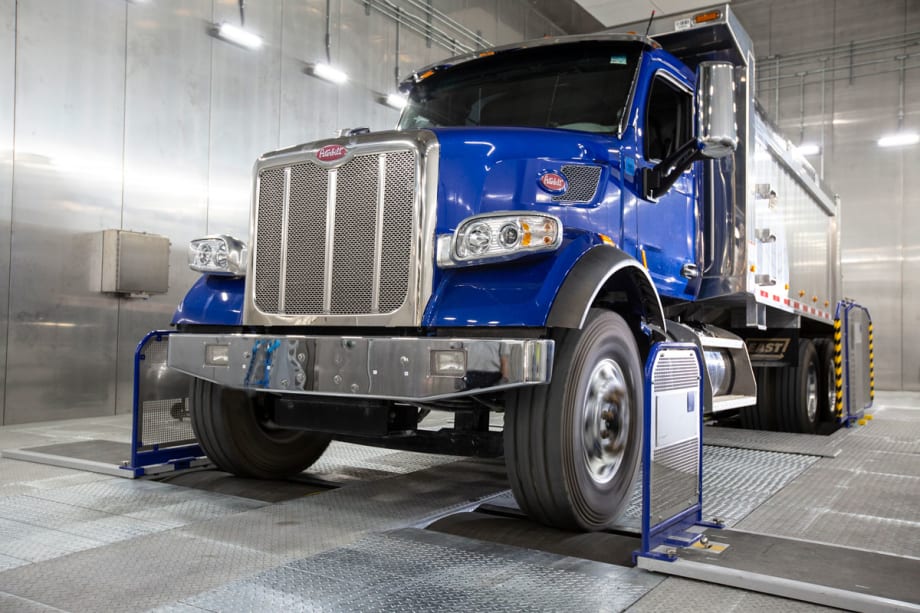
Allison's new Vehicle Enviromental Test Center features two chassis dyne-equipped environmental chambers.
Photo: Allison Transmission
5 min to read
The speed of innovation and product development in trucking today keeps accelerating, but one bottleneck is the ability to test in real-world conditions. Allison Transmission says it has a solution for that in its new Vehicle Environmental Test center, which recently started operations on Allison’s Indianapolis, Indiana, campus, and can simulate real-world conditions testing in the lab.
For instance, if you want to find out how a vehicle or component performs over a large number of miles in the heat of summer, the depth of winter, or crossing the Rockies, using traditional methods would take a lot of time, travel, or both.
The 60,000-square-foot VET houses a hot soak chamber, a cold soak chamber, and two chassis dyne-equipped environmental chambers capable of simulating a broad range of duty cycles. It can simulate environmental conditions from negative 54 degrees to 125 degrees, altitudes up to 18,000 feet, simulated grades, and other on-road conditions.
“We’re bringing the chaos of the real world into the laboratory so we can generate reliable and repeatable test results,” said Jeanne Rues, managing director, engineering services, in an exclusive interview with HDT.
Rohan Barua, vice president sales, North America, told HDT, “If you don’t have to wait for the summer and winter and high altitude, you can compress the seasons to a few months instead of 12.”
More efficient testing means a more compressed product development timeline, so new products can be brought to market faster. Allison, truck makers, and others in the industry are facing increasing pressures to innovate – and to do it quickly while keeping costs down, Rues explained.
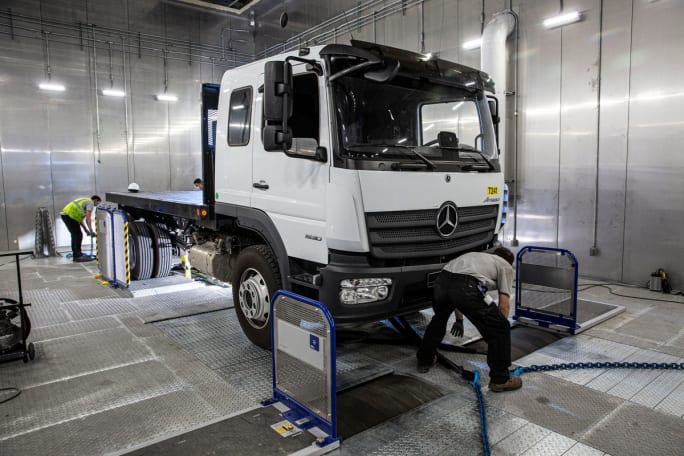
The VET center can simulate a broad range of duty cycles, environmental conditions, altitudes, simulated grades and other conditions.
Photo: Allison Transmission
Allison said the VET center is designed to help Allison’s engineers, its OEM partners, body builders, suppliers, and fleet owners innovate their vehicles, optimize performance, and accelerate time to market, by testing in a single, environment-controlled and seasonally independent location.
The center can accommodate most commercial on-highway, off-highway and wheeled defense vehicle applications.
Why Vehicle-Level Testing Matters
It’s one thing to test a component or an engine on its own. Testing it in real vehicles is key. “What you end up with in powertrain testing, a level lower than vehicle testing, you’re not replicating the vehicle,” Rues said.
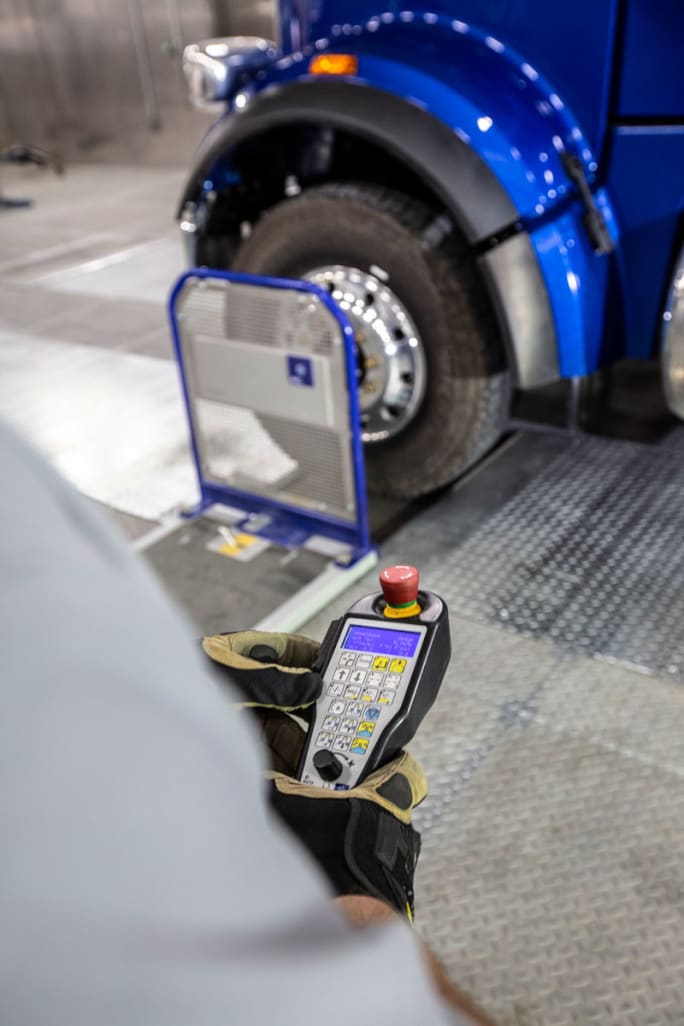
"We’re bringing the chaos of the real world into the laboratory, so we can generate reliable and repeatable test results."
Photo: Allison Transmission
One example is fuel economy. In the real world, fuel-economy testing is difficult to do precisely.
“We have the vehicle in there, it is in the facility, and it is being tested as a whole system. So you’re testing at the same level as the real world, and we’re replicating and simulating the conditions of the real world, so you can understand what factors are driving that economy.”
Located on the campus of Allison Transmission’s global headquarters in Indianapolis, the VET center is the only one of its kind in the Midwest, according to the company, and is unique in offering this range of capabilities for public use.
“Facilities with these capabilities, with vehicle-level testing for commercial vehicles, are few and have limited accessibility,” Rues said.
Simulating Electric Vehicles
The VET supports testing for a wide range of propulsion systems, including conventional powertrains, alternative fuel, electric hybrid, fully electric and hydrogen fuel cell vehicles.
“For me, the cool thing was this full electric vehicle emulation,” Rues said. “In a typical EV situation, you would have to wait for the charge and recharge situation. Doing that in a lab, you can keep running it and accumulate many more hours much faster.”
Being able to emulate an energy storage system, she said, means engineers aren’t limited by the capacity of the battery pack, which helps them do testing faster.
The VET also can simulate various states of charge. “I can test at 90% charge, then 10 minutes later test at 10%,” she said. “You can’t do that in the real world.”
Being able to test at varying states of charge, she explained, is important because electric systems act differently depending on the amount of power available to them. “Say you have an electric CV, you’re performing your work, and the state of charge becomes reduced as you’re doing that work. It’s important that it continue to respond in the same way, and the controls of the electric vehicle are helping to manage the fact, and you’re not suddenly in a place where you’re out of battery capacity and stuck by the side of the road.”
“There’s tons of engineering time spent to make sure the energy storage system, the power control system … and the management control system of the vehicle are all working together to make sure the vehicle is operating in a safe and reliable manner,” Rues said. “And doing that development early and being able to manage over all of the potential conditions. The VET is a perfect place to bring all of those systems together and make sure that it works. And of course, the VET provides the opportunity to vary the temperature, to vary road conditions – are we at negative 10 degrees and driving up a 15% grade with a 10% state of charge, and will the vehicle perform within the requirements? And we can do that, in the middle of July in Indiana.”
Testing Under Way
Electric vehicle and component development is just one example of what the VET center can be used for. Already, Allison has been working with customers to explore some hydraulic control system optimization, as well as a test on optimizing a cooler across a range of axle ratios.
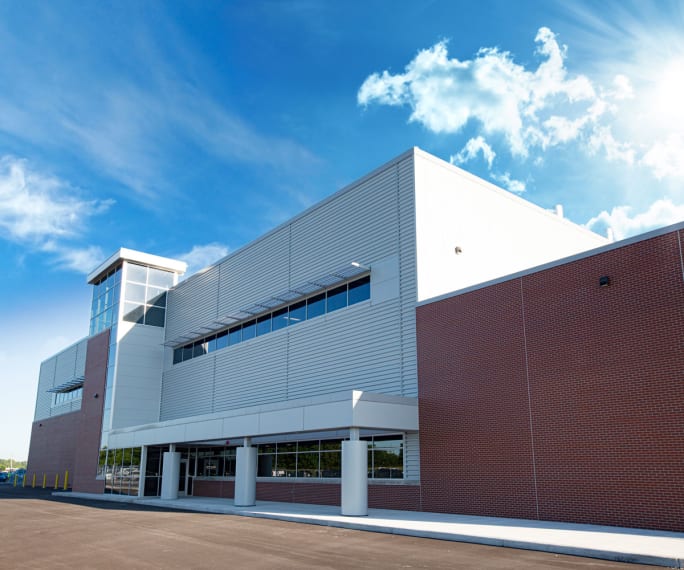
Allison's new Vehicle Environmental Test center will allow rapid product development for conventional, alternative fuel and electric vehicles.
Photo: Allison Transmission
“What was really interesting about the cooler test was that it was important to optimize it across a range of axle ratios in the vehicle, which changes how the engine and transmission respond,” Rues said. “We were able to take a single vehicle, and without changing the hardware on the vehicle, use the dynes to simulate half a dozen different axle ratios and do a cooler optimization. We got testing done in days vs. weeks, and saved on the labor and hardware that would required to test six different axles.”
More Equipment

How Volvo Updated Its D13 for EPA 2027 [Watch]
Volvo’s updated D13 promises lower emissions without sacrificing performance or fuel economy. Take a closer look at what changed inside the engine in this HDT Spotlight video.
Read More →
Michelin Tire Improves Efficiency and Durability for Regional Fleets
The Michelin X Multi Energy D2 is a regional haul drive tire engineered to help fleets improve fuel efficiency, durability and traction in demanding stop-and-go operations.
Read More →
ZF Expands Commercial Vehicle Push in North America
ZF is expanding its North American commercial-vehicle presence with new transmission applications, electrification, trailer technology and autonomous-driving systems.
Read More →
Tesla Wants a Self-Driving Semi. Are Cameras Enough?
Could Tesla’s camera-only autonomous driving technology work on an 80,000-pound Semi? In this commentary, HDT's Deborah Lockridge takes a look at Tesla, Cybercab, and how autonomous trucks see the road.
Read More →
Kodiak: Driverless Long-Haul Truck Launch on Track for 2026
Kodiak AI says its driverless long-haul safety case is 93% complete and it remains on track to begin commercial operations by year-end 2026.
Read More →
What DOT’s Automated Vehicle Strategy Means for Trucking
The U.S. Department of Transportation issued a new automated-vehicle strategy that outlines plans for driverless-truck regulations, cross-state freight corridors, and federal safety standards.
Read More →
East Coast Port Launches $45M Electric Truck Push
The Port Authority of New York and New Jersey announced millions in incentives for zero-emission drayage trucks, yard tractors, and new charging hubs near the port.
Read More →
PlusAI Going Public to Fund Autonomous Truck Launch
A SPAC deal could provide PlusAI with up to $300 million as it works toward a 2027 commercial launch of factory-built autonomous trucks.
Read More →
NHTSA Moves to Rewrite Truck Fuel-Economy Rules
The National Highway Traffic Safety Administration says it lacks authority to regulate medium- and heavy-duty truck engines separately from complete vehicles, but the existing standards have not yet been eliminated.
Read More →
Detroit Opens Orders for EPA 2027 Engines
Detroit isn’t starting from scratch to meet EPA 2027 diesel emissions standards. Its Gen 6 DD13 and DD15 engines keep much of today’s platform while updating the fuel and aftertreatment systems.
Read More →