



Survey Says....
93% of leaders believe AI can improve resiliency.
54% say fleet-to-market comparisons would enhance efficiency and decision-making.
40% of AI adopters have seen 50%+ improvements in fuel usage, cost, or routing.
 MENU
MENU SEARCH
Fuel savings. Route optimization. Customer satisfaction. Fleet execs say AI is delivering results — but there are still concerns.
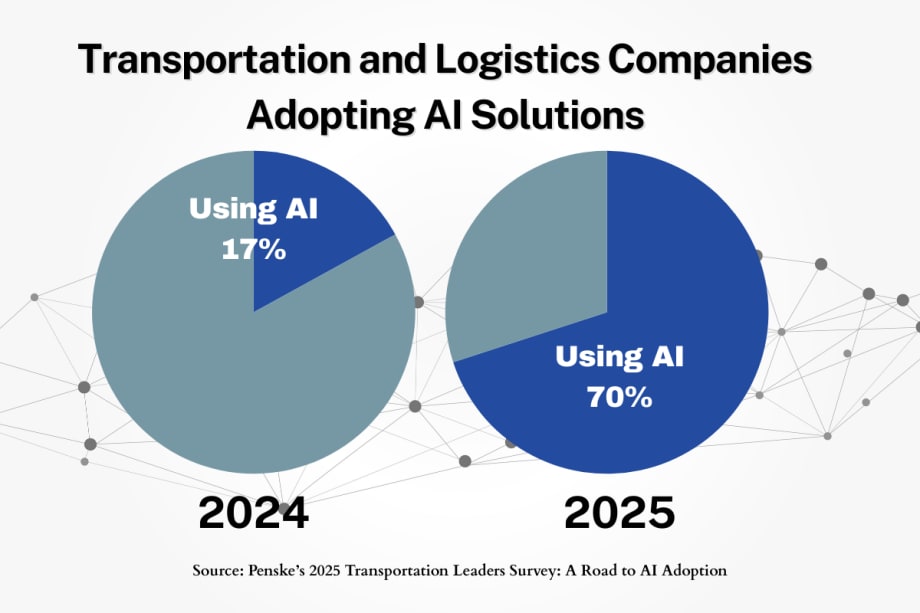
The use of artificial intelligence solutions in transportation and logistics has quadrupled over the past year, according to the Penske survey.
HDT Graphic from Penske Data
Transportation and logistics leaders are forging ahead in using artificial intelligence, but an increasing number are concerned that the industry is behind, according to a new survey from Penske.
According to Penske’s 2025 Transportation Leaders Survey: A Road to AI Adoption, 93% of senior business decision makers in the transportation and logistics industry agree that AI will improve their organization’s resiliency and ability to adapt to sudden shifts.
More than nine in ten (91%) believe organizations that adopt AI are better positioned for future growth.
And in what marks a turning point for the industry, 70% of companies now report adopting AI solutions — up 17% from last year’s survey.
Fleet executives cite improvements in fleet planning (36%), route optimization (35%), and operational efficiency (34%) among the top gains realized over the past year.
And 40% of respondents using artificial intelligence tools said they’ve seen improvements of at least 50% in fuel usage, cost reduction, or distance traveled through smarter routing and optimization.
Leaders also see gains in driver safety, customer satisfaction, and visibility across the supply chain.
However, 84% of executives in the survey believe the industry lags behind others in adopting AI — up 20% since 2024. And 36% feel only somewhat prepared for continued disruptions caused by AI.
At the same time, concerns around AI’s risks haven’t diminished.
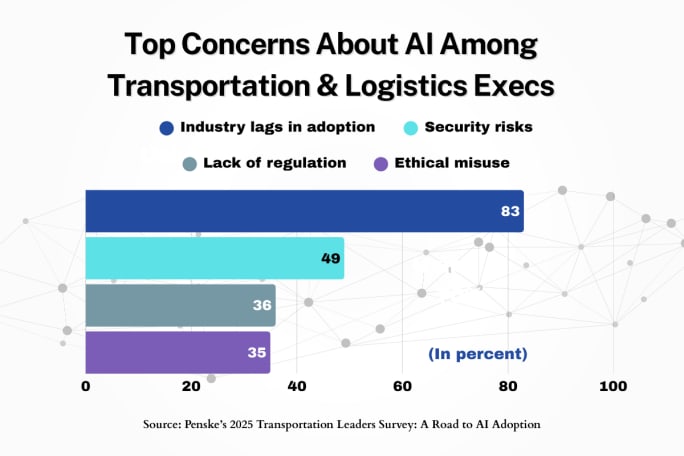
Despite growing optimism about the value of AI, concerns remain.
HDT Graphic from Penske Data
Security risks (49%), limited regulation governing (36%), and fears of unethical use (35%) are top of mind among survey respondents.
The report also highlights a stark contrast between innovation and legacy mindsets:
94% of respondents still rely on traditional annual forecasting to guide fleet planning.
97% agree that benchmarking with real-time data is becoming essential to navigate economic uncertainty and sudden market shifts.
These findings underscore the growing urgency for AI tools that deliver both visibility and measurable outcomes, Penske noted. (Penske offers an AI tool called Catalyst AI.)
While leaders recognize how AI can help future-proof their operations, many are still struggling to navigate current challenges, such as:
Rising costs (52%)
Supply chain disruptions (45%)
Managing fleet operations (40%)
More than half of respondents (54%) said the ability to compare their fleet’s performance to others in the same market would improve efficiency and operational decision-making.
As they plan for today’s continued economic uncertainty, fleet leaders cited their most critical data needs as:
Visibility into maintenance costs (44%)
Fuel price trends (41%), and
Fleet utilization (36%).
The transportation and logistics sector is moving past AI curiosity and into real-world applications.
Survey Methodology – The second edition of The Transportation Leaders Survey: A Road to AI Adoption was conducted online by Big Village among a sample of 255 U.S. adults 18 years of age and older who are owners, founders, or executive leaders or decision makers of a Transportations or Logistics businesses. This survey was live April 16-23, 2025.

For fleet managers and collision repair professionals keeping heavy-duty trucks on the road, getting the color right the first time isn't just about appearance — it's about efficiency, turnaround time, and bottom-line results. Discover how today's digital color tools are transforming the repair process from guesswork to precision.
Read More →
Carriers whose updates were due on or after June 1 have more time, while FMCSA works to stabilize its new registration system and warns of phishing sites impersonating its new carrier registration system, Motus.
Read More →
Cargo theft is no longer just the cost of doing business. It's a multi-billion-dollar criminal enterprise exploiting vulnerabilities across your fleet, drivers, and supply chain.
Read More →
Explore how telematics help refrigerated fleets improve visibility, uptime, efficiency, compliance, and cargo protection across connected cold chain operations.
Read More →
Escalating U.S.-Canada tariffs could disrupt cross-border freight, reduce truck volumes, raise costs, and create new uncertainty for carriers on both sides of the border.
Read More →
The American Transportation Research Institute wants to know what's worrying trucking fleet managers, drivers, and other stakeholders in its annual Industry Issues survey.
Read More →
ATA President and CEO Chris Spear abruptly left his job at the association on August 21, at a pivotal time for the trucking industry.
Read More →
Public Wi-Fi can expose truck drivers and fleets to credential theft, malware, and other cyber threats. Here’s how to reduce the risk on the road.
Read More →
HDT Truck Fleet Innovator Nicky Cupp turns everyday pain points at Fraley & Schilling into opportunities for better technology and smarter processes.
Read More →
HDT Truck Fleet Innovator Adam Buttgenbach helped PepsiCo build one of North America’s largest EV fleets by focusing on where electric trucks make operational sense.
Read More →
