




Ag Groups Praise Legislation Clarifying Agricultural HOS Exemption
A group of agricultural associations has come out in support of legislation that clarifies the applicability of the agricultural hours of service exemption
A group of agricultural associations has come out in support of legislation that clarifies the applicability of the agricultural hours of service exemption.
The Agricultural Retailers Association (ARA), the Agricultural and Food Transporters Conference (AFTC) of American Trucking Associations, the National Council of Farmer Cooperatives (NCFC) and The Fertilizer Institute (TFI) voiced their support today for legislation that would clarify transportation regulations that are critical to the agricultural sector's ability to expeditiously distribute farm supplies.
Congressmen Sam Graves (R-Mo.) and Blaine Luetkemeyer (R-Mo.), along with 38 additional congressional co-sponsors, introduced the legislation intended to resolve questions regarding the applicability of the agricultural hours of service exemption.
In April 2009, the Commercial Vehicle Safety Alliance called for the repeal of those exemptions that relieved ag carriers from hours-of-service regulations when operating within a 100-air-mile radius from their central base of operation during planting and harvesting seasons. The call came following the results of a study of truck crash and out of service rates by the U.S. Department of Transportation's Volpe National Transportation Systems Center.
The results of the Volpe study were disputed by veteran safety consultant, Ronald Knipling, who said, "It seems unwise to base a regulatory and economic decision as significant as revocation of the short-haul agricultural HOS exemption solely on (inadequate) statistics,"
The CVSA's action resulted in the Federal Motor Carrier Safety Administration issuing an interpretation of the regulations that resulted in transportation restrictions for certain farm supplies. The legislation introduced this week by Reps. Graves and Luetkemeyer amends aspects of the Motor Carrier Safety Improvement Act, which served as the basis for FMCSA's 2009 interpretation, to clarify the applicability of exemptions for agricultural products.
"When I visit with agricultural retailers across the country, one of the top issues they bring up as a threat to their business is the Hours of Service issue," said ARA President & CEO Daren Coppock. "We appreciate the efforts of Congressmen Graves and Luetkemeyer on this issue so that agricultural retailers are able to serve the needs of farmers during the busy planting and harvest seasons."
"The agricultural exemption to the HOS rule is a crucial tool for transporters of agricultural products during the busiest times of the year," said AFTC Chairman, Rick Yost. "We commend the work of Congressmen Luetkemeyer and Graves, and the other co-sponsors, for their work on this very important legislation."
Specifically, the legislation clarifies that the agricultural hours of service exemption is applicable to:
~ Drivers transporting agricultural commodities within a 100 air-mile radius;
~ Drivers transporting farm supplies for agricultural purposes from a wholesale or retail business to a farm or other location where the farm supplies are intended to be used within a 100 air-mile radius from the distribution point; or
~ Drivers transporting farm supplies from a wholesale location to a retail location so long as the transportation is within a 100 air-mile radius.
"This legislation will ensure that farmer co-ops can continue to provide their producer-owners and other customers with farm supplies in a timely and efficient manner," said NCFC President & CEO of Chuck Conner.
"TFI commends Congressman Graves and Luetkemeyer, along with the other co-sponsors of this legislation, for taking the steps necessary to ensure that the agricultural community has access to the crop nutrients and farm supplies necessary to produce safe, healthy and abundant crops," said TFI President Ford B. West.
More Drivers
Trucker Path Expands Reserved Parking Network
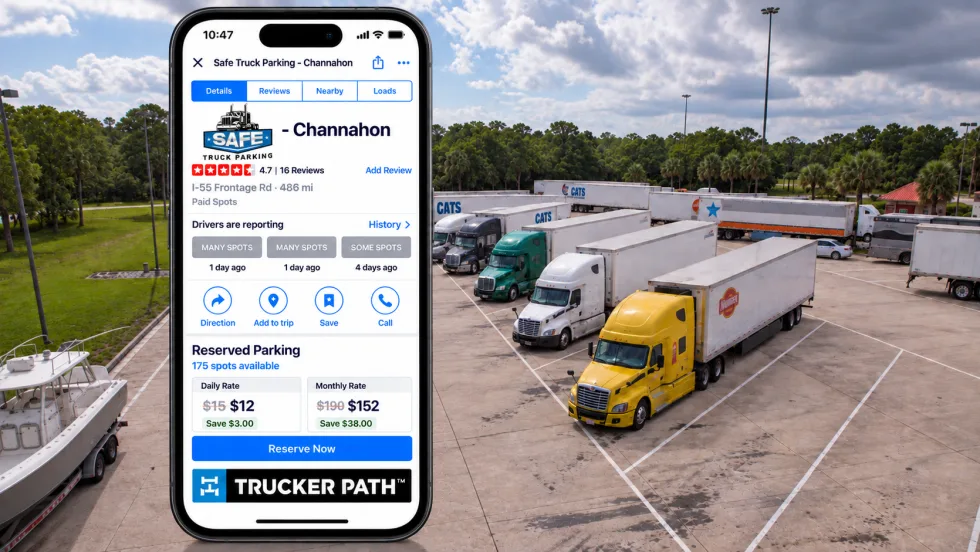
Trucker Path has added close to 6,000 more truck parking spaces to its Trucker Path Reserved Parking Network with the addition of Safe Truck Parking.
Read More →
EEOC Sues Texas Trucking Company Over Driver Age Limits
The agency says Trancasa USA rejected applicants over 65 and applied tougher driving-record standards to those over 60.
Read More →
Nussbaum, Roehl Announce Second Driver Pay Increase This Year
This year has seen a swath of major truck driver pay increases as freight capacity has tightened.
Read More →
From One Generation to the Next: How Mentorship Builds Safer Truck Drivers
After three decades in trucking, Harold Perry shares what he's learned about driver safety, mentorship, and helping the next generation build confidence behind the wheel.
Read More →
Truck Drivers Need More Than Another Alert
Fleets have more visibility into truck health, safety events, and driver activity than ever. The next challenge is turning all that information into useful guidance for the person who has to decide what to do next.
Read More →
FMCSA Removes 110 Truck Driver Training Schools from Certified ELDT List
Federal regulators also are targeting more than 160 additional training providers and launching a nationwide audit of third-party CDL skills testers as part of a broader crackdown on trucking fraud.
Read More →
Hours of Service Pilot Programs: FMCSA Readies for 2027 Rollout
Two pilot programs could eventually reshape hours-of-service rules, giving truck drivers options to pause their 14-hour clock or use longer split sleeper rest periods.
Read More →
Medical Cards, English Proficiency Reshape Roadcheck Violations
Medical-card violations jumped to the top of the driver out-of-service list during CVSA’s 2026 International Roadcheck, while English-language proficiency violations appeared among the leading violations for the first time.
Read More →
Driver Trust Can Make or Break the Success of Fleet Safety Technology
New Teletrac Navman research suggests that onboarding, transparency about driver data, and positive feedback can play a significant role in how commercial drivers respond to safety and coaching technology.
Read More →
EEOC Sues KLLM Over Alleged Sex Discrimination in Driver Training
KLLM is facing a federal sex-discrimination lawsuit over policies the EEOC alleges put female truck driver trainees at a disadvantage.
Read More →