




ACT Research: A Strong 2019 Will Mean Weaker Truck Markets Next Year
Although a recession is unlikely next year, ACT Research said uncertainty regarding the economy in the latter half of 2019 will detrimentally affect medium- and heavy-duty truck markets next year.

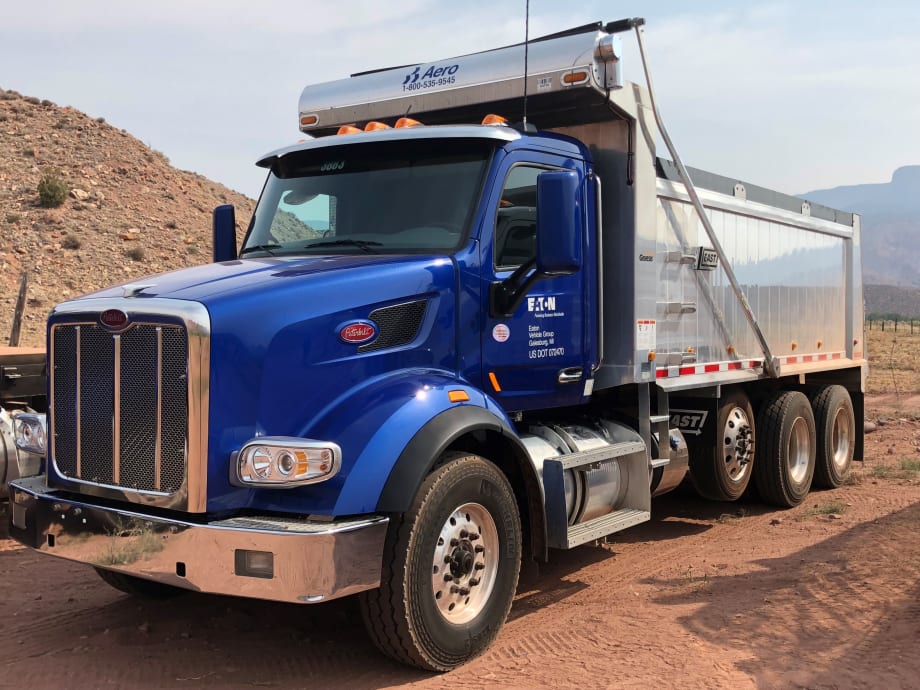
ACT Research said November Class 8 truck sales were down approximately 4,400 units from October 2019.
Photo: Jack Roberts
Economies are inherently cyclical in nature. Given that, ACT Research says, the prosperity of 2019 will likely contribute to a “tougher” 2020 for the medium- and heavy-duty truck markets in North America.
According to the transportation research firm’s latest State of the Industry North American Classes 5-8 Report, although a recession is unlikely next year, uncertainty regarding the economy in the latter half of 2019 will detrimentally affect medium- and heavy-duty truck markets next year.
“After peak build and sales in 2019, significant declines are ahead in 2020, as sales and build will follow trends in net orders and backlog volumes lower in their respective markets,” said Kenny Vieth, ACT Research’s President and Senior Analyst. He explained, “Recent articles point to a growing belief that a recession is likely to be averted in 2020, so the economic ‘days’ are likely to become brighter as we move through 2020. Unfortunately for the industry, the expected rebound will not come soon enough, or be robust enough, to take a sharp equipment downturn off the table.”
ACT’s State of the Industry: NA Classes 5-8 report provides a monthly look at the current production, sales, and general state of the on-road heavy and medium duty commercial vehicle markets in North America. It differentiates market indicators by Class 5, Classes 6-7 chassis and Class 8 trucks and tractors, detailing measures such as backlog, build, inventory, new orders, cancellations, net orders, and retail sales. Additionally, Class 5 and Classes 6-7 are segmented by trucks, buses, RVs, and step van configurations, while Class 8 is segmented by trucks and tractors with and without sleeper cabs. This report includes a six-month industry build plan, backlog timing analysis, historical data from 1996 to the present in spreadsheet format, and a ready-to-use graph package. A first-look at preliminary net orders is also published in conjunction with this report.
Looking specifically at the North American Class 8 market, Vieth said, “After October’s modest order strength, November data quelled thoughts of a better-than-expected order season, with November’s booking down about 4,400 units from the previous month.”
Regarding the medium duty markets, Vieth noted that, Weakness has spread in medium duty demand. The drivers of lower build rates are weak orders, falling backlogs, and elevated inventories. That weakness in turn is driven by the above-trend buying of the past 18 months, leading to slowing demand for trucks and RVs.”
More Equipment

How Volvo Updated Its D13 for EPA 2027 [Watch]
Volvo’s updated D13 promises lower emissions without sacrificing performance or fuel economy. Take a closer look at what changed inside the engine in this HDT Spotlight video.
Read More →
Michelin Tire Improves Efficiency and Durability for Regional Fleets
The Michelin X Multi Energy D2 is a regional haul drive tire engineered to help fleets improve fuel efficiency, durability and traction in demanding stop-and-go operations.
Read More →
ZF Expands Commercial Vehicle Push in North America
ZF is expanding its North American commercial-vehicle presence with new transmission applications, electrification, trailer technology and autonomous-driving systems.
Read More →
Tesla Wants a Self-Driving Semi. Are Cameras Enough?
Could Tesla’s camera-only autonomous driving technology work on an 80,000-pound Semi? In this commentary, HDT's Deborah Lockridge takes a look at Tesla, Cybercab, and how autonomous trucks see the road.
Read More →
Kodiak: Driverless Long-Haul Truck Launch on Track for 2026
Kodiak AI says its driverless long-haul safety case is 93% complete and it remains on track to begin commercial operations by year-end 2026.
Read More →
What DOT’s Automated Vehicle Strategy Means for Trucking
The U.S. Department of Transportation issued a new automated-vehicle strategy that outlines plans for driverless-truck regulations, cross-state freight corridors, and federal safety standards.
Read More →
East Coast Port Launches $45M Electric Truck Push
The Port Authority of New York and New Jersey announced millions in incentives for zero-emission drayage trucks, yard tractors, and new charging hubs near the port.
Read More →
PlusAI Going Public to Fund Autonomous Truck Launch
A SPAC deal could provide PlusAI with up to $300 million as it works toward a 2027 commercial launch of factory-built autonomous trucks.
Read More →
NHTSA Moves to Rewrite Truck Fuel-Economy Rules
The National Highway Traffic Safety Administration says it lacks authority to regulate medium- and heavy-duty truck engines separately from complete vehicles, but the existing standards have not yet been eliminated.
Read More →
Detroit Opens Orders for EPA 2027 Engines
Detroit isn’t starting from scratch to meet EPA 2027 diesel emissions standards. Its Gen 6 DD13 and DD15 engines keep much of today’s platform while updating the fuel and aftertreatment systems.
Read More →