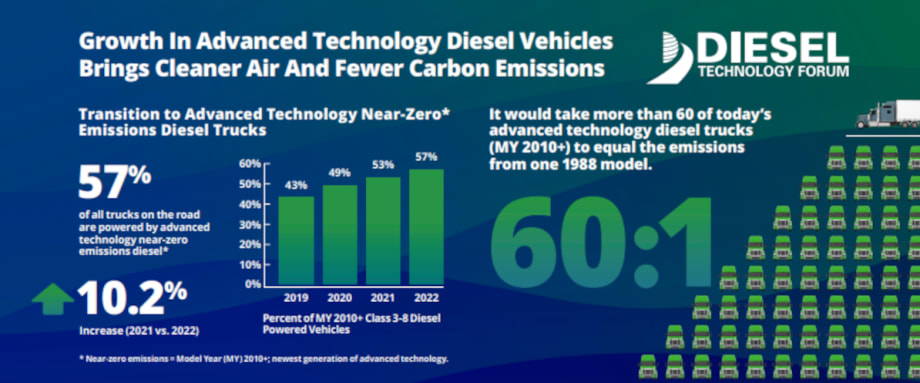
According to the Diesel Technology Forum, the percentage of near-zero emissions diesel trucks increased 10.2% from 2021 to 2022.
Source: Diesel Technology Forum
4 min to read
The number of new near-zero-emissions diesel trucks on the road increased 10.2% between 2021 and 2022, according to the Diesel Technology Forum. These are trucks using advanced diesel technology manufactured in the 2010 and later model years.
According to DTF’s analysis of S&P Global Mobility TIPNet Vehicles in Operation Data as of December 2022, diesel dominates the trucking sector, and the population of near-zero-emissions diesel technology trucks is growing:
Ad Loading...
They make up 57% of all commercial diesel trucks (Class 3-8) on the roads today. These trucks are equipped with particulate filters and selective catalytic reduction systems (SCR) that achieve near-zero levels of emissions. That’s a 10.2% increase in one year (2022 vs. 2021).
65.7% of all commercial diesel trucks (Class 3-8) on the road are 2007 and newer and are equipped with particulate filters so they achieve near-zero emissions for particulates.
"I've had a great opportunity to watch diesel’s trajectory from the late '80s to where we are today," Allen Schaeffer, DTF executive director, told HDT Equipment Editor Jim Park in an interview for the HDT Talks Trucking video podcast. "It's been fantastic watching the technology evolve. We're all reaping the benefits of cleaner air."
Schaeffer pointed out that there nearly 7 million new-technology diesel trucks are on the roads, delivering goods and services with near-zero emissions. Nationwide, for every electric commercial truck on the road, there are nearly 1,100 powered by internal combustion engines, he added.
Ad Loading...
According to the analysis, internal combustion engines (diesel, gasoline, natural gas, and propane) power about 99.9% of the nation’s trucking fleet.
"As the trucking industry explores new fuels, including all-electric and fuel cell technology, it is clear that diesel and other internal combustion engines are going to continue to play a dominant role for years to come,” Schaeffer said in a release.
California Ranked 35th in Latest Clean Diesel Adoption
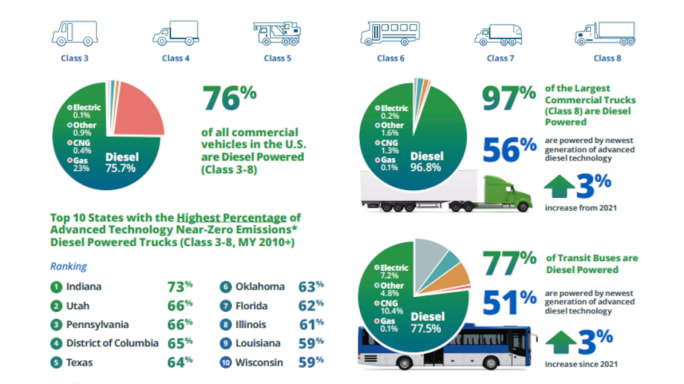
The study found that Indiana ranks first of the states for the highest percentage of registrations of 2010 and later model year near-zero emission diesel trucks (73.2%). Next in the rankings are:
Utah (66.2%)
Pennsylvania (66%)
District of Columbia (65.4%)
Texas (63.6%)
Oklahoma (62.6%)
Florida (62.3%)
Illinois (60.6%)
Louisiana (59.2%)
Wisconsin (59.1%).
California lags the national average, taking the 35th spot (51.6%).
Ad Loading...
Nevertheless, there are 125 times more new-generation advanced diesel trucks on the road in California than electric trucks.
"California has been a laggard in the past seven or eight years that we've done this research," Schaeffer told HDT. "I will say, to their credit, that they have moved up quite a bit in terms of the rate of change. But it’s no secret that if you're a trucker in California you're feeling like your business is under threat."
Schaeffer believes a higher cost of operating in California has contributed to fleets hanging on longer to some of the older technology. "Many haven't been able to invest [in newer trucks] because of the economic situation, the lack of certainty, the regulations, and for some, knowing they will have to switch to something brand new, more expensive, and more complex."
Diesel is still king and the research shows 76% of commercial vehicles in the U.S. are diesel powered vehicles.
Source: Diesel Technology Forum
Diesel Advancements
Diesel technology has fundamentally transformed over the last decade, with advancements leading to achieving near-zero emissions beginning with the 2010 model year. Its continued dominance in trucking reflects diesel’s record of continuous improvement and low-cost operati
The next milestone for advanced diesel technology is emerging in California in 2024 and other parts of the country in 2027. That next generation of diesel will further reduce NOx emissions by an additional 50-80% over current models.
Ad Loading...
No other fuel yet matches the full combination of what the newest generation of diesel technology offers, according to DTF: efficient performance, reliability, durability, low-cost operation, high market value for used products, maximum driving range, flexibility in utilization, routing, and ready access to servicing, parts and fueling throughout the nation.
Decarbonization Means More Than ZEVs
“Decarbonizing the economy will take time and require many different types of solutions for different sectors," said Schaeffer in a news release. "There isn’t a one-size or one-fuel fits all answer. In the meantime, accelerating the turnover of the existing fleet, continued improvement of internal combustion engines, and utilizing low-carbon renewable fuels is just as important as a zero-emission vehicle approach to help achieve meaningful progress toward climate goals."
"I think that we have to be careful not to put too much into the basket of all-electric, zero-emission vehicles, without giving any credibility to any other solution," Schaeffer told HDT.
"I think we're going to be surprised by the next generation of diesel engines, and the other types of internal combustion engines, like natural gas or renewable natural gas," he added, pointing out as well that renewable diesel fuel is a literally a drop-in replacement. "There's so many ways to reduce greenhouse gas emissions and help keep our economy humming without waiting for new technologies that we're not yet sure will even work. I'm excited about the future."
Diesel Still Dominates
For the largest commercial trucks (Class 8) in operation that are 2010 or later model years, 95.4% are advanced diesel technology; 2.1% are compressed natural gas, 0.3% are electric, and the remainder are gasoline or other fuels.
For the entire (Class 3-8) commercial truck population of over 15 million vehicles, 75.6% are powered by diesel, gasoline (22.9%), compressed natural gas (0.46%), other (ethanol, fuel cell, LNG, propane, 0.85%) and electric (0.09%).
Illinois is the state with the fastest-growing registration of new advanced diesel technology Class 8 commercial trucks, up 4.6% as of December 2022 as compared to 2021.
Volvo’s updated D13 promises lower emissions without sacrificing performance or fuel economy. Take a closer look at what changed inside the engine in this HDT Spotlight video.
Energy Vision estimates fleets could recover the higher purchase price of an RNG-fueled Class 8 tractor in 1.3 to 2.8 years under current fuel-price scenarios.
Calstart is now Catalyst Mobility, reflecting the nonprofit’s growing national role in clean transportation, including zero-emission trucks, infrastructure and incentive programs.
Average U.S. diesel prices have climbed to nearly $6 a gallon, surpassing the 2022 record as tight refinery capacity and Middle East disruptions keep fuel costs elevated.
Fuel delivery depends on more than what happens at the injector. For fleet, maintenance and technical professionals, looking at the full path from pump to injector can provide useful context for understanding engine performance.
The Port Authority of New York and New Jersey announced millions in incentives for zero-emission drayage trucks, yard tractors, and new charging hubs near the port.
Why do battery-electric Class 8 trucks remain so expensive? A California bill headed to Gov. Gavin Newsom would give fleets and state agencies more visibility into what manufacturers charge.
Detroit isn’t starting from scratch to meet EPA 2027 diesel emissions standards. Its Gen 6 DD13 and DD15 engines keep much of today’s platform while updating the fuel and aftertreatment systems.
California, Oregon, Washington, British Columbia and Baja California are coordinating plans for truck charging and hydrogen fueling from Canada to Mexico.
Learn more about Kenworth's T880E battery-electric vocational truck at the Paccar Technical Center, including its range, applications, upfitting considerations, and PTO options, in this HDT Spotlight video.