




Why We Need Good Driver Training
VIDEO -- Equipment Editor Jim Park recently found a truck route that reminded him of the importance of good driver training. Suspend your disbelief for a few minutes, pretend the sound of Jim's motorcycle engine is a Jake Brake, and join him for a trip down a truly hair-raising hill.

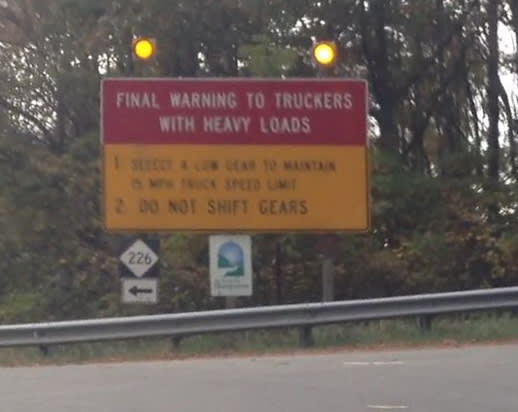
The prospect of descending the Montreal River Hill, to the north and west of Sault Ste. Marie on Ontario's Hwy 17, used to terrify me. Before I had really cut my teeth in trucking, I had heard all the old-timers' tales of coming down that hill backwards on sheer ice, dodging the moose as they went. (While it's true the hill has a nasty habit of icing up dangerously in the spring and fall, I doubt any actually went down the hill backwards. Sideways, maybe. It's a stinky bit of road.)
Back then, in the early 1980s, I was driving a mid-70s-vintage Freightliner COE pulling A-train double tankers. Wiggle-wagons and icy hills give even the best drivers heartburn. I had a couple of years of experience, and that was before ABS -- and the truck did not have an engine brake.
That I'm writing this indicates I made it down in one piece, and over the years there have been many more hills like it: Donner Pass, The Grapevine, Loveland Pass, British Columbia's Hwy 3, the Fraser River Canyon and The Coquihalla Highway, I-80 east of Salt Lake City ...
I once took my chances on a mountain pass in West Virginia, going over one of the tunnels on I-77. I had a flammable load in a tanker and didn't want to run 70 miles off route -- and unpaid -- to get around the tunnel. Going over it seemed like a good alternative. Likewise, that I'm writing this ...
I had the benefit of a few very good drivers teaching me the craft of trucking. Exposure to big hills was limited in my journeyman days, but there were a few where I learned that I shouldn't trust my engine brake on a big hill at 50 mph. I was advised to run hills at no more than half the posted speed limit, or about the same speed and gear I'd use to climb the hill.
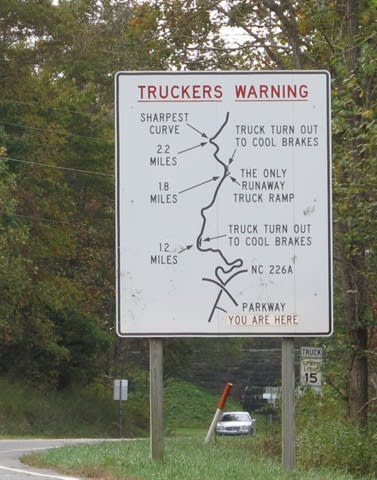
That advice has served me well over the years. That I'm writing this ... But there were moments when I wished I was in Kansas rather than British Columbia. Like they say in aviation, it's better to be on the ground wishing you were flying than the other way around.
Which brings me to our featured video. I shot this in October while on a motorcycle tour of the Blue Ridge Parkway in Virginia and North Carolina. I had spent a night in a cool old motel near Spruce Pine, N.C., just off the parkway. Just around the corner from the motel was this big red-and-yellow sign warning truckers of the dangers of a steep and winding road, N.C. Route 226.
Since steep winding hills are made for motorcycles, I decided to check it out. It was a serious hill, and also a truck route. Descending the hill, I started thinking about how a driver with a heavy load would handle such a hill. It would be taxing, indeed. I decided to run the hill a second time with my iPhone camera jammed behind my windshield to record the trip.
Upon reviewing the video, I thought it would make a good example of how a driver, like me in the early days, could get himself into some serious trouble by not heeding the warnings. I narrated the video from the imaginary perspective of just such a driver.
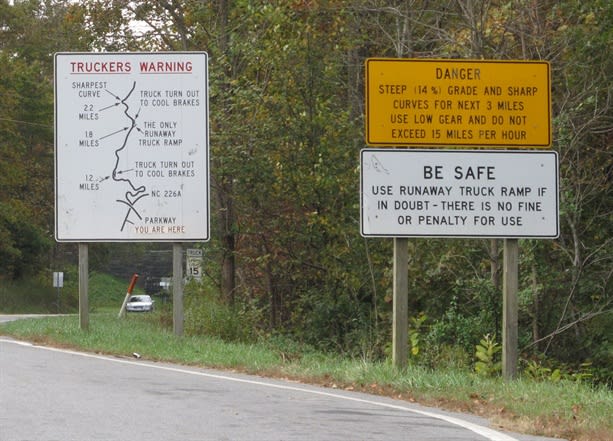
Suspend your disbelief for a few minutes, pretend the sound of my motorcycle engine is a Jake Brake, and join me for a trip down a truly hair-raising hill. It's a 3-mile ride on a 14% grade with two hairpin 180-degree turns and a bunch of less threatening curves. It's narrow, too, and the drop-off is dramatic.
Roads like this are no place for rookie drivers to learn hill driving techniques, but I can't imagine how schools in Kansas, Nebraska or Indiana could possibly prepare drivers for such an experience.
More Blog Posts

Truck Driver’s Dilemma: Click, Twist or Swipe?
Whether 'tis safer to twist a knob or press a button than to swipe right then swipe down to scan the menu for your favorite playlist...? That's a question for the age.
Read More →
Even the Swedes are Doing Turnpike Doubles
The government doesn't seem to mind asking trucking to invest a trillion dollars toward a greener future. But they won't let us pull turnpike doubles making 30% less CO2. Which is insanity, says HDT's Jim Park in his On the Road blog.
Read More →
Is Your Recruiting Message on Point?
How does your recruiting and retention messaging compare with the reality at your company? Would your drivers agree with your own assessment? Jim Park explores those questions in his On the Road blog.
Read More →
You Can’t Blame Trucks for the Highland Rest Area Bus Crash [Commentary]
The causes of the Highland Park rest area crash go far beyond the parking shortage and the need for flexibility in hours of service — but those issues must be addressed, too, says Jim Park in his On the Road blog.
Read More →
Electric Trucks Seem Far Down the Road for Fleets Dealing with Today's Maintenance Challenges
While the push for zero-emissions trucks rings clear for regulators, advocates and even a small crowd of suppliers, ZEVs seem to have run out of steam down on Main Street, says HDT Equipment Editor Jim Park in his latest On the Road blog.
Read More →
Guinea Pigs 2.0: Can Trucking Comply with a Near Impossible NOx Reduction?
The EPA’s Final Rule on NOx reduction will be incredibly difficult if not nearly impossible for trucking to comply with. Rather than endure another round of equipment failures, downtime and loss of customer faith, industry needs to rally ‘round the OEMs and seek a solution to this wrong-headed rule.
Read More →
Is Downspeeding Bad for Brakes?
Is there a connection between downsped drivetrains and increased brake wear? There shouldn’t be. Downsped fleets seeing increased brake wear are probably not letting the technology do its job, explains HDT Equipment Editor Jim Park.
Read More →
Dig for the Gold Behind CVSA’s Out-of-Service Numbers
Published out-of-service rates don’t mean much until you dig into the why. With brake problems consistently placing in two of the top five spots, maybe we’re missing something in brake maintenance, writes HDT Equipment Editor Jim Park.
Read More →
Things That Go Poof in the Night
We’re in electric-truck heydays now. But like another famous heyday, the 1849 California Gold Rush, there will be a lot fewer winners than losers, says Jim Park in his On the Road blog.
Read More →
Do Your Truck Drivers Know How to Descend a Mountain Grade?
Where do drivers learn mountain-driving techniques? It's sure not from the typical state CDL manual. Jim Park shares what he learned following a deadly 2019 Colorado crash.
Read More →