




Whaddya Think of Those Canucks, Eh?
For the second time, two Canadian truckload fleets earned top honors in the Truckload Carriers Association National (maybe it should be International?) Fleet Safety Awards. In his "On the Road" blog, Jim Park muses on whether Canadian truckers have a leg up in safety, despite longer work days and bigger rigs.

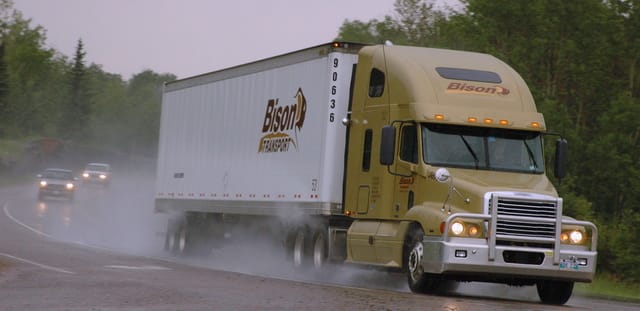
Bison Transport, based in Winnipeg, Manitoba, took top honors in the over 25 million annual miles category.
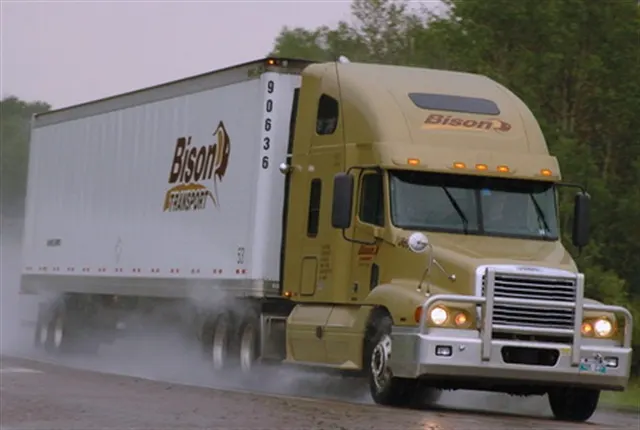
Bison Transport, based in Winnipeg, Manitoba, took top honors in the over 25 million annual miles category.
For the second time, two Canadian truckload fleets earned top honors in the Truckload Carriers Association National (maybe it should be International?) Fleet Safety Awards.
Bison Transport, based in Winnipeg, Manitoba, took top honors in the over 25 million annual miles category, while Brian Kurtz Trucking of Breslau, Ontario, grabbed the brass ring in the fewer than 25 million annual miles category.
I'm not sure simply being Canadian is enough to push these two fleets to such exalted levels. Both are extremely well run companies, one considerably smaller than the other, but both with cultures and missions that put safety ahead of almost everything else.
Bison is a pioneering company in Canada's bourgeoning LCV (turnpike doubles programs) and the first carrier in the country to participate in trial runs in Saskatchewan's triple-53-foot trailer program. They wouldn't get that assignment by being a name drawn from of a hat. The award handed down by TCA in March confirms Bison's commitment to safety. Bison placed 9th on Today's Trucking magazine's Top 100 carriers list this year, with 1,208 tractors, 3,561 trailers and 429 owner-operators. By U.S. standards, Bison is a mid-sized company at best.
For the record, Bison Transport is now a four-time winner of the 25 million mile category, earning the title in 2007, '10, '11 and '12. BKT is now a two-time winner, having previously claimed top spot in 2011.
Brian Kurtz Trucking remains a family-owned and operated company, with about 50 tractors, fewer than 100 trailers and a handful of owner-operators. BKT wasn't even close to the TT Top 100 list, with the smallest company showing 288 tractors and 192 trailers. Still, they run spotless equipment, have a loyal driver force and never get their name in the paper for the wrong reasons.
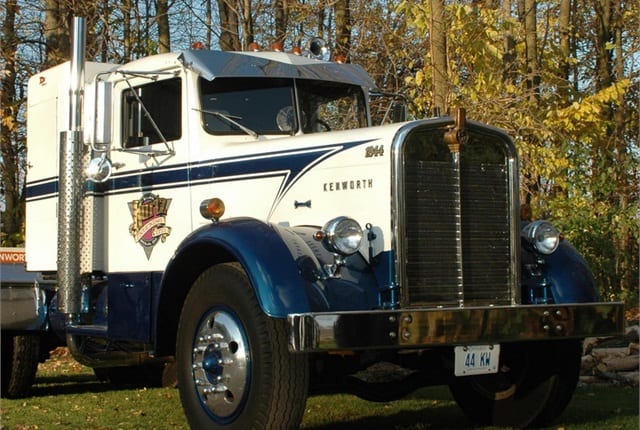
Not a working part of the Brian Kurtz fleet, this splendid 1944 Kenworth was restored in-house, and regularly appears at local truck shows.
That these two winning fleets are Canadian is academic in this context. They could be based in Phoenix or Kenosha, as long as the focus on a dedication to safety remained, it really wouldn't matter where they were based.
But there is an interesting footnote to this year's National Fleet Safety Awards; of the 18 fleets listed as finalists, four were from north of the border.
On top of that, in recent CVSA Roadcheck and Operation Airbrake exercises, Canadians had lower violation and out-of-service rates in both driver and vehicle categories. The margin was slim in most cases -- a couple of percentage points or so -- but the difference was noticeable in the scores.
That fact would probably escape notice too, except that Canadian fatal crash rates per million miles are lower than the American rates and it accomplishes that with significantly heavier trucks and significantly longer work hours for drivers. Those, the so-called safety advocates would have us believe, are the devil's own work and cannot be allowed to gain a foothold on U.S. highways.
Despite the politically charged nature of the debate on HOS and size and weight rules in the U.S., it's pretty clear that Canada's experience with both have not hurt the country's fleets' safety records. Clearly, pulling 137,000 pounds around for 13 hours a day doesn't put any undue stress on drivers or equipment or the country's National Highway System -- some of which is little better than a goat path in comparison to the Interstates we enjoy here.
It's also worth noting that three of the four Canadian semi-finalist fleets are could be considered heavy-haulers, that is, they run 6-axle combos loaded to 105,000 pounds, and even larger 7- and 8-axle combos.
Improved efficiency is nothing to fear. Nor, apparently, does it get in the way of a winning safety record.
More Blog Posts

Truck Driver’s Dilemma: Click, Twist or Swipe?
Whether 'tis safer to twist a knob or press a button than to swipe right then swipe down to scan the menu for your favorite playlist...? That's a question for the age.
Read More →
Even the Swedes are Doing Turnpike Doubles
The government doesn't seem to mind asking trucking to invest a trillion dollars toward a greener future. But they won't let us pull turnpike doubles making 30% less CO2. Which is insanity, says HDT's Jim Park in his On the Road blog.
Read More →
Is Your Recruiting Message on Point?
How does your recruiting and retention messaging compare with the reality at your company? Would your drivers agree with your own assessment? Jim Park explores those questions in his On the Road blog.
Read More →
You Can’t Blame Trucks for the Highland Rest Area Bus Crash [Commentary]
The causes of the Highland Park rest area crash go far beyond the parking shortage and the need for flexibility in hours of service — but those issues must be addressed, too, says Jim Park in his On the Road blog.
Read More →
Electric Trucks Seem Far Down the Road for Fleets Dealing with Today's Maintenance Challenges
While the push for zero-emissions trucks rings clear for regulators, advocates and even a small crowd of suppliers, ZEVs seem to have run out of steam down on Main Street, says HDT Equipment Editor Jim Park in his latest On the Road blog.
Read More →
Guinea Pigs 2.0: Can Trucking Comply with a Near Impossible NOx Reduction?
The EPA’s Final Rule on NOx reduction will be incredibly difficult if not nearly impossible for trucking to comply with. Rather than endure another round of equipment failures, downtime and loss of customer faith, industry needs to rally ‘round the OEMs and seek a solution to this wrong-headed rule.
Read More →
Is Downspeeding Bad for Brakes?
Is there a connection between downsped drivetrains and increased brake wear? There shouldn’t be. Downsped fleets seeing increased brake wear are probably not letting the technology do its job, explains HDT Equipment Editor Jim Park.
Read More →
Dig for the Gold Behind CVSA’s Out-of-Service Numbers
Published out-of-service rates don’t mean much until you dig into the why. With brake problems consistently placing in two of the top five spots, maybe we’re missing something in brake maintenance, writes HDT Equipment Editor Jim Park.
Read More →
Things That Go Poof in the Night
We’re in electric-truck heydays now. But like another famous heyday, the 1849 California Gold Rush, there will be a lot fewer winners than losers, says Jim Park in his On the Road blog.
Read More →
Do Your Truck Drivers Know How to Descend a Mountain Grade?
Where do drivers learn mountain-driving techniques? It's sure not from the typical state CDL manual. Jim Park shares what he learned following a deadly 2019 Colorado crash.
Read More →