




Trucking in Japan
Having returned from my first trip to Japan just over a week ago, I'm still marveling at the differences between North America and that geographically small island nation. From a trucking perspective, there is almost no comparison.
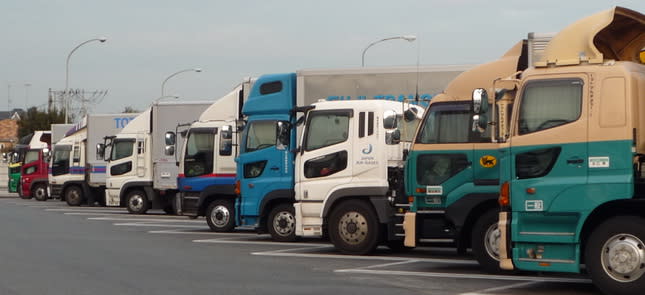
Having returned from my first trip to Japan just over a week ago, I'm still marveling at the differences between North America and that geographically small island nation. From a trucking perspective, there is almost no comparison.
For a little perspective, Japan is an archipelago of nearly 7,000 islands. The four largest islands -- Honshu, Hokkaido, Kyushu and Shikoku -- together account for 97 percent of Japan's land area. Most of the islands are mountainous; many are volcanic. The largest island, Honshu, is home to Tokyo, which is home to more than 30 million people. The City of Tokyo proper claims a population of about 12 million, the remainder live in the surrounding areas known as Greater Tokyo -- the largest metropolitan area in the world.
The island of Honshu is roughly 800 miles long and ranges from 30 to 130 miles wide. Its total land area is about 88,000 square miles -- roughly the same as the State of Minnesota.
I was told that only about four percent of the land on the island is inhabited. Even if you're blessed with only the tiniest bit of imagination, I'm sure you can envision a population that size stuffed into such a small territory.
I was in Japan as an invited guest of Hino Motors. During my stay, I visited two of the company's manufacturing plants, one in Hamura, the other in Hino City. Both were about 45 minutes from central Tokyo by bus (about 25 miles as the crow flies), and for the entire trip, we were in a dense urban environment -- houses and stores and factories and offices were crammed together with apparently little regard for zoning requirements. Streets, some little more than alleyways, darted off in every direction from the two- and four-lane arteries the bus traveled.
There are expressways all over Tokyo; mostly two-lanes in each direction and many elevated, sometimes three and four tiers high. At one point during a trip across town, we exited an elevated expressway and I noticed that the roadway wound around several tall buildings. At that point, we were six stories above ground level.
The main city streets are as you'd expect in any big city, but one needn't go far to find one of the alley-sized streets crammed with shops and restaurants and houses. It's to those little establishments that trucks must deliver the goods.
Sized for the Job
The trucks that serve these markets are tiny by North American standards. I saw many of them sitting in parking stalls designed for cars, and there was room to spare. The cargo boxes are no more than 6 feet square, and I'm told many of those trucks will make three deliveries a day to the same customer. They can't take any more because the truck just won't fit down the street.
To give you an idea of how tight space is, I saw a column of pint-sized Class 5 concrete mixers waiting to make deliveries on of those pint-sized side streets. There were four single-axle trucks on 16-inch wheels fitted with drums could not have held more than 1.5 yards of concrete. Not very efficient, one might argue, but certainly better than using a wheelbarrow, which might be the only alternative.
Most of the delivery trucks I saw were of the Class 6 variety; two axles with 16- to 20-foot boxes -- very common here in North America. But these trucks use smaller wheels and so the box sits closer to the ground. Also, most of the boxes open from the side as well as the rear. Since many of the deliveries are made at curb side, its makes a great deal of sense that the driver can reach into the box from the sidewalk. Nobody parks on the main streets in Tokyo, so trucks have easy access to their delivery points.
One of our hosts told me that when buying a car in Tokyo, you must first produce proof that you have a place to park it before you'll get the registration and tags.
But not everything is small in Japan. The concrete mixer in the photo is a full-sized Class 8 with a 28,300 kg GVW (62,400-pound) weight rating. A step up from this one is the 8X4 chassis, with a tandem drive and independently sprung twin steer axles. That set up is good for 32,000 kg GVW (71,800 pounds). Many of the big "long-haul" freight carriers use that set up. I'm not sure if they are licensed to haul that weight, but that's what they are built for.
Tractor-trailers are on the rare side in Japan. I heard that single- and tandem-axle tractors account for less than 5 percent of Hino's domestic sales. I saw several while I was there, mostly hauling marine containers and fuel tankers. There were a few freight haulers and some specialty heavy-haulers, but their access to the bowels of the city would be very limited.
A Few Interesting Bits
Aside from the freeways (all tolled) and the main arteries, few of the streets in Tokyo have names. Our bus driver told me -- through our translator -- that people navigate by landmarks. There is a system of postal districts with formal names that you can navigate to, but once there, you're on your own. Some buildings have addresses, but they are not numbered sequentially along the street. Instead, the address is more likely to reflect the time the building was built. The older building, the lower the number.
Long-haul trucking in Japan is likely to mean a trip of no more than one or two days.
Much of the freight moves into and out of Tokyo, rather than going cross-country, which cuts down on the length of haul. Trains and ferries move a lot of cargo to and from the two islands to the north and south of Honshu -- Hokkaido and Kyushu respectively. The Akashi-Kaikyo Bridge, also known as the Pearl Bridge, links the mainland with the southern island city of Kobe. It boasts the longest central span of any suspension bridge in the world, at 6,532 feet.
The highway trucks have small bunks behind the seat, but they are only about 16 inches wide. A truck like the one pictured above has a wider bunk built above the cab. The driver has to crawl through a hole in the ceiling to get into it. The cargo boxes are huge -- up to 30 feet in length. Those trucks are about the size of tour buses.
Truck drivers are highly regarded in Japan because of the rigorous training and testing process the drivers go through. I wasn't able to determine how long the training period is, but wage scales seem similar to the U.S. Statistics from Japan's Ministry of Health, Labor and Welfare in 2008 place truck drivers earnings somewhere between construction workers, and those in the manufacturing sectors. Like here, white collar jobs seem to pay better than blue collar occupations.
Truckers do, however, have a badge of honor of sorts. Many of them wear white gloves as a symbol of their professionalism.
I found Japan to be a fascinating place, though I barely made a scratch on a dent in the surface of the land and its people. The lack of street names is baffling to my western mind, but they seem to have it figured out. I was astounded, too, but the civility of the place. The drivers weren't aggressive, people on the streets weren't pushy, and for a city its size, it was surprisingly quiet at street level. No Harleys, no little-fart mufflers on the imported cars, no horns blowing, and no barking engine brakes. Now I'd like to see the country beyond the city.
To my Japanese hosts, domo arigato gozaimas!
More Blog Posts
Truck Driver’s Dilemma: Click, Twist or Swipe?
Whether 'tis safer to twist a knob or press a button than to swipe right then swipe down to scan the menu for your favorite playlist...? That's a question for the age.
Read More →
Even the Swedes are Doing Turnpike Doubles
The government doesn't seem to mind asking trucking to invest a trillion dollars toward a greener future. But they won't let us pull turnpike doubles making 30% less CO2. Which is insanity, says HDT's Jim Park in his On the Road blog.
Read More →
Is Your Recruiting Message on Point?
How does your recruiting and retention messaging compare with the reality at your company? Would your drivers agree with your own assessment? Jim Park explores those questions in his On the Road blog.
Read More →
You Can’t Blame Trucks for the Highland Rest Area Bus Crash [Commentary]
The causes of the Highland Park rest area crash go far beyond the parking shortage and the need for flexibility in hours of service — but those issues must be addressed, too, says Jim Park in his On the Road blog.
Read More →
Electric Trucks Seem Far Down the Road for Fleets Dealing with Today's Maintenance Challenges
While the push for zero-emissions trucks rings clear for regulators, advocates and even a small crowd of suppliers, ZEVs seem to have run out of steam down on Main Street, says HDT Equipment Editor Jim Park in his latest On the Road blog.
Read More →
Guinea Pigs 2.0: Can Trucking Comply with a Near Impossible NOx Reduction?
The EPA’s Final Rule on NOx reduction will be incredibly difficult if not nearly impossible for trucking to comply with. Rather than endure another round of equipment failures, downtime and loss of customer faith, industry needs to rally ‘round the OEMs and seek a solution to this wrong-headed rule.
Read More →
Is Downspeeding Bad for Brakes?
Is there a connection between downsped drivetrains and increased brake wear? There shouldn’t be. Downsped fleets seeing increased brake wear are probably not letting the technology do its job, explains HDT Equipment Editor Jim Park.
Read More →
Dig for the Gold Behind CVSA’s Out-of-Service Numbers
Published out-of-service rates don’t mean much until you dig into the why. With brake problems consistently placing in two of the top five spots, maybe we’re missing something in brake maintenance, writes HDT Equipment Editor Jim Park.
Read More →
Things That Go Poof in the Night
We’re in electric-truck heydays now. But like another famous heyday, the 1849 California Gold Rush, there will be a lot fewer winners than losers, says Jim Park in his On the Road blog.
Read More →
Do Your Truck Drivers Know How to Descend a Mountain Grade?
Where do drivers learn mountain-driving techniques? It's sure not from the typical state CDL manual. Jim Park shares what he learned following a deadly 2019 Colorado crash.
Read More →