




Trucking down the glass highway
Glass highway? Does that have something to do with electronic dashboards, as in the Glass Cockpit concept in modern aircraft? Nope, we're talking about roadways made of glass. But you're not far off on the electronic angle
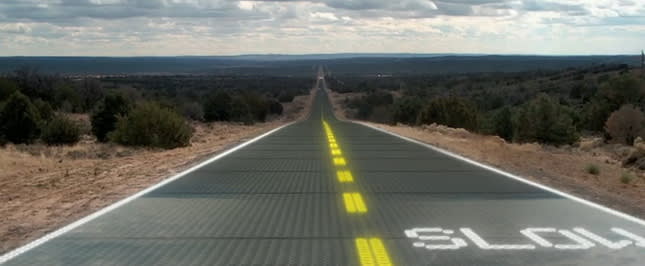
A highway that produces electricity and delivers messages to drivers? It's already in the prototype stage.
Glass highway? Does that have something to do with electronic dashboards, as in the Glass Cockpit concept in modern aircraft? Nope, we're talking about roadways made of glass. But you're not far off on the electronic angle.
Paved road surfaces have been around for thousands of years, but the basic construction technique and the materials used haven't changed much in the last 100 years.
The ancient Romans are credited with building the first paved roads using tightly fitted blocks of stone. Some of those roads, the Appian Way in Rome for example, have survived more than 2,000 years. Roman city streets, with their curbstones and elevated sidewalks, became the basis for today's street designs.
According to www.curbstone.com, The first recorded "paved" road in America dates back to 1625, and is said to be in Permaquid, Maine. It is now called Colonial Pemaquid Drive. In 1795, the Philadelphia to Lancaster turnpike became the first "engineered" road in America -- and it was a toll road.
In the early 1800s, a pair of Scots, Thomas Telford and John Loudon McAdam pioneered road building techniques that are still used today. using an underlay of stones of various sizes laid in symmetrical, tight patterns and covered with compacted surface of much smaller stones and sand. That technique became what we today call a macadam road. Telford gets credit for raising the foundation of the road in the center so water could drain off to the sides, making them less susceptible to puddles and rutting.
The first macadam surface in the United States was laid in 1823 on the Boonsborough Turnpike Road between Hagerstown and Boonsboro, Maryland.
Road builders enhanced the macadam technique using what was the forerunner of cement as a surface. Spraying stone dust with water improved its binding ability, creating a more durable surface. Later, a bitumen-based tar replaced water as the binder, becoming the forerunner of modern asphalt. That technique was called tarmacadam. The word was later shortened to the now familiar "tarmac." In 1854, The Champs-Elysee in Paris became first tarmac road ever built.
The first American uses of road asphalt were in Battery Park and on Fifth Avenue in New York City in 1872, and on Pennsylvania Avenue, Washington D.C., in 1877. On July 4th, 1909, Detroit's Woodward Avenue between 6 Mile and 7 Mile Roads became the nation's first mile of concrete pavement.
Today there are more than 2.7 million miles of paved roads in the U.S. At $1,000 a ton for liquid asphalt, imagine what it could cost to repave all those roads?
If the price of oil continues to rise, or if the stuff becomes precious enough as we come closer to exhausting the supply, we'll be scrambling for new materials for road construction. So, why not glass?
It's easy and inexpensive to manufacture, the raw materials are in abundant supply, and suitably engineered glass roads could also generate enough electricity to power every town and city in the country.
Sound far fetched? Check out the video below and then tell me its impossible.
Scott Brusaw, the co-originator of the Glass Highway concept already has a working prototype, and will soon begin installing test patches in parking lots.
There's still work to be done, but this idea is rife with potential.
Highway construction techniques haven't changed much in 100 years; the time might be right for a truly revolutionary concept. Check out the video before you dismiss the idea.
http://youtu.be/Ep4L18zOEYI
More Blog Posts

Truck Driver’s Dilemma: Click, Twist or Swipe?
Whether 'tis safer to twist a knob or press a button than to swipe right then swipe down to scan the menu for your favorite playlist...? That's a question for the age.
Read More →
Even the Swedes are Doing Turnpike Doubles
The government doesn't seem to mind asking trucking to invest a trillion dollars toward a greener future. But they won't let us pull turnpike doubles making 30% less CO2. Which is insanity, says HDT's Jim Park in his On the Road blog.
Read More →
Is Your Recruiting Message on Point?
How does your recruiting and retention messaging compare with the reality at your company? Would your drivers agree with your own assessment? Jim Park explores those questions in his On the Road blog.
Read More →
You Can’t Blame Trucks for the Highland Rest Area Bus Crash [Commentary]
The causes of the Highland Park rest area crash go far beyond the parking shortage and the need for flexibility in hours of service — but those issues must be addressed, too, says Jim Park in his On the Road blog.
Read More →
Electric Trucks Seem Far Down the Road for Fleets Dealing with Today's Maintenance Challenges
While the push for zero-emissions trucks rings clear for regulators, advocates and even a small crowd of suppliers, ZEVs seem to have run out of steam down on Main Street, says HDT Equipment Editor Jim Park in his latest On the Road blog.
Read More →
Guinea Pigs 2.0: Can Trucking Comply with a Near Impossible NOx Reduction?
The EPA’s Final Rule on NOx reduction will be incredibly difficult if not nearly impossible for trucking to comply with. Rather than endure another round of equipment failures, downtime and loss of customer faith, industry needs to rally ‘round the OEMs and seek a solution to this wrong-headed rule.
Read More →
Is Downspeeding Bad for Brakes?
Is there a connection between downsped drivetrains and increased brake wear? There shouldn’t be. Downsped fleets seeing increased brake wear are probably not letting the technology do its job, explains HDT Equipment Editor Jim Park.
Read More →
Dig for the Gold Behind CVSA’s Out-of-Service Numbers
Published out-of-service rates don’t mean much until you dig into the why. With brake problems consistently placing in two of the top five spots, maybe we’re missing something in brake maintenance, writes HDT Equipment Editor Jim Park.
Read More →
Things That Go Poof in the Night
We’re in electric-truck heydays now. But like another famous heyday, the 1849 California Gold Rush, there will be a lot fewer winners than losers, says Jim Park in his On the Road blog.
Read More →
Do Your Truck Drivers Know How to Descend a Mountain Grade?
Where do drivers learn mountain-driving techniques? It's sure not from the typical state CDL manual. Jim Park shares what he learned following a deadly 2019 Colorado crash.
Read More →