




Silent Running
I had my first drive in an all-electric vehicle recently. I'm not sure, in the long run, if industry will accept this technology as an alternative to diesel-powered trucks, but plug-in trucks are certainly worth watching
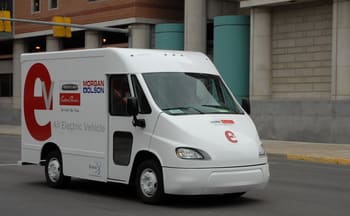
Under the right conditions, electric trucks will run up to 100 miles on a charge, or at least a day's driving in an urban stop 'n' go duty cycle.
I had my first drive in an all-electric vehicle recently. I'm not sure, in the long run, if industry will accept this technology as an alternative to diesel-powered trucks, but plug-in trucks are certainly worth watching.
While at the NTEA Work Truck show in Indianapolis in March, members of the trade media and prospective customers were invited to test drive an assortment of alternative-power vehicles ranging from full-electric and hydraulic and electric hybrids to LNG/CNG, and propane powered trucks. There's little doubt diesel will some day be replaced as the main source of motive power for many medium- and light-duty, urban-duty-cycle trucks, like P&D bodies, curbside vans and small package delivery vans. The $64 million question is which alternate power source will prevail.
In all likelihood, each fuel -- and probably others -- will find a place in the market, depending on the application. Vehicles like this and their power systems are very application dependent.
I had a chance to drive three all-electric trucks at NTEA: a Freightliner Custom Chassis Corp. MT45-EV walk-in van (pictured above), A Smith Newton cargo van chassis (minus the cargo box), and International's E-Star curbside van.
Each was a combination of electric plug-in and electric series hybrid, meaning they had batteries that had to be plugged into a 220-volt source for their initial charge, but they also have the capability of recovering energy through regenerative braking. While decelerating, the drive wheels spin the motor/generator sending current back into the on-board batteries, thus prolonging the charge. Under the right conditions, they'll run up to 100 miles on a charge, or at least a day's driving in an urban stop 'n' go duty cycle.
At this stage of their development, there were differences in the driver displays and start-up and shut-down procedures, but everything else from the operator's perspective is remarkably similar to a traditionally powered vehicle, except the noise. There was no noise -- and that poses some problems from a pedestrian safety point of view -- but regulators are already working on that.
The vehicles were peppy to say the least. The thing with electric motors -- compared to diesel -- is they will produce 100 percent of their possible torque output at any rpm, even from a dead stop. They are very quick to accelerate, and they will hold their own up to about 30 mph. A diesel would probably overtake them at that point as horsepower begins to take over from torque, but in the city, where are you going to get much above 30 mph?
While decelerating -- with the help of the regenerative braking system -- the energy needed to charge the batteries comes from the momentum of the vehicle. The retarding power of this system is quite remarkable, and it's bound to save operators a ton of money on brake maintenance over the life of the vehicle. It's much like a compression brake, but without the noise.
The vehicles are designed so that weight distribution is similar to a typical engine-powered vehicle. The batteries are up front where the engine used to be, thus adding considerable weight to the forward part of the vehicle. The motor/generator is located around the middle of the vehicle where the transmission would be. They feel quite "natural."
A couple of manufacturers have even programmed in "creep torque" similar to what a driver would experience with an automatic transmission in drive. Just a slight bit of forward movement while in gear with the brake released. Again, totally natural in feel.
The real treat, of course, is that it's totally silent except for a faint whine from the motor. That's bound to improve a driver's state of mind at the end of a long day behind a loud diesel.
These trucks weren't designed for highway use, or even for intercity use. Primarily they will work on city routes where the mileage and on-time are predictable and within the duty-cycle parameters. At night, they are parked against the fence and plugged in for about 10 hours to gain a full charge for the next day's work. I can see these working splendidly for fleets like FedEx and UPS where loads are reasonable and driving time is minimal.
Heaters and air conditioning are all electric too, as are the rest of the vehicle systems, so care has to be taken not to tax the battery excessively, but I'm told at current evolution, the batteries can tolerate moderate electrical loads in addition to driving the vehicle.
The batteries are currently heavy and expensive -- very expensive. So much so that the technology could hardly be called commercially viable right now, but that's now. Given the right incentives to spur uptake, thus driving production scales upwards, the battery costs are bound to come down. And as battery technology improves, smaller, lighter batteries might be sufficient where large heavy ones are needed today.
Among the other advantages is reduced vehicle maintenance, particularly oil changes and brake service. One of the representatives told me there are dozens of moving parts on these vans as opposed to thousands of moving parts on a conventionally powered truck. That'll help keep costs down, and eliminating fluid changes will keep that much oil, lube and coolant out of the waste stream.
What can I really tell from a 10-minute spin around downtown Indianapolis? That downtown is where these vehicles belong. They aren't designed for high-speed driving, and over-the-road driving doesn't offer the stopping cycles needed for recharging the batteries. Dozens of these vans are already in customer hands for real-world testing and evaluation, and so far, I'm told, they are working out well.
If there's a downside, I think it's the silence. Regulators will require some kind of artificial sound source to warn pedestrians, especially the visually impaired, of the approach or proximity of these types of vehicle -- electric cars included. It could be synthesized engine sounds, or god forbid, beeps like they make now when going backwards. I hope common sense prevails here. But I can't help wondering if they'll synthesize Jake brake sounds for the deceleration cycle.
Hey, maybe there's an idea for all those Billy Big Riggers who insist on leaving the engine brake on in the city, straight pipes and all. Now that DPFs are required we won't hear the Jakes any more -- until somebody figures out how to get the synthesized Jake sounds to play through the truck's sound system so the guy inside -- and only the guy inside -- can enjoy it.
More Blog Posts
Truck Driver’s Dilemma: Click, Twist or Swipe?
Whether 'tis safer to twist a knob or press a button than to swipe right then swipe down to scan the menu for your favorite playlist...? That's a question for the age.
Read More →
Even the Swedes are Doing Turnpike Doubles
The government doesn't seem to mind asking trucking to invest a trillion dollars toward a greener future. But they won't let us pull turnpike doubles making 30% less CO2. Which is insanity, says HDT's Jim Park in his On the Road blog.
Read More →
Is Your Recruiting Message on Point?
How does your recruiting and retention messaging compare with the reality at your company? Would your drivers agree with your own assessment? Jim Park explores those questions in his On the Road blog.
Read More →
You Can’t Blame Trucks for the Highland Rest Area Bus Crash [Commentary]
The causes of the Highland Park rest area crash go far beyond the parking shortage and the need for flexibility in hours of service — but those issues must be addressed, too, says Jim Park in his On the Road blog.
Read More →
Electric Trucks Seem Far Down the Road for Fleets Dealing with Today's Maintenance Challenges
While the push for zero-emissions trucks rings clear for regulators, advocates and even a small crowd of suppliers, ZEVs seem to have run out of steam down on Main Street, says HDT Equipment Editor Jim Park in his latest On the Road blog.
Read More →
Guinea Pigs 2.0: Can Trucking Comply with a Near Impossible NOx Reduction?
The EPA’s Final Rule on NOx reduction will be incredibly difficult if not nearly impossible for trucking to comply with. Rather than endure another round of equipment failures, downtime and loss of customer faith, industry needs to rally ‘round the OEMs and seek a solution to this wrong-headed rule.
Read More →
Is Downspeeding Bad for Brakes?
Is there a connection between downsped drivetrains and increased brake wear? There shouldn’t be. Downsped fleets seeing increased brake wear are probably not letting the technology do its job, explains HDT Equipment Editor Jim Park.
Read More →
Dig for the Gold Behind CVSA’s Out-of-Service Numbers
Published out-of-service rates don’t mean much until you dig into the why. With brake problems consistently placing in two of the top five spots, maybe we’re missing something in brake maintenance, writes HDT Equipment Editor Jim Park.
Read More →
Things That Go Poof in the Night
We’re in electric-truck heydays now. But like another famous heyday, the 1849 California Gold Rush, there will be a lot fewer winners than losers, says Jim Park in his On the Road blog.
Read More →
Do Your Truck Drivers Know How to Descend a Mountain Grade?
Where do drivers learn mountain-driving techniques? It's sure not from the typical state CDL manual. Jim Park shares what he learned following a deadly 2019 Colorado crash.
Read More →