




Saskatchewan to try out triple LCVs
As the debate over longer and heavier trucks simmers in this country, to our north, the Canadian province of Saskatchewan is about to begin a pilot project that will see triple 53-foot trailers in turnpike configuration operated on limited routes
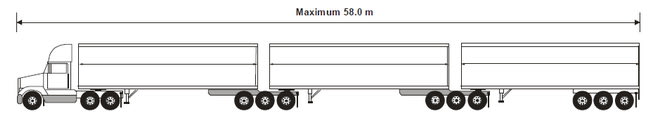
As the debate over longer and heavier trucks simmers in this country, to our north, the Canadian province of Saskatchewan is about to begin a pilot project that will see triple 53-foot trailers in turnpike configuration operated on limited routes.
A few months ago, news emerged from Saskatchewan of a pilot project that will allow triple LCVs to operate between the cities of Regina and Saskatoon (a distance of about 160 miles). They will measure nearly 200 feet in length, and tip the scales at more than 200,000 pounds. How's that for efficient?
There will be certain restrictions on their operation -- during the test phase anyway. They will be allowed only on Hwy 11 between Regina and Saskatoon, and just between designated drop yards. They will be allowed to operate only from 9:00 PM until 6:00 AM, and only when the weather is suitable.
They will be limited to 55 mph, and must use four-way flashers if road speed drops 25 mph below the posted speed limit. They must be staged in such a way that the trailer weights are equal or decreasing from the front trailer to the rear.
And they must be in B-train configuration.
The B-train configuration is key. It's a Canadian invention, and it's incredibly stable and maneuverable. In fact, an experienced driver can easily alley dock a typical 75-foot two-trailer B-train. When I felt like impressing somebody, I'd parallel park one.
As you can see in the illustration above, each appropriately equipped trailer has a sliding bogey that slides up under the rear of the trailer when it's set up as a regular trailer. When it slides out for B-train operation, there's a fifth-wheel mounted at the rear of the bogey. The second trailer hooks directly to the first trailer, giving you two articulation points in a two-trailer set up rather than three as is the case here with doubles.
These triple LCV units will be reversible to a limited extent, but while moving forward they won't wiggle around like the A-train triples in common use here, and in a turn the rear trailer will track on a radius very similar to the lead trailer.
Vehicle and Administrative Requirements
Among the sensible mechanical requirements for the triple LCVs are an engine capable of pulling the load, brake booster valves to ensure proper application and release timing, an air compressor capable of keeping up with the demand of as many as 22 air springs and 24 brake chambers, anti-lock brakes, and a device to record vehicle speed -- probably an EOBR of some description.
The drivers who will pull these things must have a minimum two years experience or 90,000 miles on LCVs, no more than two moving violations in the prior 12 months and no more than three in the prior 36 months, and they must have completed an LCV training course.
Carriers wishing to get into the pilot program will have to pay a $2,000 fee, and pass a pre-entry compliance audit. Detailed records of all trips must be kept for a period of two years.
Once the pilot project is complete, the province will assess safety concerns, public opinion, and other factors before opening more lanes to more carriers.
The Current Canadian Situation
Canada has historically had much more liberal axle and gross weight allowances than the U.S., but it lagged behind in the adoption of Long Combination Vehicles (LCV) configurations. Over the past decade, however, most provinces have introduced legislation allowing LCVs on limited routes. They are legal now in most parts of Canada on four-lane limited-access highways, though you can't quite get right across the country with an LCV. Highways in the northern part of Ontario, from the Manitoba border to about 300 miles north of Toronto, are still two-lane roads -- and will be for the foreseeable future.
Canada's gross and axle weights are considerably higher than the U.S., making Canadian trucks demonstrably more efficient. For example, a five-axle combination could weigh as much as 92,600 pounds.
The six-axle combos, such as are currently being debated here, could weigh as much as 110,200 pounds.
It's worth pointing out to those who claim the heavier trucks will mean the end of the world, Canucks run that weight on the same tires, brakes and suspensions (suitably rated) as Yanks use. The equipment is up to the task, and the Canadian truck safety record is the same as America's.
I've always thought it ironic that the best highway system in the world is found in a country with the one of the least efficient weights and dimensions regulations in the world.
I'd be very surprised to hear a call for triple LCVs here anytime soon, but just imagine what the railroads would say. They'd be apoplectic. Triple 53s would certainly give Intermodal a run for its money, and they'd go some way to resolving our pending labor crisis.
But don't worry, we'll probably never see triple LCVs in this country as long as the self-proclaimed minders of public safety have any sway in Washington. And the problem with that is sooner or later someone will do the math and figure out just how inefficient 80,000-pound, five-axle combos are, and will then try to ban trucks on environmental grounds.
Don't laugh. That idea would probably get more traction than the concept of more efficient trucks. That's something we should all be worried about.
More Blog Posts

Truck Driver’s Dilemma: Click, Twist or Swipe?
Whether 'tis safer to twist a knob or press a button than to swipe right then swipe down to scan the menu for your favorite playlist...? That's a question for the age.
Read More →
Even the Swedes are Doing Turnpike Doubles
The government doesn't seem to mind asking trucking to invest a trillion dollars toward a greener future. But they won't let us pull turnpike doubles making 30% less CO2. Which is insanity, says HDT's Jim Park in his On the Road blog.
Read More →
Is Your Recruiting Message on Point?
How does your recruiting and retention messaging compare with the reality at your company? Would your drivers agree with your own assessment? Jim Park explores those questions in his On the Road blog.
Read More →
You Can’t Blame Trucks for the Highland Rest Area Bus Crash [Commentary]
The causes of the Highland Park rest area crash go far beyond the parking shortage and the need for flexibility in hours of service — but those issues must be addressed, too, says Jim Park in his On the Road blog.
Read More →
Electric Trucks Seem Far Down the Road for Fleets Dealing with Today's Maintenance Challenges
While the push for zero-emissions trucks rings clear for regulators, advocates and even a small crowd of suppliers, ZEVs seem to have run out of steam down on Main Street, says HDT Equipment Editor Jim Park in his latest On the Road blog.
Read More →
Guinea Pigs 2.0: Can Trucking Comply with a Near Impossible NOx Reduction?
The EPA’s Final Rule on NOx reduction will be incredibly difficult if not nearly impossible for trucking to comply with. Rather than endure another round of equipment failures, downtime and loss of customer faith, industry needs to rally ‘round the OEMs and seek a solution to this wrong-headed rule.
Read More →
Is Downspeeding Bad for Brakes?
Is there a connection between downsped drivetrains and increased brake wear? There shouldn’t be. Downsped fleets seeing increased brake wear are probably not letting the technology do its job, explains HDT Equipment Editor Jim Park.
Read More →
Dig for the Gold Behind CVSA’s Out-of-Service Numbers
Published out-of-service rates don’t mean much until you dig into the why. With brake problems consistently placing in two of the top five spots, maybe we’re missing something in brake maintenance, writes HDT Equipment Editor Jim Park.
Read More →
Things That Go Poof in the Night
We’re in electric-truck heydays now. But like another famous heyday, the 1849 California Gold Rush, there will be a lot fewer winners than losers, says Jim Park in his On the Road blog.
Read More →
Do Your Truck Drivers Know How to Descend a Mountain Grade?
Where do drivers learn mountain-driving techniques? It's sure not from the typical state CDL manual. Jim Park shares what he learned following a deadly 2019 Colorado crash.
Read More →