





Related: Autonomous Trucks - A Disruptive Positive Force Coming but Fast
Robots in the Jungle
An autonomous steering test in the cane fields of Brazil shows why autonomous technology won't be limited to city centers and freeways.
June 8, 2017
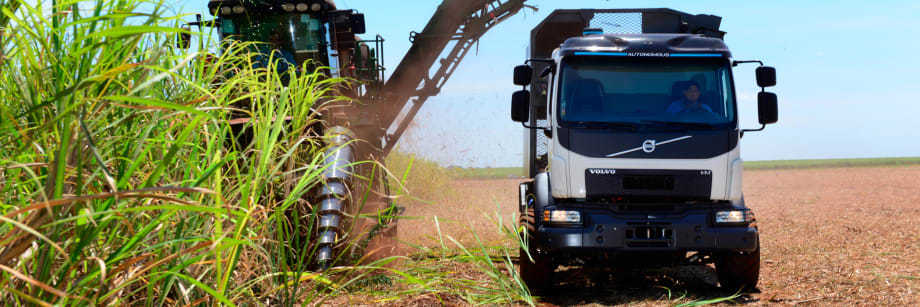
A new self-steering system developed by Volvo is being tested in South American sugarcane fields to see if it can reduce crop spoilage and increase yields. Photo: Volvo
4 min to read
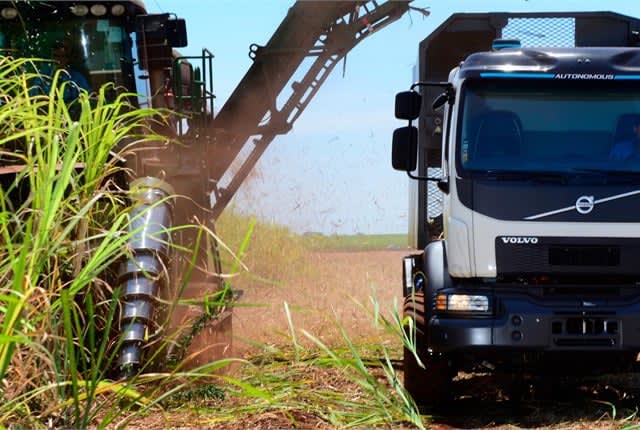
A new self-steering system developed by Volvo is being tested in South American sugarcane fields to see if it can reduce crop spoilage and increase yields. Photo: Volvo
These are the days of lasers in the jungle
Lasers in the jungle somewhere
Staccato signals of constant information
- Paul Simon, The Boy In The Bubble
Volvo tends to keep a lot of its autonomous technology development work under wraps. But, if you look around in the unlikeliest of places, you can find evidence of what the Swedish OEM is up to in terms of advanced vehicle tech.
Case in point, the sugarcane fields of Brazil, where Volvo has deployed a new self-steering truck that the company says can become a significant productivity booster for Brazilian sugarcane growers. It’s also a good example of how emerging autonomous vehicle technology can be used to solve problems that are sometimes beyond the capabilities of all but the most seasoned truck drivers.
The truck, which is used to transport newly harvested sugar cane, is steered with great precision through the fields in order to avoid damaging the young plants that will form the following year's crop. At present, Volvo said, about 4% of the crop is lost as young plants are run over and the soil is compacted by moving vehicles. This can translate into tens of thousands of U.S. dollars in lost revenue per truck per season. Volvo said its new autonomous steering system is so precise, it will not allow a truck to deviate more than 25 mm laterally off a preset course.
The truck is undergoing field trials in a town called Maringá, an hour's flight west of São Paulo, where the Usina Santa Terezinha Group produces sugar and ethanol from its own sugarcane crops. The truck was developed to examine how automated driving can make it possible to avoid damage to soil and crops, thus boosting revenues. The potential for bigger harvests is significant-- up to ten tons per hectare per year.
Volvo Trucks has solved the problem with a driver assistance system that automates steering. It ensures that the truck always maintains exactly the right course when it drives to, alongside, and away from the harvester, so that the plants are not damaged by trampling.
With the help of GPS receivers, the truck follows a coordinate-based map across the sugarcane field. Two gyroscopes ensure that not only the front wheels but the entire vehicle is steered with great precision. When loading, the driver can choose to regulate speed with the help of the vehicle's cruise control or to accelerate and brake manually. Since the driver is released from the burden of the concentration-demanding and tiring high-precision steering process, it is easier to remain focused and work in a more relaxed and safe way throughout a shift.
"With the help of Volvo Trucks' solution we can increase productivity, not just for one single crop but for the entire lifecycle of the sugar-cane plant, which lasts five to six years," explained Santa Terezinha's Finance and Procurement Director, Paulo Meneguetti.
At present, sugarcane is brought in from the fields using harvesters and manually controlled trucks, which drive alongside each other at a low speed. When a truck is fully loaded and drives off to empty its load, the next one moves up next to the harvester and the procedure is repeated. The big challenge for the truck driver is to match the speed of the harvester and at the same time concentrate fully on driving in its tracks, so as not to trample the nearby plants that will become the following year's crop.
"With this solution, we will soon be able to significantly increase the productivity of our customers in the sugarcane industry," said Wilson Lirmann, president of Volvo Group Latin America. "At the same time, we will improve their drivers' working conditions and safety. This, in turn, will make the job more appealing, and make it easier to recruit and maintain drivers."
Volvo said that this summer the research project will transition into the product development phase, with more vehicles being field-tested. After that, the solution can be expected to become commercially available in the foreseeable future.
Already this year, Volvo Trucks Brazil will offer its VM customers in the sugarcane industry an advanced GPS-based map-reading system that gives the driver far better scope for maintaining a predetermined course, even though actual steering will still be handled manually at this stage.
The project is a reminder that there are real-world problems driving the development of autonomous vehicle technology and serious financial returns waiting for companies willing to adopt and perfect such technology once it’s commercially available. It’s also another reason I think the advent and acceptance of autonomous technology will happen much quicker than many in the trucking industry today currently expect.
Subscribe to Our Newsletter
More Blog Posts

That Time Mack Trucks Threw Me a Birthday Party
Sometimes the best birthdays are the ones you never planned. Mine happened courtesy of one of America's oldest truck manufacturers, and it reminded me why I still love this industry after more than three decades.
Read More →
Trucking Should Prepare for Long Siege of High Fuel Prices
Many in trucking are treating today's fuel-price surge as a temporary disruption. History suggests they may be making a costly mistake.
Read More →
30 Days on the Road: April 2026
There was a glut of good news for the North American trucking industry. HDT's Jack Roberts takes a look back at our major stories from the month.
Read More →
30 Days on the Road: HDT's Monthly News Roundup for March 2026
HDT's Monthly News Roundup takes a look at the major North American trucking industry news stories from March, 2026.
Read More →
The Major Autonomous News No One is Talking About
Both Aurora Innovation and PlusAI have made under-the-radar announcements that signal a massive game-changer for trucking is coming soon.
Read More →
HDT's Monthly News Roundup: February 2026
February was dreary and dull -- as usual. But the North American trucking industry finally showed some signs of life. But how long that will last is anybody's guess.
Read More →
Like it or Not, The New Year is Here!
HDT's Monthly Trucking Newsletter looks back on the top stories from January, 2026.
Read More →
The Robots are Here
After a bruising year for trucking, CES 2026 felt subdued. Until it suddenly offered a glimpse of trucking's next disruption and reminded everyone that technology never waits for the next freight cycle.
Read More →
Robots and Road Rage
Computers never get angry. And that's a good thing on crowded stretch of interstate.
Read More →
For the Love of Old Trucks
Old trucks generally get ignored in classic car circles. Maybe that's changing.
Read More →