




Red light. Green light. Whoops, red light!
Anyone who has ever thumped his or her steering wheel in frustration at a green light turning red for no apparent reason just as you approach an intersection will appreciate this recent achievement from Carnegie Mellon University
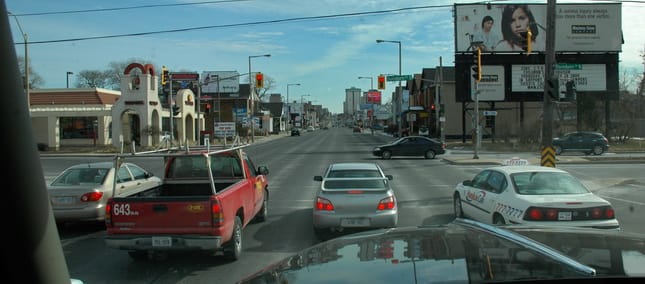
Anyone who has ever thumped his or her steering wheel in frustration at a green light turning red for no apparent reason just as you approach an intersection will appreciate this recent achievement from Carnegie Mellon University.
Researchers and engineers at Carnegie Mellon University have developed a high-tech traffic signal timing system that automatically adjusts and coordinates signal timing at adjoining intersections to accommodate varying traffic volumes. A pilot project in the Pittsburgh neighborhood of East Liberty has shown a reduction in vehicle wait times of 40%, a reduction in travel time through the area of 26% and a decline in exhaust emissions of about 21%.
This a quantum leap beyond simply synchronizing traffic signals -- which in itself isn't as easy as it might seem. Synchronizing traffic signals on a stretch of roadway will improve traffic flow as long as traffic remains within the timed parameters. If cars go too fast, they'll hit a red. If they go too slow, they'll eventually hit a red. On top of that, the greater the distance between the signals, the greater the likelihood that vehicles speed out of the sync timing. And sync'ing the lights only works in one direction; the cross streets don't see the benefits.
It's costly too. In the past, the signals had to be hard-wired together and timed from a single location. There are advantages to wireless communications between the signals, but that adds cost, too.
The system developed by CMU is not only very cost effective, it uses road loop sensors and cameras to gauge traffic flow so it can adjust the timing of the lights accordingly.
A report published by the Pittsburgh Post-Gazette pegs the cost of the system -- used to manage traffic at nine intersections -- at a mere $150,000. In 2011, the Washington State Department of Transportation estimated that the benefit-cost relationship of simple traffic synchronization as 40:1, so the cost benefit to the CMU system could be exponentially higher.
The paper reports Allen Biehler, executive director of CMU's University Transportation Center and former state secretary of transportation, called the results of the pilot project "startling" -- a word you don't often hear from bureaucrats.
I really welcome such developments. In my 2 million miles of big-truck travel around North America, I've come across some incredibly stupid traffic light systems. Some even appear to have been set up to deliberately thwart rather than improve traffic flow.
One of the worst is Tomken Road in Mississauga, Ontario.
It's a north/south artery running parallel to a major artery called Dixie Road in the heart of the city's industrial and warehousing area. During the day, you don't notice the problem, but after hours and especially in the wee hours of the morning when there's little traffic on the road, the lights will drive you to distraction.
The lights are generally green, and of course the side roads see red lights. Sitting on such a side road, facing a red light, you'll wait and wait and wait for the light to change -- until a vehicle approaches on Tomken, the main road. The approaching vehicle triggers something, causing its light to turn red and forcing it to stop, while the side street gets a green. Until a vehicle approaches on Tomken, the side street will not get a green. How can you explain that?
Another street in an industrial section of Toledo, Ohio, has synchronized signals, but nobody knows about them. Somebody on a CB told me if you run along the road at 35 mph (5 mph above the speed limit, oddly) you can skip all the way through about 15 traffic light without fear of hitting red. It won't work in a loaded truck from a stop, but if you hit the first light green and you maintain a steady speed, you're golden. There are no signs advising motorists of this well-kept secret. Why not? If everyone kept a steady speed going through town, they stand a better chance of making across in better time. It would cut down on speeding too. Surely that's an advantage.
The area of the CMU pilot project, Penn Circle in East Liberty, Penn. is -- or was -- a nightmare too. You could once be assured of hitting every light on the road red if you were in a truck. I don't know if the lights were timed to stop trucks, but they were very effective at that task. Given the emissions and congestion caused by trucks in stop and go traffic, I can't imagine a more poorly conceived traffic set up.
But that's all changed now.
CMU's Traffic21 Initiative is much more complex than existing synchronized signal systems. The adaptive signal system uses concepts from the fields of artificial intelligence and traffic theory to fine-tune green light lengths in real time to best accommodate vehicle flow, writes Don Hopey of the Post-Gazette. Then, it relays those changes in real time to system sensors at neighboring intersections in the urban street grid.
The next phase of the project will be to expand the area served by the system and see how well in can manage a larger area with denser and more complex traffic patterns.
Presuming that proves successful, the world could be CMU's oyster. Cities and municipalities around the country and indeed the world would clamor for an inexpensive, highly adaptable and apparently very efficient traffic management system.
The Washington State Department of Transportation estimates benefit-cost relationship of adding one new lane of travel in each direction to a roadway at 10:1 -- assuming it can be done at all. No city in the world is going to tear up sidewalks to make way for wider roads, to even that relatively poor return isn't an option. CMU's system could offer an exponentially better return on the investment.
I can't wait to see where this goes from here.
Read the full Post-Gazette story here.
More Blog Posts
Truck Driver’s Dilemma: Click, Twist or Swipe?
Whether 'tis safer to twist a knob or press a button than to swipe right then swipe down to scan the menu for your favorite playlist...? That's a question for the age.
Read More →
Even the Swedes are Doing Turnpike Doubles
The government doesn't seem to mind asking trucking to invest a trillion dollars toward a greener future. But they won't let us pull turnpike doubles making 30% less CO2. Which is insanity, says HDT's Jim Park in his On the Road blog.
Read More →
Is Your Recruiting Message on Point?
How does your recruiting and retention messaging compare with the reality at your company? Would your drivers agree with your own assessment? Jim Park explores those questions in his On the Road blog.
Read More →
You Can’t Blame Trucks for the Highland Rest Area Bus Crash [Commentary]
The causes of the Highland Park rest area crash go far beyond the parking shortage and the need for flexibility in hours of service — but those issues must be addressed, too, says Jim Park in his On the Road blog.
Read More →
Electric Trucks Seem Far Down the Road for Fleets Dealing with Today's Maintenance Challenges
While the push for zero-emissions trucks rings clear for regulators, advocates and even a small crowd of suppliers, ZEVs seem to have run out of steam down on Main Street, says HDT Equipment Editor Jim Park in his latest On the Road blog.
Read More →
Guinea Pigs 2.0: Can Trucking Comply with a Near Impossible NOx Reduction?
The EPA’s Final Rule on NOx reduction will be incredibly difficult if not nearly impossible for trucking to comply with. Rather than endure another round of equipment failures, downtime and loss of customer faith, industry needs to rally ‘round the OEMs and seek a solution to this wrong-headed rule.
Read More →
Is Downspeeding Bad for Brakes?
Is there a connection between downsped drivetrains and increased brake wear? There shouldn’t be. Downsped fleets seeing increased brake wear are probably not letting the technology do its job, explains HDT Equipment Editor Jim Park.
Read More →
Dig for the Gold Behind CVSA’s Out-of-Service Numbers
Published out-of-service rates don’t mean much until you dig into the why. With brake problems consistently placing in two of the top five spots, maybe we’re missing something in brake maintenance, writes HDT Equipment Editor Jim Park.
Read More →
Things That Go Poof in the Night
We’re in electric-truck heydays now. But like another famous heyday, the 1849 California Gold Rush, there will be a lot fewer winners than losers, says Jim Park in his On the Road blog.
Read More →
Do Your Truck Drivers Know How to Descend a Mountain Grade?
Where do drivers learn mountain-driving techniques? It's sure not from the typical state CDL manual. Jim Park shares what he learned following a deadly 2019 Colorado crash.
Read More →