





"...Congress continues to do the trucking industry’s bidding by frustrating the very regulators the government has empowered to oversee motor carriers."
NYT Op-Ed Attacks Trucking Industry – From the Inside
"The Trucks are Killing Us." The latest diatribe from an anti-truck group? No, it's an op-ed piece in the New York Times by a longtime former trucking editor. Deborah Lockridge writes about it in her All That's Trucking blog.
August 28, 2015
6 min to read
"The Trucks Are Killing Us."
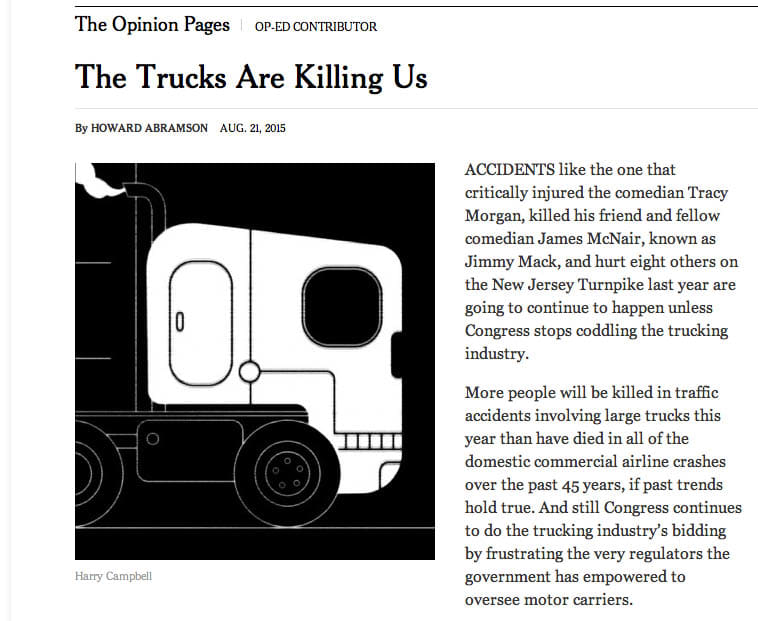
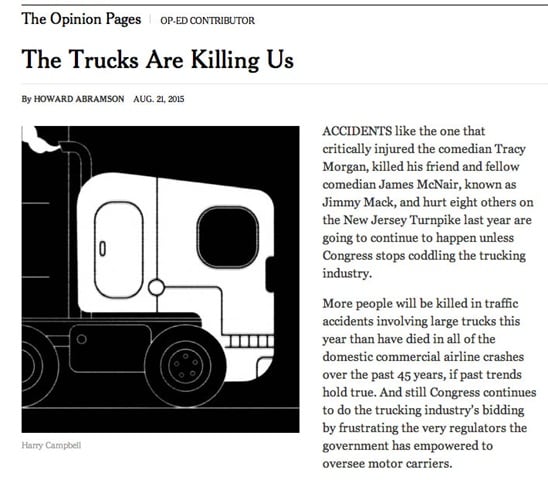
The headline on the op-ed page of the New York Times was accompanied by a drawing of a cabover truck as a skull, with the window for eyes, and smoke spewing out the stack. At first glance, it looked like the latest diatribe from an anti-truck group like The Truck Safety Coalition.
The byline, however, was Howard Abramson, former publisher and editorial director of the American Trucking Associations publication Transport Topics, with a long career covering transportation. It left some in the industry scratching their heads. Others were angry.
Neither the headline nor the graphic (which Abramson likely had no control over) gets to the heart of his opinion piece, which is that Congress is coddling the trucking industry, kowtowing to ATA, and that safety suffers at the expense of trucking profits.
"More people will be killed in traffic accidents involving large trucks this year than have died in all of the domestic commercial airline crashes over the past 45 years, if past trends hold true," Abramson writes. "And still Congress continues to do the trucking industry’s bidding by frustrating the very regulators the government has empowered to oversee motor carriers."
It goes on to criticize the trucking industry and specifically ATA for "insist[ing] that it needs longer work weeks and bigger vehicles," pushing to lower the minimum age for interstate truck drivers, and "discourag[ing] the Federal Motor Carrier Safety Administration from investing in wireless technology designed to improve the monitoring of drivers and their vehicles."
The editorial paints all of trucking with the same brush, much as the safety "advocates" do. Yet we in the industry know it's an incredibly diverse industry, with many different opinions.
In fact, a small but influential group of safety-minded carriers, The Alliance for Driver Safety & Security, lobbies for some different priorities than ATA. This group, known as The Alliance for short, criticized the funding bill for riders it said would negatively affect safety. It opposed amendments that would delay completion of a study on the restart rules, force states to allow longer double-33-foot trailers, and prohibit the USDOT from pursuing the development of wireless roadside electronic truck inspections.
In addition to attacking Congress for a bill that gives the American Trucking Associations much of what it wants, the op-ed attacks what he says is the industry's slow adoption of safety technologies.
"Most automakers now include or offer anti-lock brakes, electronic stability control, airbags and collision-avoidance devices in their vehicles, and the technology is included in many of the heavy trucks sold in Europe," he writes. "But the United States trucking industry has largely avoided using the safety technologies available for vehicles sold here, because of their cost."
Yes, there are some companies who prefer to wait until expensive technology is mandated, or at least thoroughly proven in the field, before investing the pennies-on-the-dollar profits. Early adopters of technology are often burned – thus the term "bleeding edge" rather than "leading edge." For instance, the earliest radar-based collision warning systems were notorious for false positives. These were so annoying to drivers that they would simply ignore the beeping or find ways to disable them, meaning fleets had essentially wasted their money.
The average person reading "The Trucks are Killing Us" will not realize this. They will have no concept of the complexities of the hours of service rules or the challenges involved in developing safety technologies that don't inundate drivers with false positives.
And the general public has no way of knowing the motivations behind this op-ed. The piece only notes at the end that Abramson is a "former executive" of ATA. So readers have no way of knowing whether it was disagreement with his former boss over these issues that led him to leave, or if he is writing a vengeful attack against an employer from whom the departure was not amicable.
To make matters worse, his message has been picked up by other writers across the country:
"Though large trucks are involved crashes that kill nearly 4,000 people a year — a number that has grown by 17 percent over the past five years — the DRIVE Act actually rolls back what few protections exist," writes Tanya Snyder in Streetsblog USA, making it sound as if trucks would be allowed under this bill to operate with no regulations whatsoever.
"Even a retired executive from the American Trucking Associations, an industry lobbying group, was recently moved to speak out against the changes… Trucking companies are continually looking to pinch pennies at the expense of public safety, and this bill lets them. Collision-avoidance technology, increasingly standard in passenger vehicles, is still a rarity in heavy trucks. Trucking companies are reluctant to spend the money for simple vehicle technologies that save lives."
(I would hardly characterize collision mitigation systems as "simple vehicle technology," and I bet neither would Bendix or Meritor Wabco.)
An editorial in the Montgomery [Alabama] Advertiser adapts much of Abramson's points, decrying the "glaring irresponsibility of members of Congress now working to relax safety regulations on the trucking industry, at the behest of the powerful trucking lobby" reporting that in the highway bill, "lawmakers attempt to curtail requirements that drivers take a certain amount of time off between shifts — restrictions needed to prevent accidents caused by fatigue."
And an article on www.allgov.com asks, "Why Can't the Trucking Industry Give up Just Some of its Profits to Save Lives?"
I'm not saying the trucking industry is perfect. Of course carriers want to earn a profit. After all, they are in business to make money, not pursuing a hobby. And if you ever doubt that there are indeed carriers who operate under the mantra that profits trump safety, just read a few of the FMCSA's shutdown orders of dangerous fleets. But to paint an entire industry this way, when most fleets work hard to do the right thing while still showing a positive bottom line, is just wrong.
Abramson spends a fair amount of the column discussing the highly publicized crash in New Jersey involving comedian Tracy Morgan, which killed one passenger in a limo that the truck crashed into in a construction zone.
He makes much of the fact that there was a collision avoidance device (manufacturers prefer the term collision mitigation) in the Walmart truck in that crash, although the National Transportation Safety Board's investigation couldn't determine whether the device activated or not.
Yet in some ways the crash argues against Abramson's thesis that trucking is too interested in profits to invest in safety. Like most private fleets, Walmart is keenly aware of the importance of safety to its reputation with customers. It had invested in electronic logs. It had invested in collision mitigation systems. Neither of those prevented this crash, which the NTSB said was largely caused by fatigue because of the driver's 12-hour commute to work.
The crash seems to illustrate that no matter how much you spend on safety technology, some people are still going to take actions that are ill-advised, that lead to unhappy and unintended consequences.
Kind of like a former trucking publisher writing a scathing op-ed in the New York Times.
Subscribe to Our Newsletter
More Blog Posts

Beyond the Central Transport Settlement: Lessons on Hiring and Risk
The $5.5 million discrimination settlement raises broader questions about hiring practices, safety performance, and the hidden risks that can lurk in a fleet's recruiting process.
Read More →
Are Diesel Shortages Something to Worry About Again?
There’s a certain déjà vu when tensions flare in the Middle East and diesel price spikes can give you panic attacks. What parallels are there between the current situation and the 1970s energy crisis?
Read More →
NOx Isn’t Laughing Gas. Let’s Clear That Up.
A recent EPA reference mixed up NOx and nitrous oxide. It’s an easy mistake. Just not one you expect to see in emissions policy. Let’s look at the difference.
Read More →
TMC 2025 Takeaway 2: Buy... or Subscribe?
TaaS. Does that mean trucks as a service, trailers as a service, or tires as a service? HDT's Deborah Lockridge has another takeaway from the Technology & Maintenance Council meeting in her blog.
Read More →
TMC 2025 Takeaway: The Journey Toward Vertical Integration
HDT's Deborah Lockridge on how the trucking industry has moved toward "vertical integration" over the past 25 years.
Read More →
Trucks Are For Girls!
HDT Editor and Associate Publisher Deborah Lockridge is a longtime Girl Scout leader and loves to connect her passion for inspiring girls with her love of the trucking industry.
Read More →
Trucking Advocacy: Impact Beyond the 2024 Elections
No matter who wins the election, trucking continues to work to educate the people who pass the laws and make the rules that affect the industry. HDT's Deborah Lockridge shares insights from two major trucking associations in her All That's Trucking blog.
Read More →
Recharge Your Brain for Better Business
Skimping on vacation may be the worst thing you can do for your business, your career, and your mental health. In her All That's Trucking blog, Deborah Lockridge writes about the importance of giving your brain what it needs to be innovative.
Read More →
Trucker Pre-Trip Leads to Mission 'Im-paw-sible'
See what happened when a truck driver found an unexpected stowaway during his pre-trip inspection.
Read More →
HDT Editor: 2023's Most Important Trucking Topics
Read Deborah Lockridge's picks for the most significant stories we covered at HDT in 2023: freight recession, zero-emission trucks, drivers and marijuana, and more.
Read More →