





Related: FMCSA Releases Mandated 'Corrective Action Plan' for CSA Program
FMCSA Keeping Sights on Hours-of-Service Reform, New Safety Rating System
At TRB meeting, Federal Motor Carrier Safety Administration officials discussed the agency's goals for the new year, highlighting hours-of-service reform and a new safety rating system. Blog commentary by Executive Editor David Cullen.
January 26, 2019
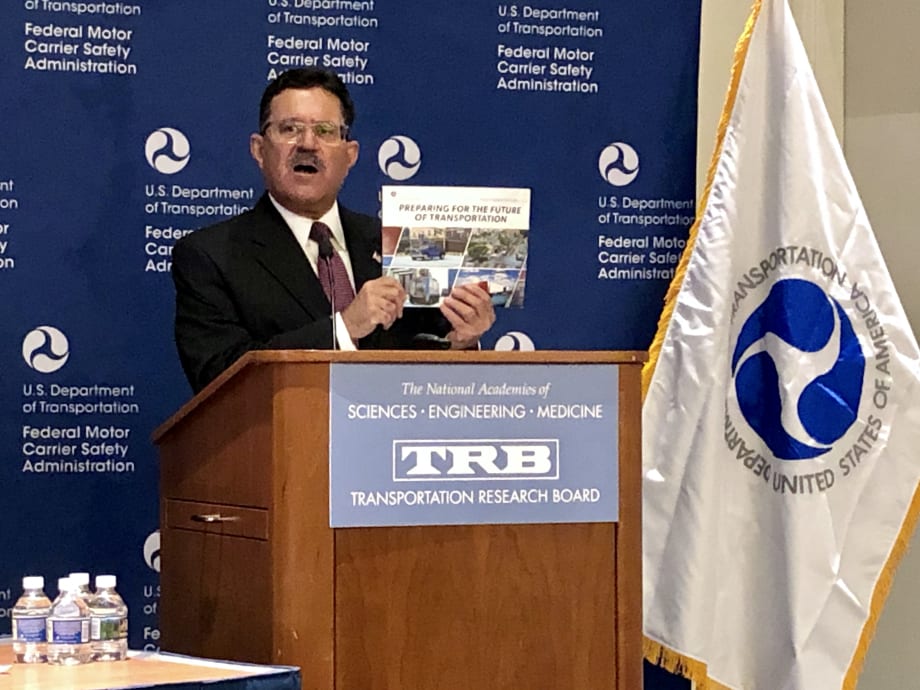
FMCSA Adminstrator Ray Martinez at agency forum in Washington, D.C., on Jan. 15.
Photo: David Cullen
4 min to read
What a difference a year can make. In Washington, D.C. on Jan. 15, I covered the Federal Motor Carrier Association’s annual Analysis, Research, and Technology Forum for the second time. It was the 18th time the agency put on the program. It’s always held during the Transportation Research Board'sannual meeting, which itself was being put on for the 98th time.
Sure, a lot has changed on the roads in almost a hundred years. More remarkably, though, things are different at the federal truck and bus safety agency from just a year ago. For one thing, of course, there is a new chief at the helm of FMCSA. Administrator Ray Martinez took over his poston March 1, so he was there addressing the agency event for the first time.
Also a year ago,Cathy Gautreauxwas serving as deputy administrator and so as de facto chief, she was the main speaker at the 2018 TRB forum. But word came just days before this year’s meeting that she was moving on to take a leadership position with the National Highway Transportation Safety Administration.
And it was just over a year ago, on Dec. 18, 2017, that FMCSA rolled out its electronic logging device mandate. Now, ELDs are being adopted industry-wide with relatively little fuss and the final compliance data (for those still operating automated onboard recording devices) kicks in at the end of the year.
Indeed, during the TRB session, FMCSA Director of Compliance and Enforcement Joe DeLorenzo reported that hours-of-service compliance has improved since full enforcement of the ELD rule kicked in on April 1, 2018. He reported that less than 1% (17,651) of all driver inspections (2.3 million) have resulted in writing up drivers cited for running without an ELD or grandfathered AOBRD.
On top of all that, it was almost six months to the very day of the meeting that FMCSA announced it had delivered a required “Correlation Study Corrective Action Plan” for its Compliance, Safety, Accountability program to Congress. Essentially, the plan is the agency’s response to how it will address recommendations made in the National Academy of Sciences’ “Improving Motor Carrier Safety Measurement”report.
That report, as you may recall (and I cannot seem to forget), was commissioned by FMCSA to comply with a provision of the FAST Act highway bill of 2015 that mandated a study be conducted of the agency’s Compliance, Safety, Accountability program and its Safety Measurement System component.
A key element of the NAS report is the recommendation that FMSCA study is using a more scientific modeling approach known as “Item Response Theory” and then consider implementing it to make the SMS function more accurately.
The hope is that turning to an IRT-based method will help develop “an estimate of the measure of ‘safety culture’ for each carrier and be used to monitor and identify carriers in need of intervention,” rather than just zero in on violations, DeLorenzo said back on Oct. 22, 2017, during an educational session at the American Trucking Associations’ annual Management Conference & Exhibition In Orlando, Florida.
During the TRB forum, DeLorenzo gave an update on the agency’s progress on implementing its CSA plan. It would seem FMCSA has made progress on the core IRT element as he said the agency will run a small-scale data test on the model in the next few months.
As to why the IRT statistical model is seen as central to improving the Safety Measurement System, DeLorenzo said that “the model can see things not apparent to our expert judgment. The general construct [of SMS] will likely remain the same, but the BASICs [the Behavior Analysis and Safety Improvement Categories that drive CSA scoring] may change” as the result of what is learned from an IRT data model.
If the agency is learning a lot by continuing its planned two-year deep dive into the NAS recommendations on CSA, it’s also tuned in and listening to the comments, suggestion, and petitions sent its way. During his turn at the podium, Administrator Martinez said being open to stakeholder concerns is helping drive FMCSA’s safety priorities for this year.
He said these will include inputting more accurate and timely crash data; evaluating tools that may help drivers realize when they are fatigued; continuing research on truck platooning, and supporting research and technology adoption for automated driving systems. Martinez noted that while autonomous trucks “may not impact the industry right now, but there are decisions that government regulators have to make now that in the coming years will allow the United States to be on firm ground with continued development of these technologies.”
Since taking the reins at FMCSA, he said, “one of my primary goals has been to emphasize the role of collaboration” with stakeholders. “That’s a key to the success of any organization, but especially for FMCSA” as its mission is to help improve highway safety.
Martinez said that while the agency has its agenda to pursue, it is “aiming to listen to and form partnerships with research, government, enforcement, and state regulatory organizations. That’s critical to making sure we have buy-in [of rules and programs] from [trucking] businesses, with everyone from the CEO to the driver.”
Subscribe to Our Newsletter
More Blog Posts
Congress Dancing on the Ceiling. Again.
It’s time once more on Capitol Hill to battle over the debt ceiling, rather than conduct the nation’s urgent business, says HDT Business/Washington Contributing Editor David Cullen.
Read More →
Infrastructure on Capitol Hill: On Two Tracks to Somewhere
It’s likely an infrastructure bill will pass. But how big it will be, and who will pay for it, rides on lots of politicking.
Read More →
Gaming Out The Biden Infrastructure Proposal on Capitol Hill
The Biden Administration's American Jobs Act, the core of which is infrastructure funding, is on a long road to becoming law – replete with more twists and turns than a mountain highway.
Read More →
4 Ways Washington May Change Trucking Laws and Regulations
As the balance of power in Washington has shifted, trucking likely will see changes in laws and regulations. But how that happens isn't just like the Schoolhouse Rock version of "I'm Just a Bill."
Read More →
Regulatory Outlook 2020: Keep an Eye on Hours of Service
What's in store for trucking from the regulators in Washington, D.C., this year? Executive Editor David Cullen says the government wheels move slowly, but hours-of-service is among those to watch in 2020.
Read More →
Logistics Ain't What it Used to Be
You can no longer expect to run a motor carrier of any size without at least a glancing appreciation for the impact logistics— in one way or another-- has on every link in the supply chain.
Read More →
Will Dustup over Cleanup of Car Emissions Gut Truck GHG Rules?
What does Trump's revocation of California's vehicle emission waiver mean for the federal Phase 2 GHG emission rules already in place for commercial vehicles? Commentary by Executive Editor David Cullen.
Read More →
Some Sober Advice on the Drug & Alcohol Clearinghouse
The Federal Motor Carrier Safety Administration's prep work for the Drug & Alcohol Clearinghouse includes amassing an impressive amount of informational guidance online that can be accessed at a dedicated website. Commentary by Executive Editor David Cullen.
Read More →
Here's to Our Winners
The managers, executives, and owners of truck operations who are honored each year by Heavy Duty Trucking with our Truck Fleet Innovator awards so often seem to be moving at a fast clip in how they think about things. Blog Commentary by Executive Editor David Cullen.
Read More →
ATA Takes Madison Avenue to Pitch Highway Funding on Capitol Hill
A new advertising and grassroots campaign by ATA might just sell Congress on fixing our roads. Commentary by David Cullen, Executive Editor.
Read More →