




Infrastructure on Capitol Hill: On Two Tracks to Somewhere
It’s likely an infrastructure bill will pass. But how big it will be, and who will pay for it, rides on lots of politicking.

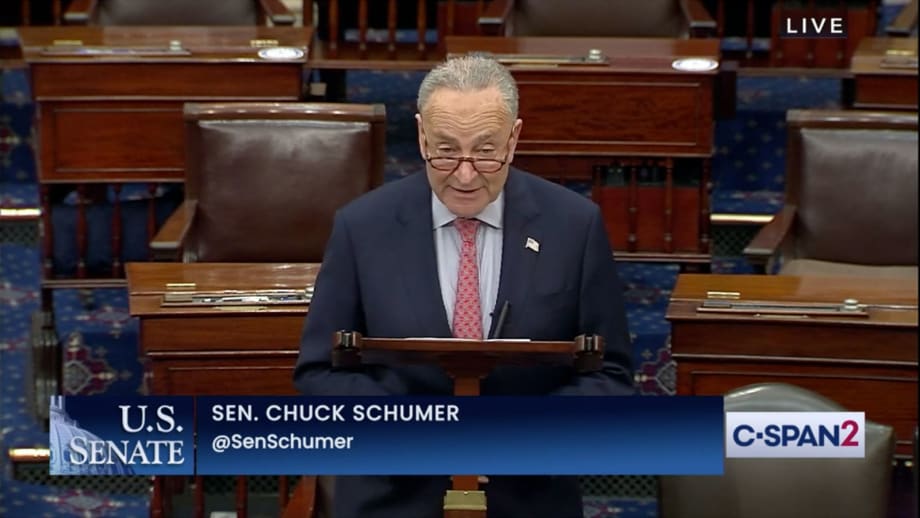
"Discussions about infrastructure are moving forward along two tracks... the truth is both tracks are moving forward very well and both tracks need each other," said Senate Majority Leader Chuck Schumer, D-N.Y., on the Senate floor June 17.
Photo: C-Span screen capture
$2.2 trillion? $974 billion? $6 trillion? It’s not just a question of how many billions or trillions of dollars will ultimately be notched for infrastructure funding by President Joe Biden’s policymaking push and the deal-making on both sides of the aisle on Capitol Hill.
Nor is it just a question of when a pumped-up infrastructure package — gargantuan by any measure, no matter the final dollar figure — might actually get passed and signed into law.
Nope, it’s also a question of on which track this money train will end up rolling into the station. That’s the gazillion dollar question. Because the answer to it goes straight to answering the other two questions.
On the surface, it should be easy to pass an infrastructure bill with the president’s party also controlling Congress. But the Democrats hold the House by a narrow margin and the Senate only by dint of the tie-breaking vote of Vice President Kamala Harris. And in this era of hyper-partisanship, it’s not easy to drum up Republican senators willing to support a landmark Democratic initiative.
Biden’s proposal to improve public-works and safety-net programs, dubbed the American Jobs Plan, calls for spending roughly $2.2 trillion. That would include $621 billion on road, bridge, rail, port, waterway, airport, and public transit improvements, as well as building the market for electric vehicles. Broken down further, $115 billion would go to modernizing 20,000 miles of highways and other roads and $20 billion to improve road safety for all users. In addition, funds would be directed to repair the “most economically significant large bridges” and the worst 10,000 smaller bridges.
All that’s a big sell in itself. But Biden’s package would also spend hundreds of billions more, on everything from boosting manufacturing in certain sectors and investing in R&D for critical technologies to delivering nationwide high-speed broadband coverage and growing and improving the nation’s housing stock. The president wants to implement ways to bring in more taxes from corporations to raise the more than $2 trillion needed over the next 15 years.
To date, the Republican response has been to commit to spending only a fraction of what Biden seeks — and to do so without raising any taxes. On June 15, the president ended lengthy negotiations with a group of Senate Republicans when it became clear common ground could not be reached.
However, the White House signaled that Biden was still open to a plan being worked up by a bipartisan group of 10 centrist senators. That plan has been picking up more support, growing the group to number 11 Republicans, nine Democrats, and an independent who caucuses with the Democrats.
The centrists’ “skinny alternative” would spend $974 billion on infrastructure over five years. To get it that slimmed down, money would go only to fund “physical” public works projects. This bipartisan package would be funded without raising taxes on corporations or high net-worth individuals. However, some Democrats argue infrastructure spending doesn’t need to be offset anyway, because it will pay for itself over time by boosting economic activity.
But wait, there’s more: On June 17, news broke that Senate Democrats had begun privately considering an even more massive economic package that could run as high as $6 trillion.
Right now, both the somewhat fleshed-out bipartisan plan and the $6 trillion plan under consideration by leadership are moving ahead on parallel tracks. While centrist senators in both parties are pushing to gain more support for their compromise, Senate Democratic leaders are not shy about their willingness to use the fast-track budget process of reconciliation to roll over any Republican filibustering to get either President Biden’s or their own plan passed.
So, as summer comes in, that’s the state of play on moving desperately needed infrastructure legislation to the president’s desk for signing. Stay tuned for updates.
More Blog Posts
Congress Dancing on the Ceiling. Again.
It’s time once more on Capitol Hill to battle over the debt ceiling, rather than conduct the nation’s urgent business, says HDT Business/Washington Contributing Editor David Cullen.
Read More →
Gaming Out The Biden Infrastructure Proposal on Capitol Hill
The Biden Administration's American Jobs Act, the core of which is infrastructure funding, is on a long road to becoming law – replete with more twists and turns than a mountain highway.
Read More →
4 Ways Washington May Change Trucking Laws and Regulations
As the balance of power in Washington has shifted, trucking likely will see changes in laws and regulations. But how that happens isn't just like the Schoolhouse Rock version of "I'm Just a Bill."
Read More →
Regulatory Outlook 2020: Keep an Eye on Hours of Service
What's in store for trucking from the regulators in Washington, D.C., this year? Executive Editor David Cullen says the government wheels move slowly, but hours-of-service is among those to watch in 2020.
Read More →
Logistics Ain't What it Used to Be
You can no longer expect to run a motor carrier of any size without at least a glancing appreciation for the impact logistics— in one way or another-- has on every link in the supply chain.
Read More →
Will Dustup over Cleanup of Car Emissions Gut Truck GHG Rules?
What does Trump's revocation of California's vehicle emission waiver mean for the federal Phase 2 GHG emission rules already in place for commercial vehicles? Commentary by Executive Editor David Cullen.
Read More →
Some Sober Advice on the Drug & Alcohol Clearinghouse
The Federal Motor Carrier Safety Administration's prep work for the Drug & Alcohol Clearinghouse includes amassing an impressive amount of informational guidance online that can be accessed at a dedicated website. Commentary by Executive Editor David Cullen.
Read More →
Here's to Our Winners
The managers, executives, and owners of truck operations who are honored each year by Heavy Duty Trucking with our Truck Fleet Innovator awards so often seem to be moving at a fast clip in how they think about things. Blog Commentary by Executive Editor David Cullen.
Read More →
ATA Takes Madison Avenue to Pitch Highway Funding on Capitol Hill
A new advertising and grassroots campaign by ATA might just sell Congress on fixing our roads. Commentary by David Cullen, Executive Editor.
Read More →
FedEx Reveals What's Inside Every 'Last Mile'
Valuable insight about how FedEx sees the marketplace and reacts to it will not be found in the stark numbers of its latest earnings report. Commentary by David Cullen, Executive Editor.
Read More →