





Related: Highway Deaths Climbed 7.2% in 2015
In the Land Where Zero Wins
David Cullen takes you to The Badger State, where the state DOT is determined to change the human culture around highway safety for the better, in his Passing Zone blog.
August 24, 2017
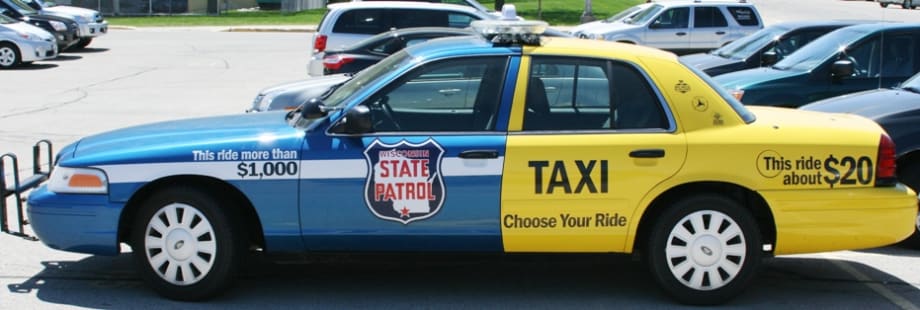
“Choose Your Ride” is literally a publicity vehicle. Wittily marked up by WisDOT as half State Patrol cruiser and half taxi, it’s an award-winning public-service ad warning against the danger and expense of drunk driving. Photo: Wisconsin DOT
3 min to read
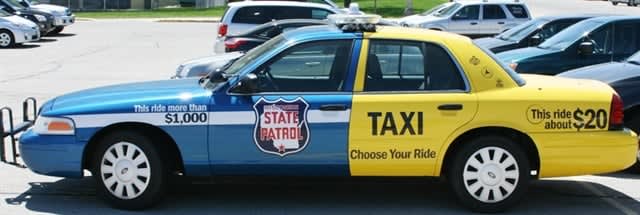
“Choose Your Ride” is literally a publicity vehicle. Wittily marked up by WisDOT as half State Patrol cruiser and half taxi, it’s an award-winning public-service ad warning against the danger and expense of drunk driving. Photo: Wisconsin DOT
Travel with me now to The Badger State, or America’s Dairyland, if you prefer, a land of two Great Lakes, lush North Woods, rich farmland, solid cities, plentiful roads, and a state DOT determined to change the human culture around highway safety for the better.
Saying 588 people died on Wisconsin roads in 2016, the Wisconsin DOT is convinced that number can be brought way, way down. Not just by such-and-such a percentage, as numbers people tend to speak of, but right down to zero. Yes, to zero. As in zilch.
That goal is obvious by the very name of the innovative multimedia campaign—dubbed “Zero in Wisconsin”— that WisDOT is directing to drive down highway fatalities in the state.
Underscoring the need for the ongoing initiative, on Aug. 23, speaking at the Governor's Conference on Highway Safety in Appleton, David Pabst, the agency’s director of Transportation Safety, said traffic deaths are “right up there” as one of the top three causes of death in Wisconsin,
He noted some good news — that alcohol-related car crashes have been reduced over the past 10 years — but contended that’s not enough to markedly reduce traffic deaths. Pabst said the state is seeing an increase in highway fatalities overall “because people are still not wearing their seat belt as much as they should, they’re not slowing down, they’re driving distracted, and they’re driving drowsy.”
On the program’s dedicated website, the WisDOT declares that, “In Wisconsin, our Zero Vision means that any preventable traffic death is one too many. By staying within the speed limit, being sober behind the wheel, and buckling up, you can do simple things that can turn nearly 500 annual deaths into zero.”
The website then lays out those “simple things” (none of which will be news to safety advocates). But what might pleasantly surprise truckers is that this effort is squarely aimed at changing the behavior, nay, the very thinking about safety, by motorists.
Over a half-dozen program areas are explained on the website, running the gamut from wearing seat belts to swearing off texting and avoiding other distractions to having no part in allowing drunk driving.
Among my favorite topics – that should be required reading for every four-wheeler (including yours truly) – is the section on “Speeding & Aggressive Driving.” After all, when you get right down to it, safety should not start in the milliseconds before an accident, but as soon as the ignition is engaged.
But hands-down the most compelling element of “Zero in Wisconsin” is the array of video- and audio-based “safety spots” that have been created to support the program’s praiseworthy goal.
For distracted driving alone, there are almost a dozen video clips, including TV spots, and almost two dozen audio files that address different aspects of this safety issue. A range of clips have been put together to support WisDOT’s message about each safety concern.
All are professionally produced; the one that grabbed me the most was about drunk driving and showed starkly what you will go through if a police officer pulls you over and asks that you take a “field sobriety test.”
According to WisDOT, these TV and radio spots, some of which have won awards, aim to raise awareness of the campaign “while helping Wisconsin residents understand that by making simple changes in their driving behavior, they can make a big difference in helping to turn over 500 annual deaths into zero.”
What’s more, the agency makes this simple yet potentially impactful request: “Please take some time to view and listen to these safety messages, as well as to send this link to family and friends, in order to help us to achieve Zero in Wisconsin!”
And zero in every state.
Subscribe to Our Newsletter
More Blog Posts

Congress Dancing on the Ceiling. Again.
It’s time once more on Capitol Hill to battle over the debt ceiling, rather than conduct the nation’s urgent business, says HDT Business/Washington Contributing Editor David Cullen.
Read More →
Infrastructure on Capitol Hill: On Two Tracks to Somewhere
It’s likely an infrastructure bill will pass. But how big it will be, and who will pay for it, rides on lots of politicking.
Read More →
Gaming Out The Biden Infrastructure Proposal on Capitol Hill
The Biden Administration's American Jobs Act, the core of which is infrastructure funding, is on a long road to becoming law – replete with more twists and turns than a mountain highway.
Read More →
4 Ways Washington May Change Trucking Laws and Regulations
As the balance of power in Washington has shifted, trucking likely will see changes in laws and regulations. But how that happens isn't just like the Schoolhouse Rock version of "I'm Just a Bill."
Read More →
Regulatory Outlook 2020: Keep an Eye on Hours of Service
What's in store for trucking from the regulators in Washington, D.C., this year? Executive Editor David Cullen says the government wheels move slowly, but hours-of-service is among those to watch in 2020.
Read More →
Logistics Ain't What it Used to Be
You can no longer expect to run a motor carrier of any size without at least a glancing appreciation for the impact logistics— in one way or another-- has on every link in the supply chain.
Read More →
Will Dustup over Cleanup of Car Emissions Gut Truck GHG Rules?
What does Trump's revocation of California's vehicle emission waiver mean for the federal Phase 2 GHG emission rules already in place for commercial vehicles? Commentary by Executive Editor David Cullen.
Read More →
Some Sober Advice on the Drug & Alcohol Clearinghouse
The Federal Motor Carrier Safety Administration's prep work for the Drug & Alcohol Clearinghouse includes amassing an impressive amount of informational guidance online that can be accessed at a dedicated website. Commentary by Executive Editor David Cullen.
Read More →
Here's to Our Winners
The managers, executives, and owners of truck operations who are honored each year by Heavy Duty Trucking with our Truck Fleet Innovator awards so often seem to be moving at a fast clip in how they think about things. Blog Commentary by Executive Editor David Cullen.
Read More →
ATA Takes Madison Avenue to Pitch Highway Funding on Capitol Hill
A new advertising and grassroots campaign by ATA might just sell Congress on fixing our roads. Commentary by David Cullen, Executive Editor.
Read More →