




Cosmo and the Woman Trucker
Cosmopolitan is not where most would-be truckers will turn for advice on launching a career behind the wheel.

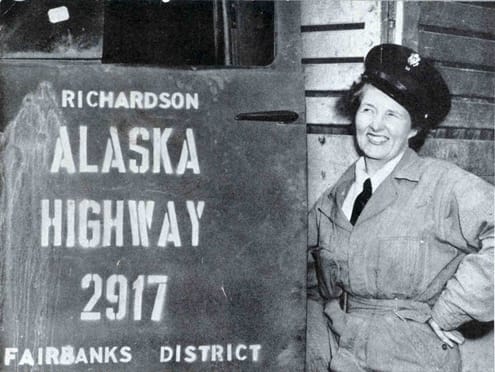
Rusty Dow, a Corps truck driver, traversed the Alaska Highway during the 1940s. Image: Army Corps of Engineers

Cosmopolitan is not where most would-be truckers will turn for advice on launching a career behind the wheel. Just because roughly 95% of American truck drivers are male and Cosmo is a women’s magazine— not to mention one known more for its expansive coverage of beauty and sex than anything else.
Apparently, though, even the editors at that glossiest of zines have heard of the driver shortage. I can’t think why else they would feature an “as told to” post on the ins and outs of driving a truck for a living in a section titled “Things I Wish I Knew Before I Started My Career.”
Presented by contributing writer Arielle Pardes are 13 key insights gleaned by Lindsay Slazakowski during her three-year stint as a long-haul truck driver. Slazakowski for the most part sticks to the format, talking about what she discovered working and thus living out on the road.
Perhaps most notably, she also reveals what led her to climb into a truck cab in the first place: “I always saw truck driving as a temporary job. I wanted to pay off my student loans and save up some money to go back to school, and once I accomplished those things, there wasn't much keeping me there.”
I can’t speak from personal experience, having not even a CDL to my name, but based on what I’ve observed as a journalist for over 30 years of the working life of long-haulers, Slazakowski’s take on the job tracks true..
Her 13 points take in the good, the bad and the ugly of driving, including just how ugly it can get for a woman just trying to do her job. She reports that sexual harassment is all too common: “I've been catcalled by regular drivers on the road and from other truck drivers; even the customers I delivered to made overtly sexual comments toward me. Other women have reported sexual assault during training and while on the road, which is an uncomfortable reality for any woman in this industry.”
Slazakowski also weighs in on other negatives to making long-haul a career, noting that the starting pay “isn’t great,” the job can be very lonely if not driving as a team, that you should “forget about working out or eating well,” that the job is dangerous, and, yes, “you're constantly traveling, but you don't get to be a tourist.”

On the other hand, she appreciates that she was able to increase her pay “pretty quickly… When I first started driving, I was making 27 cents for every mile that I drove, which equated to around $35,000 a year— so, not great. But by the time I quit three years later, I was making $55,000 a year. Pay raises are regular, and your rate goes up if you hit goals each quarter, like making on-time deliveries, driving without accidents, staying under the speed limit, and having more years of experience under your belt.”
Slazakowski also liked that the job was just about hers for the taking: “There's a huge shortage of truck drivers, so getting hired is basically as easy as getting your commercial driver's license. It's a 10-week program to get the certification, and by the time mine was over, I had a job lined up with a company.”
She liked something else, too. What she calls the “beautiful moments.” Slazakowski advises those included being “in charge of your own schedule and how you spend your time in the truck. You can save a lot of money, since your living expenses are minimal while you're on the road.
"And," she adds, "the views from the driver's seat beat any office window.”
More Blog Posts

Congress Dancing on the Ceiling. Again.
It’s time once more on Capitol Hill to battle over the debt ceiling, rather than conduct the nation’s urgent business, says HDT Business/Washington Contributing Editor David Cullen.
Read More →
Infrastructure on Capitol Hill: On Two Tracks to Somewhere
It’s likely an infrastructure bill will pass. But how big it will be, and who will pay for it, rides on lots of politicking.
Read More →
Gaming Out The Biden Infrastructure Proposal on Capitol Hill
The Biden Administration's American Jobs Act, the core of which is infrastructure funding, is on a long road to becoming law – replete with more twists and turns than a mountain highway.
Read More →
4 Ways Washington May Change Trucking Laws and Regulations
As the balance of power in Washington has shifted, trucking likely will see changes in laws and regulations. But how that happens isn't just like the Schoolhouse Rock version of "I'm Just a Bill."
Read More →
Regulatory Outlook 2020: Keep an Eye on Hours of Service
What's in store for trucking from the regulators in Washington, D.C., this year? Executive Editor David Cullen says the government wheels move slowly, but hours-of-service is among those to watch in 2020.
Read More →
Logistics Ain't What it Used to Be
You can no longer expect to run a motor carrier of any size without at least a glancing appreciation for the impact logistics— in one way or another-- has on every link in the supply chain.
Read More →
Will Dustup over Cleanup of Car Emissions Gut Truck GHG Rules?
What does Trump's revocation of California's vehicle emission waiver mean for the federal Phase 2 GHG emission rules already in place for commercial vehicles? Commentary by Executive Editor David Cullen.
Read More →
Some Sober Advice on the Drug & Alcohol Clearinghouse
The Federal Motor Carrier Safety Administration's prep work for the Drug & Alcohol Clearinghouse includes amassing an impressive amount of informational guidance online that can be accessed at a dedicated website. Commentary by Executive Editor David Cullen.
Read More →
Here's to Our Winners
The managers, executives, and owners of truck operations who are honored each year by Heavy Duty Trucking with our Truck Fleet Innovator awards so often seem to be moving at a fast clip in how they think about things. Blog Commentary by Executive Editor David Cullen.
Read More →
ATA Takes Madison Avenue to Pitch Highway Funding on Capitol Hill
A new advertising and grassroots campaign by ATA might just sell Congress on fixing our roads. Commentary by David Cullen, Executive Editor.
Read More →