




Cheap insurance, really cheap insurance
A set of visual brake stroke indicators costs no more than a few bucks per wheel-end, and can save hundreds by preventing just one out-of-service situation. So why aren't more fleets and owner-operators using them
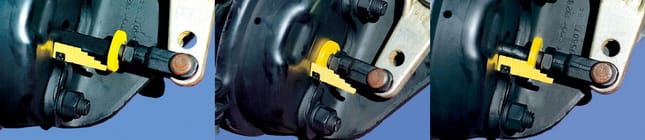
Brake stroke indicators are your best hedge against drivers who won't do mark-and-measure brake inspections.
A set of visual brake stroke indicators costs no more than a few bucks per wheel-end, and can save hundreds by preventing just one out-of-service situation. So why aren't more fleets and owner-operators using them?
Recollections abound of lying under a trailer with a 9/16ths wrench and a hammer adjusting my brakes. I went through the procedure each time I picked up a different wagon, and I set up my tractor brakes at least once a week in the days before automatic brake adjusters. Today it seems we've come to think of automatic brake adjusters and infallible brake adjusters, and nothing could be further from the truth.
I mean no disrespect to the producers of automatic brake adjusters -- they have dramatically improved brake performance and reduced the out-of-service rate due to bad brake adjustment by nearly half -- but since the OOS rate for brake adjustment still hovers around the 20-22 percent range, clearly something still needs to be addressed.
Automatic brake adjusters, or autoslacks as they are often called, are designed to maintain a pretty close line between under and over-stroking. If a brake has a 2-in. stroke limit, an autoslack will probably maintain a stroke length of about 1-5/8 to 1-3/4 of an inch. There's not a lot of margin there.
And chances are, when a wheel equipped with an automatic adjuster is over-stroking it's not the fault of the adjuster, but of something else at the wheel-end, such as worn cam bushings, a seized clevis pin or something. The warranty rate on autoslacks is very low, I'm told, which buttresses my previous statement. Over-stroking with autoslacks is very often an indicator of some other problem with the foundation brake.
Amazingly, overstroking autoslacks are often readjusted and set to the proper length -- even by so-called qualified mechanics. Autoslacks should never be "adjusted" to cure excess pushrod travel. If there's any misunderstandings about adjusting automatic brake adjusters, please read the NTSB report on the truck crash at Glenn Rock, Penn. that claimed one life in 2003. NTSB attributed that incident to slack adjusters that were so badly worn due to constant readjustment that were unable to maintain their stroke, and just backed off each time the brakes were applied.
That's another story for another day. Getting back to brake stroke indicators, we have a situation where problems can occur with a mission critical component and there's no practical roadside fix, short of inspection the brake to reveal the source of the over-stroke condition.
Given the CSA emphasis on brake stroke -- violations carry four points -- and the semi-annual reminders we get from CVSA on our brake adjustment shortcomings, why is more emphasis not placed on checking brake stroke?
Let's face it; drivers are not going to do a mark-and-measure brake inspection every day. If they tell you they are or if you think they are, you're deluding yourself. It just doesn't happen.
So what's the answer to a 22-percent out of service rate due to improper brake adjustment? Visual brake stroke indicators. When installed properly, and when drivers check them periodically, they are near-guaranteed prevention of brakes out of adjustment citations.
I've noticed over the years that almost every Canadian truck or trailer you see has visual brake stroke indicators installed, but a very small percentage of American trucks have them. No commentary here, just an observation, but I've always wondered why something so inexpensive and so reliable that can prevent such a costly problem isn't on every wheel on every truck in the land.
Once the driver understands what the brake stroke indicator is telling him, and assuming he does the inspection properly, there should never be a brake stroke problem because the situation went undetected.
There are also electronic versions of the visual stroke indicators, for those who like blinking lights and messing around with wiring. But I honestly can't see going to those lengths and expense. The plastic ones work fine if they are set up properly and checked for accuracy once in a while.
To me, these are one of the highest ROI items you can hang on a truck. And I'm not just talking about the OOS citations. That would be the least of your worries. If the truck is involved in a fatal collision, you can count on the plaintiff attorneys doing a forensic inspection of the truck -- including brake adjustment. God help you if you have one or more brakes out of adjustment. You'll be handed a hefty portion of the blame for the crash, even if your driver did nothing wrong.
Brake adjustment is a serious concern for trucking, or at least it should be. With one in five trucks sidelined for bad brake adjustment during highly publicized brake blitzes -- the number is often much higher during surprise brake inspection blitzes -- as a fleet owner or an owner-operator, I'd be looking for a tool to help solve that problem.
Below are a few links to brake stroke indicator manufacturers. Check them out.
www.tectran.com.
www.brakchek.com
www.cplsystems.com.
www.spectraproducts.ca
www.brakesentry.com
www.brakeadjust.com
... or just google "brake stroke indicator"
More Blog Posts

Truck Driver’s Dilemma: Click, Twist or Swipe?
Whether 'tis safer to twist a knob or press a button than to swipe right then swipe down to scan the menu for your favorite playlist...? That's a question for the age.
Read More →
Even the Swedes are Doing Turnpike Doubles
The government doesn't seem to mind asking trucking to invest a trillion dollars toward a greener future. But they won't let us pull turnpike doubles making 30% less CO2. Which is insanity, says HDT's Jim Park in his On the Road blog.
Read More →
Is Your Recruiting Message on Point?
How does your recruiting and retention messaging compare with the reality at your company? Would your drivers agree with your own assessment? Jim Park explores those questions in his On the Road blog.
Read More →
You Can’t Blame Trucks for the Highland Rest Area Bus Crash [Commentary]
The causes of the Highland Park rest area crash go far beyond the parking shortage and the need for flexibility in hours of service — but those issues must be addressed, too, says Jim Park in his On the Road blog.
Read More →
Electric Trucks Seem Far Down the Road for Fleets Dealing with Today's Maintenance Challenges
While the push for zero-emissions trucks rings clear for regulators, advocates and even a small crowd of suppliers, ZEVs seem to have run out of steam down on Main Street, says HDT Equipment Editor Jim Park in his latest On the Road blog.
Read More →
Guinea Pigs 2.0: Can Trucking Comply with a Near Impossible NOx Reduction?
The EPA’s Final Rule on NOx reduction will be incredibly difficult if not nearly impossible for trucking to comply with. Rather than endure another round of equipment failures, downtime and loss of customer faith, industry needs to rally ‘round the OEMs and seek a solution to this wrong-headed rule.
Read More →
Is Downspeeding Bad for Brakes?
Is there a connection between downsped drivetrains and increased brake wear? There shouldn’t be. Downsped fleets seeing increased brake wear are probably not letting the technology do its job, explains HDT Equipment Editor Jim Park.
Read More →
Dig for the Gold Behind CVSA’s Out-of-Service Numbers
Published out-of-service rates don’t mean much until you dig into the why. With brake problems consistently placing in two of the top five spots, maybe we’re missing something in brake maintenance, writes HDT Equipment Editor Jim Park.
Read More →
Things That Go Poof in the Night
We’re in electric-truck heydays now. But like another famous heyday, the 1849 California Gold Rush, there will be a lot fewer winners than losers, says Jim Park in his On the Road blog.
Read More →
Do Your Truck Drivers Know How to Descend a Mountain Grade?
Where do drivers learn mountain-driving techniques? It's sure not from the typical state CDL manual. Jim Park shares what he learned following a deadly 2019 Colorado crash.
Read More →