




3 Things Trucking Fleets Should Know About Runaway Jury Verdicts
You've heard about the growth of "nuclear verdicts" in truck crash cases. But you might not know about these factors that are helping to drive those numbers up. Deborah Lockridge explores the topic in her All That's Trucking blog.

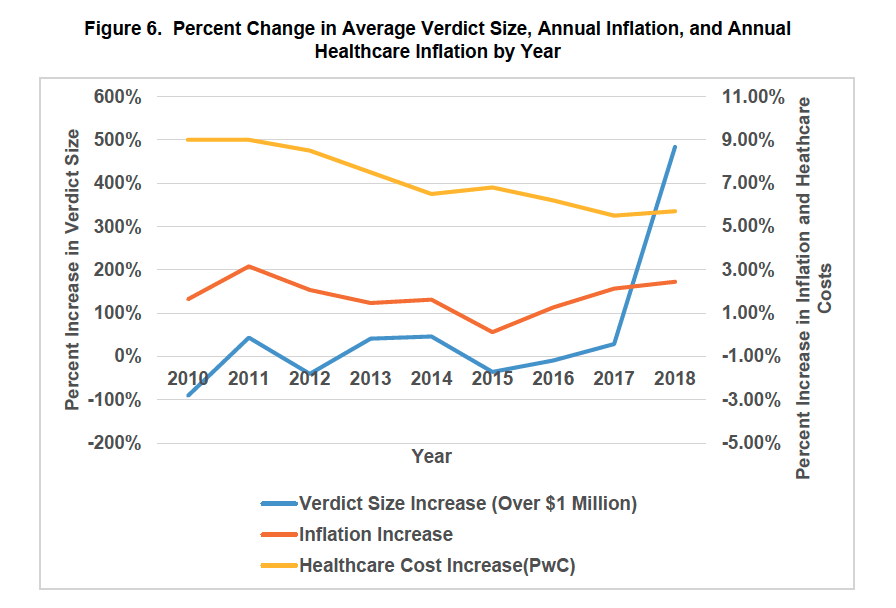
ATRI research demonstrates the recent increase in runaway jury verdicts.
Graph: ATRI
From 2010 to 2018, the size of court verdict awards against trucking companies increased 51.7% a year – while standard inflation and healthcare costs grew 1.7% and 2.9%, respectively, according to a recent report by the American Transportation Research Institute.
ATRI’s research is partially based on a newly created trucking litigation database that provides detailed information on 600 cases between 2006 and 2019, with 26 cases awarding more than $1 million in the first five years of the data and close to 300 similar cases in the last five years.
“Runaway verdicts are increasing in both size and numbers. This study documents a frequency in excessive awards that, while not surprising, tells us that the trial system has gotten completely off track,” said Clay Porter, partner at Porter Rennie Woodard and Kendall.
Here are three things I've recently learned about factors that are driving up the numbers:
1. Lawyers focus on emotion, not facts
An appeals court recently threw out a record $101 million “nuclear verdict” against a trucking company, saying the verdict was excessive and apparently “based upon the jury's disapproval of FTS rather than adequate and reasonable compensation for Patterson's actual injuries.”
And that’s exactly what many plaintiff’s lawyers are trying to achieve.
One term you hear in relation to this is “reptile theory” – the strategy of unlocking the jury’s “reptilian brain,” triggering the primitive part of their mind instead of using logic and applying the facts of the case to the law.
These attorneys are “trying to generate fear and anger in the jury pool over the practices of the trucking company as opposed to the facts of the actual case,” said Todd Reiser, a senior VP and transportation insurance professional with Lockton Companies, during a Truckload Carriers Association virtual safety event in June. “Even if the trucking company wasn’t liable in any way, the attorneys are convincing the jury that the motor carrier doesn’t care about the public.”
“Even if the trucking company wasn’t liable in any way, the attorneys are convincing the jury that the motor carrier doesn’t care about the public.”
ATRI’s report said that while there was much discussion and debate on the existence and role of the reptile theory, “there was general consensus that emotion, egos, and sentiment play a crucial role in ‘winning over the jury.’”
The report also said that the difference between the defense and plaintiff approaches can be defined using classical rhetoric terms: logos vs pathos. “The defense often relies on logic, technical witnesses, compliance with FMCSRs and other rational arguments. Plaintiff attorneys often times rely on emotional pleas and ‘heart string’ stories to win over the jury with sympathy and empathy. The example provided was juxtaposing a mechanical engineer describing brake stopping distances vs a child testifying about the loss of a sibling.”
2. Fraud is getting more sophisticated
Whether it is medical fraud, insurance fraud or crash fraud, ATRI said, it was described as previously uncommon and unsophisticated. “Now entire ‘teams’ involving medical and legal stakeholders as well as fake victims and spotters often work together,” said the report.
One only has to look at the recent news out of New Orleans, where nearly 20 people have been charged in a scheme to purposefully cause accidents with tractor-trailers.
“In some cases, the attorneys knew that the participants were uninjured but referred them to medical providers for treatment to increase the value of subsequent lawsuits,” said a release from the U.S. Attorney’s Office for the Eastern District of Louisiana. “In total, the victim trucking and insurance companies paid out $277,500 for these fraudulent claims.”
One of them, Damian Labeaud, has pleaded guilty, admitting he staged numerous accidents for various attorneys, including at least 40 staged accidents with 18-wheeler tractor-trailers for just a single lawyer.
After each staged accident, Labeaud would connect the passengers in the staged accidents with the attorney, so the lawyer represent them in conjunction with the accident. The attorney would then pay Labeaud $1,000 for every passenger that was involved in a staged accident with an 18-wheeler.
3. ‘Investors’ are rolling the dice on trucking lawsuits
Litigation financing has become one of the fastest-growing trends in trucking litigation. This is where outside interests make investments in plaintiff’s attorney firms and fund lawsuits with the intent of sharing in the winnings. It’s sort of a cross between playing the stock market on Wall Street and rolling the dice in Vegas, and according to ATRI, it’s largely unregulated.
“A private equity firm or a hedge fund could look at a case that the plaintiff’s lawyer might not see as a great chance for a verdict and fund litigation with the intent that if there is a large verdict they get to keep a large amount,” explained Reiser. “People with no interest in these cases are rolling the dice. In many jurisdictions, that’s not even admissible to a jury. The jury isn’t necessarily even aware that some outside party is going to share in the winnings if they do get a big verdict.”
Worldwide, ATRI said, litigation financing is estimated to be a $400 billion industry, although it is just in its infancy in the U.S. Litigation financing in the U.S. grew more than 745% between 2015 and 2019.
Reiser said there are efforts to fight this practice. “We have been making some headway at least in making sure it’s something the juries at least are aware of.”
What can you do?
In ATRI’s conclusions, it notes that “almost any failure to adhere to FMCSRs or company safety policies will be the focus of plaintiff arguments. The most common examples included failure to run proper background checks, failure to conduct or review drug testing, and tolerance of driver violations such as HOS and logbook citations.”
In the FTS case cited above, for instance, the company was sued for negligent hiring, in part because because the truck driver was hired despite having three traffic violations within 36 months before he was hired – even though there was a company policy against it.
ATRI recommends that motor carriers should consider FMCSRs as the minimum standards, which can and should be exceeded. “The ability of defense attorneys to document carrier or driver safety activities that exceed FMCSRs carries great weight with juries.”
Two other sessions we reported on this summer offered some practical advice for what fleets can do to up their safety game in the face of this environment:
More Blog Posts
The Diesel Price Crisis Has No Easy Fix
Washington is trying everything from oil-reserve releases to longer driving hours for fuel haulers. None addresses all the forces keeping diesel prices high.
Read More →
Beyond the Central Transport Settlement: Lessons on Hiring and Risk
The $5.5 million discrimination settlement raises broader questions about hiring practices, safety performance, and the hidden risks that can lurk in a fleet's recruiting process.
Read More →
Are Diesel Shortages Something to Worry About Again?
There’s a certain déjà vu when tensions flare in the Middle East and diesel price spikes can give you panic attacks. What parallels are there between the current situation and the 1970s energy crisis?
Read More →
NOx Isn’t Laughing Gas. Let’s Clear That Up.
A recent EPA reference mixed up NOx and nitrous oxide. It’s an easy mistake. Just not one you expect to see in emissions policy. Let’s look at the difference.
Read More →
TMC 2025 Takeaway 2: Buy... or Subscribe?
TaaS. Does that mean trucks as a service, trailers as a service, or tires as a service? HDT's Deborah Lockridge has another takeaway from the Technology & Maintenance Council meeting in her blog.
Read More →
TMC 2025 Takeaway: The Journey Toward Vertical Integration
HDT's Deborah Lockridge on how the trucking industry has moved toward "vertical integration" over the past 25 years.
Read More →
Trucks Are For Girls!
HDT Editor and Associate Publisher Deborah Lockridge is a longtime Girl Scout leader and loves to connect her passion for inspiring girls with her love of the trucking industry.
Read More →
Trucking Advocacy: Impact Beyond the 2024 Elections
No matter who wins the election, trucking continues to work to educate the people who pass the laws and make the rules that affect the industry. HDT's Deborah Lockridge shares insights from two major trucking associations in her All That's Trucking blog.
Read More →
Recharge Your Brain for Better Business
Skimping on vacation may be the worst thing you can do for your business, your career, and your mental health. In her All That's Trucking blog, Deborah Lockridge writes about the importance of giving your brain what it needs to be innovative.
Read More →
Trucker Pre-Trip Leads to Mission 'Im-paw-sible'
See what happened when a truck driver found an unexpected stowaway during his pre-trip inspection.
Read More →