





A Tough But Rewarding Journey: 4Gen’s Path to All-Electric Trucks[Video]
Why Zero-Emission Trucks See Higher Tire Wear
More torque, more weight, more wear: 4Gen Logistics shares more insights into the tire trade-offs of going electric with heavy-duty trucks.
October 2, 2025
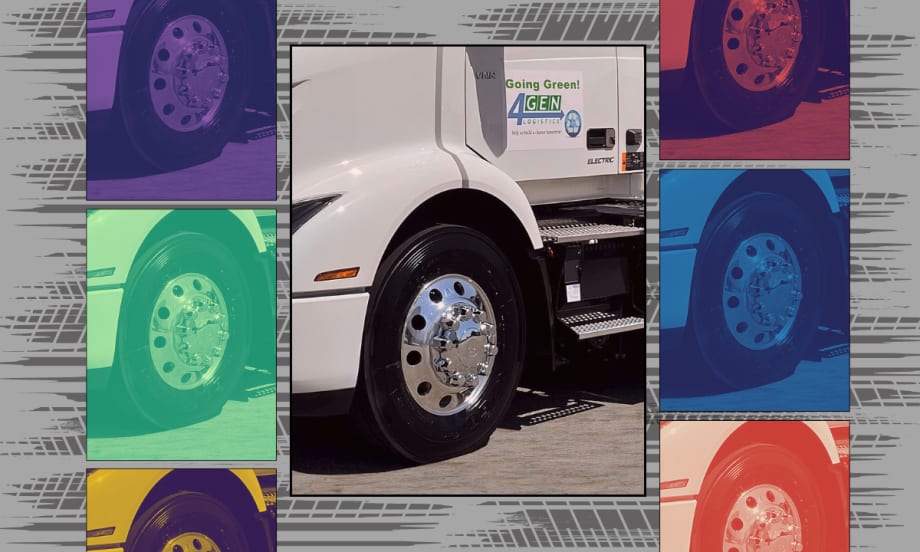
4Gen's Brad Bayne shares more on why tires wear faster on battery-electric trucks.
Credit:
HDT Graphic/4Gen Photo
3 min to read
A Heavy Duty Trucking reader had some questions about zero-emission trucks and tire wear after reading the recent story, “What 4Gen Logistics Has Learned About Electric Trucks.”
In that article, Brad Bayne, VP of strategic initiatives for 4Gen, talked about his experience in electrifying the southern California drayage fleet. One of those insights was that tires wear faster on battery-electric and hydrogen-fuel-cell trucks. While Bayne and his team knew going in that tire wear would be greater, the reality was a bit worse than they expected.
This reader was curious about just how the additional tire wear occurs.
“Is it due to higher acceleration rates with the EV powertrain? My thinking is this: Most of the miles and time are spent at highway speeds, e.g. in top gear for the diesels. That is not a high torque condition for the tires. That leaves two situations: One, the EVs climb hills faster, because they have more torque available; and two, EVs accelerate from lower speeds with the higher torque available.
“Meanwhile, diesels have a lower maximum torque available, so the only way to multiply the torque is when the transmission is operating in lower gears. That would be during acceleration from a stop or low speed, during hill climbs, and during downhill braking. Where do the EV's have an advantage? Acceleration and downhill braking (regeneration).
Bayne was kind enough to respond with some answers and insights:
Weight and Torque in Zero-Emission Trucks
BEVs are heavier than diesels, and the additional torque is a major factor.
Torque varies by OEM, but our fleet ranges from 2,000 to 10,000 ft-lbs, compared to about 1,600 ft-lbs on a typical diesel.
Because of this, BEVs can accelerate nearly the same, whether empty or fully loaded at 80,000 lbs. When drivers launch too aggressively from a stop, that extra torque directly increases tire wear.
Grade Performance and Powertrain Differences Between Diesel and Electric Trucks
On moderate grades (3–4%), our BEVs and FCEVs can climb at twice the speed or more of a diesel. We don’t encourage this behavior, but when it happens, it leads to additional wear.
Most BEVs have just two gears. For example, our Volvos shift from 1st to 2nd at around 20 mph, making their driveline performance very different from any diesel transmission.
BEV Duty Cycle Realities
BEVs aren’t yet a regional or long-haul replacement. They’re primarily used in drayage and short-haul operations (100–250 miles), where constant stop-and-go driving is common.
This operational profile magnifies both the torque advantage and the associated tire wear.
Regenerative Braking on Electric Trucks
Regenerative braking is a key benefit. We train drivers on one-pedal driving, which is strong enough that in many cases, brakes are never used.
Some of our drivers recover up to 20% of their daily energy use from regen alone.
While there’s not much formal data yet, many in the industry suspect regen also contributes to tire wear due to the way energy transfer and deceleration forces are applied.
In short: Heavier vehicles, higher torque, and unique duty cycles all drive higher tire wear on battery-electric trucks.
At the same time, regenerative braking delivers meaningful efficiency gains and reduced brake wear, although it may also contribute to tire wear in ways that are still being studied.
Subscribe to Our Newsletter
More Maintenance

Sponsored•September 16, 2026
Color Match Smarter: Tools That Restore & Perform
For fleet managers and collision repair professionals keeping heavy-duty trucks on the road, getting the color right the first time isn't just about appearance — it's about efficiency, turnaround time, and bottom-line results. Discover how today's digital color tools are transforming the repair process from guesswork to precision.
Read More →
Wrong Repair Prompts Recall of Freightliner, Western Star 4x2 Trucks
DTNA is recalling more than 2,400 trucks that received an incompatible software fix instead of the hardware repair required to address brake valve corrosion.
Read More →
Truck Drivers Need More Than Another Alert
Fleets have more visibility into truck health, safety events, and driver activity than ever. The next challenge is turning all that information into useful guidance for the person who has to decide what to do next.
Read More →
The Maintenance Checks Trucking Fleets Should Prioritize Before Fall Freight Picks Up
Making it through August isn’t the same as being ready for the next several months of operation. Find out what systems may have suffered from summer heat and need to be checked out before fall.
Read More →
What Three Fleets Are Doing Differently When Buying Truck Parts in 2026
With freight improving but costs still climbing, fleet maintenance executives explain how they're balancing price, quality, and supplier relationships.
Read More →
Paccar Recalls 2027 Trucks Built This Summer for Possible Electrical Problem
The nearly 6,000 Kenworth and Peterbilt trucks in the recall could potentially lose engine power, among other things.
Read More →
Will API PC-12 Oil Change Trucking Fleet Maintenance?
The new API PC-12 heavy-duty engine oil category reflects the changing demands of modern diesel engines. But fleets like Foodliner are looking to getting their own data before making decisions on adopting the new oils and questions such as extending oil drain intervals.
Read More →
Brake Safety Week to Focus on Drums and Rotors
Commercial vehicle inspectors are focusing on truck brakes during CVSA's Brake Safety Week, August 23-29.
Read More →Possible Battery-Cable Fires Prompt Recall of 15,000+ International MV and HV Trucks
On the recalled vehicles, manufacturing variations can cause the battery interconnect cable to contact the auxiliary stud and hold down the bracket.
Read More →
Rush, MCT Team Up to Grow Refrigeration Service Network
The joint venture will operate MCT's network of Carrier Transicold dealerships and mobile service locations, with the companies promising greater service capacity and uptime for refrigerated fleets.
Read More →