




Why Trucking May Not Be a Leading Economic Indicator This Cycle
Traditionally, trucking was looked to as an early indicator of larger economic problems. Find out why HDT’s economic analyst thinks this freight cycle may be different.

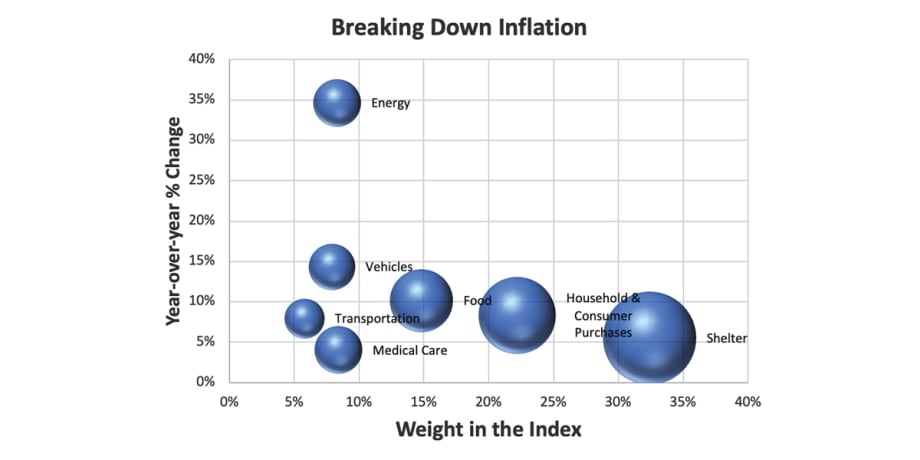
The May consumer price index report showed an unexpected acceleration in total inflation to about 8.6%.
Source: Bureau of Labor Statistics/Tahoe Ventures
Inflation, Inventory Bullwhip, Stagflation, Recession… there’s no shortage of negative headlines. Yet freight markets continue to show positive volume growth and double-digit yield improvement, resulting in stronger year-over-year profits. Rental utilization remains strong, less-than-truckload weight per shipment continues to rise, and industrial production continues to improve at a 6% clip.
So are the stock market and media concerns overblown?
Traditionally, trucking was looked to as an early indicator of larger economic problems. This freight cycle may be different.
The type of slowdown we could be headed toward might not resemble anything we have seen in about 50 years. Each of the last four or five downturns (excluding the Covid-shutdown recession of 2020) was caused by an imbalance of some sort. In 1990 it was the savings and loan crisis. In 2001, the dot-com bubble; in 2008-2009, the housing/mortgage crisis. And the soft economic landings of 1986, 1995, 2015 and 2019 were inventory/overbuild driven.
Why This Cycle Is Different
What is different this cycle is we have uncontrolled inflation that was given an unexpected boost by the geopolitical events in Europe. We have broken down the sources of current inflation and their weight in the calculation of the index in the graph below to make this point.
The May consumer price index report showed an unexpected acceleration in total inflation to about 8.6%. It rose 1% from April after a 0.3% increase the previous month. The largest contribution was from energy. Energy makes up only 8.3% of the index, but this sector rose 34.6% year-over-year, largely over concerns about a potential withdrawal of Russian oil. This accounted for about 2.9% of that 8.6% inflation.
The second largest contribution was the cost of shelter. It only rose 5.5%, but it accounts for about 32.4% of the index, so that’s another 1.8% of the 8.6%.
The other large contributions came from food, which saw 10.1% inflation because of drought, supply chain challenges, and the Russia-Ukraine conflict. This accounts for about 14.8% of the index, or about 1.5% of the 8.6%. Vehicles (new and used) account for 7.9% of the index and saw inflation of 14.3%.
How Do We Beat This Inflation?
In theory, the government can try to slow the economy by raising interest rates (monetary policy) and taking actions such as releasing strategic oil reserves and improving supply chain congestion (fiscal policy). A slowing economy will result in slower growth or contraction in housing/rent, energy use/prices, and consumer prices. Hopefully, inflation should moderate toward a more acceptable level like 3% to 4%.
However, here is the concern: This might not be enough to contain inflation. A continued push for higher rates may slow economic activity too much, causing a recession.
Energy and food inflation (23% of the index) are being caused more by geopolitical events in Europe and weather, which governmental slowdown initiatives cannot control. Furthermore, the supply chain squeeze might take more than the economy to stabilize, and that accounts for about 20% of the index.
Lastly, the 32.4% of the index that is being caused by shelter costs might not slow quickly with rising interest rates. The positive news is that shelter, medical, and transportation-related inflation is only rising at a 5.6% rate, contributing only a 2.6% impact toward the index. Food and energy are adding 4.5% to the figure.
What’s the Message for Trucking?
We may not see it yet, but the slowdown is coming. Consumer spending patterns are already reacting to the higher prices. The magnitude and duration of the pending downturn remains uncertain, and the market for bank and capital access may be more challenging in a year.
Will there be a recession? Most likely. When will it happen and how long will it last? This is the uncertainty, so plan accordingly. By the time we see it in the freight data, it may be too late.
This commentary first appeared in the July 2022 issue of Heavy Duty Trucking.
More from Jeff Kauffman: Fleet Financial Trends Imply Solid Start to 2022
More Fleet Management

Color Match Smarter: Tools That Restore & Perform
For fleet managers and collision repair professionals keeping heavy-duty trucks on the road, getting the color right the first time isn't just about appearance — it's about efficiency, turnaround time, and bottom-line results. Discover how today's digital color tools are transforming the repair process from guesswork to precision.
Read More →
FMCSA Pauses Biennial-Update Enforcement Amid Motus Transition
Carriers whose updates were due on or after June 1 have more time, while FMCSA works to stabilize its new registration system and warns of phishing sites impersonating its new carrier registration system, Motus.
Read More →
2026 Blueprint for Countering Smarter Supply Chain Theft
Cargo theft is no longer just the cost of doing business. It's a multi-billion-dollar criminal enterprise exploiting vulnerabilities across your fleet, drivers, and supply chain.
Read More →


How Telematics Improves Visibility, Control, and Performance in Refrigerated Fleets
Explore how telematics help refrigerated fleets improve visibility, uptime, efficiency, compliance, and cargo protection across connected cold chain operations.
Read More →
What the U.S.-Canada Trade War Means for Trucking
Escalating U.S.-Canada tariffs could disrupt cross-border freight, reduce truck volumes, raise costs, and create new uncertainty for carriers on both sides of the border.
Read More →
What Are Trucking’s Top Concerns for 2026?
The American Transportation Research Institute wants to know what's worrying trucking fleet managers, drivers, and other stakeholders in its annual Industry Issues survey.
Read More →
American Trucking Associations Looks for a New Leader
ATA President and CEO Chris Spear abruptly left his job at the association on August 21, at a pivotal time for the trucking industry.
Read More →
Public Wi-Fi Cybersecurity Risks: How Truck Drivers and Fleets Can Protect Their Data
Public Wi-Fi can expose truck drivers and fleets to credential theft, malware, and other cyber threats. Here’s how to reduce the risk on the road.
Read More →
For Nicky Cupp, Fleet Innovation Starts With Frustration
HDT Truck Fleet Innovator Nicky Cupp turns everyday pain points at Fraley & Schilling into opportunities for better technology and smarter processes.
Read More →
Adam Buttgenbach’s Approach to Electric Trucks: Start With Where They Fit
HDT Truck Fleet Innovator Adam Buttgenbach helped PepsiCo build one of North America’s largest EV fleets by focusing on where electric trucks make operational sense.
Read More →