




What Does Inflation Mean For Trucking?
Driver costs, equipment costs, insurance costs, travel and food costs may have longer-term legs of reducing the purchasing power of your budget, says HDT's Contributing Economic Analyst Jeff Kauffman.

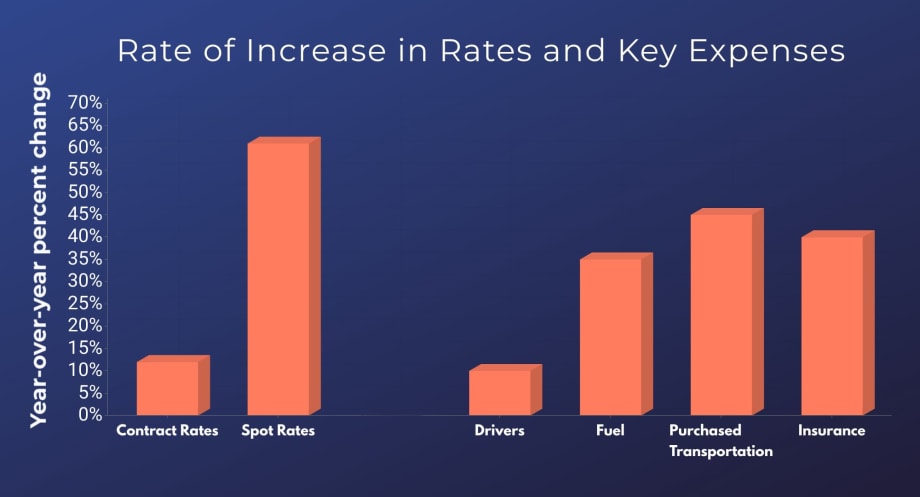
Driver costs, equipment costs, insurance costs, travel and food costs may have longer-term legs of reducing the purchasing power of your budget.
Source: Truckstop.com, FTR, company reports
We’re hearing the word “inflation” a lot these days, a term we haven’t used much in the economic world for some time — decades, in fact.
I’m not talking about the air in your tires, or when someone inflates a grade from a B to a B+. It’s not about seeing higher fuel prices caused by a specific situation or that are otherwise short-term in nature (the better term in this case would be “headwind.”)
No; the type of inflation I am going to discuss this month is the scary type of inflation. Here I’m talking about a sustained increase in the overall general level of prices that results in a decline in the purchasing power of money. Those three elements make this different from a cost headwind.
It’s a little like the Matrix for you movie fans. You can’t see it, feel it, or touch it, but it is all around you — raising the cost of everything in your life, from the food you eat and the things you buy to expectations about your future ability to afford the things that are important to your company.
How did we get here?
What is going on right now was created by a series of events. It started with global shutdowns across multiple economies due to the COVID-19 pandemic. This forced a change in consumption patterns that resulted in an unanticipated acceleration in demand for certain goods above normal levels.
Then there was a sharp resumption of broad demand as economies began to reopen. But there was not a like-kind resumption of productive capacity, making the shortages more acute and affecting more industries, such as microchips, lumber, and steel. This created a bottleneck in supply chain efficiency, forcing shippers to seek expensive and creative solutions. Add to that the impact of extended social programs and challenges such as the need to find child-care when schools were shut down, which have reduced the number of job seekers, and you now have labor shortages that have led to a rapid increase in low-end wages.

Jeff Kauffman
All this has affected the cost of almost every commodity. The measure much of the financial world follows is the Consumer Price Index (CPI), which rose by a higher-than-expected 5% in May — the fastest rate since 2008, according to the Bureau of Labor Statistics. There is hope that as extended unemployment benefits end, workers will come back to jobs, reducing labor cost inflation, but I am not so sure of that.
Commodity inflation seems like it is going to be here for a while. This means that eventually, companies will have to further raise their prices. The same income will buy fewer things, reducing spending power.
What does this mean for trucking?
Equipment costs will rise, and probably meaningfully. By our numbers, it’s about an $8,000 to $9,000 increase on what used to be a $30,000 trailer because of higher lumber, aluminum, steel, and polyethylene costs. The worker shortage will also force direct labor costs to rise, so your capital budget won’t go as far.
This, in our view, is why recent equipment orders are dropping — not because OEMs are sold out, but because they are repricing backlog and fleets can afford fewer vehicles.
In terms of operations, driver costs will continue to rise (they’re already up about 9-10% right now). Staffing costs will rise with higher minimum wages and skilled worker shortages (total labor expense averages about one-third of revenues, so that would require a 3-4% rate increase to cover).
Fuel costs are up 34% year-over-year, implying another 3-4% rate increase needed (although many companies surcharge for this).
Spot rates are still about 60% higher, implying purchased transportation costs could remain elevated. Many carriers are absorbing about 40-50% higher insurance costs, so another 1-2% rate increase is needed there.
Overall, that’s about a 10-12% rate increase required to offset higher costs (less for less-than-truckload fleets). Right now, the market is allowing carriers to recover that, so margins are rising. But recall, our definition of inflation emphasizes sustained increases. How long can fleets continue to price at these levels? Maybe for the next year. But driver costs, equipment costs, insurance costs, travel and food costs may have longer-term legs of reducing the purchasing power of your budget.
This commentary appears in the July 2021 issue of Heavy Duty Trucking.
More Fleet Management

Color Match Smarter: Tools That Restore & Perform
For fleet managers and collision repair professionals keeping heavy-duty trucks on the road, getting the color right the first time isn't just about appearance — it's about efficiency, turnaround time, and bottom-line results. Discover how today's digital color tools are transforming the repair process from guesswork to precision.
Read More →
FMCSA Pauses Biennial-Update Enforcement Amid Motus Transition
Carriers whose updates were due on or after June 1 have more time, while FMCSA works to stabilize its new registration system and warns of phishing sites impersonating its new carrier registration system, Motus.
Read More →
2026 Blueprint for Countering Smarter Supply Chain Theft
Cargo theft is no longer just the cost of doing business. It's a multi-billion-dollar criminal enterprise exploiting vulnerabilities across your fleet, drivers, and supply chain.
Read More →


How Telematics Improves Visibility, Control, and Performance in Refrigerated Fleets
Explore how telematics help refrigerated fleets improve visibility, uptime, efficiency, compliance, and cargo protection across connected cold chain operations.
Read More →
What the U.S.-Canada Trade War Means for Trucking
Escalating U.S.-Canada tariffs could disrupt cross-border freight, reduce truck volumes, raise costs, and create new uncertainty for carriers on both sides of the border.
Read More →
What Are Trucking’s Top Concerns for 2026?
The American Transportation Research Institute wants to know what's worrying trucking fleet managers, drivers, and other stakeholders in its annual Industry Issues survey.
Read More →
American Trucking Associations Looks for a New Leader
ATA President and CEO Chris Spear abruptly left his job at the association on August 21, at a pivotal time for the trucking industry.
Read More →
Public Wi-Fi Cybersecurity Risks: How Truck Drivers and Fleets Can Protect Their Data
Public Wi-Fi can expose truck drivers and fleets to credential theft, malware, and other cyber threats. Here’s how to reduce the risk on the road.
Read More →
For Nicky Cupp, Fleet Innovation Starts With Frustration
HDT Truck Fleet Innovator Nicky Cupp turns everyday pain points at Fraley & Schilling into opportunities for better technology and smarter processes.
Read More →
Adam Buttgenbach’s Approach to Electric Trucks: Start With Where They Fit
HDT Truck Fleet Innovator Adam Buttgenbach helped PepsiCo build one of North America’s largest EV fleets by focusing on where electric trucks make operational sense.
Read More →