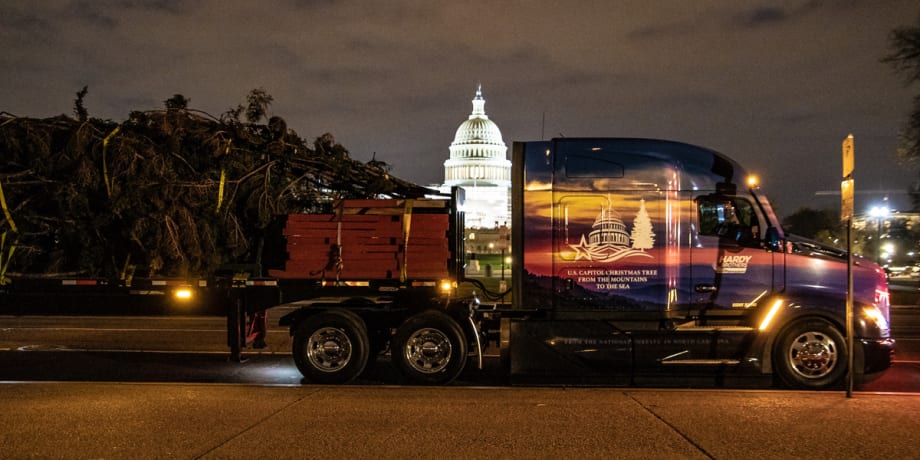
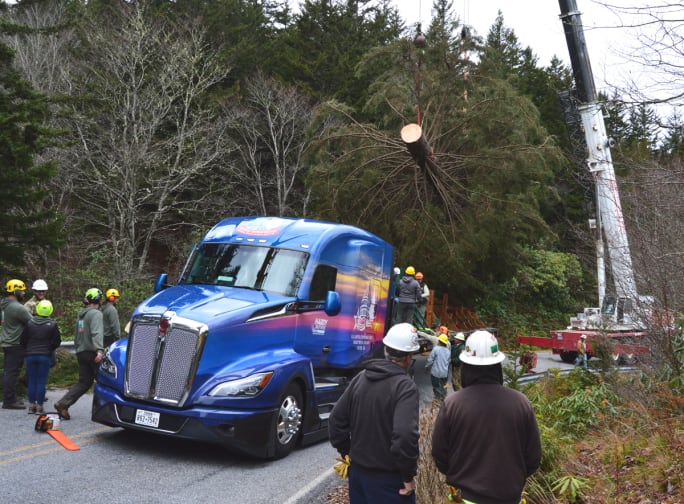
A husband-and-wife truck driver team for Hardy Brothers delivered the U.S. Capitol Christmas tree from North Carolina to Washington, D.C. Read what it takes to transport the tree.
A husband-and-wife truck driver team for Hardy Brothers delivered the U.S. Capitol Christmas tree from North Carolina to Washington, D.C.
Photo: James Edward Mills
3 min to read
For the third time, the Christmas tree on display on the U.S. Capitol building lawn came from the National Forests in North Carolina. And just like most good things, it was hauled in on a truck.
Ad Loading...
Each year, a carrier is selected to transport a tree from cut-down to installation. This time, the honor goes to Siloam, North Carolina-based carrier Hardy Brothers Inc.
The husband-and-wife driver team of Harold “Ed” Kingdon Jr. and Deborah Kingdon hauled a 78-foot tall Red Spruce harvested from the Pisgah National Forest in North Carolina to the West Lawn of the U.S. Capitol building in Washington, D.C.
Ad Loading...
Ed Kingdon Jr. and Deborah Kingdon hauled a 78-foot tall Red Spruce.
Photo: James Edward Mills
Who: Hardy Brothers Inc.
Where: Siloam, North Carolina
Fleet: 55 Kenworth trucks, 100 drivers
Operations: Coast-to-coast refrigerated freight
Fun Fact: Ed and Deborah Kingdon have been married for 42 years.
Challenge: Transporting the Capitol Christmas Tree
To get there the Kingdons drove a Kenworth T680 Next Gen equipped with a 76-inch mid-roof sleeper and the Paccar powertrain. The Kingdon’s typically drive a 2022 T680, but this T680 Next Gen was decked out with Kenworth’s latest features and comforts, including a 15-inch digital display and advanced driver assistance systems.
While the tree had to be delivered by Nov. 18 in order to be set in place by Nov. 30 for the official tree lighting ceremony, the driver team had to make daily stops on their way through North Carolina. The tree was on its two-week media tour.
What would typically be a day-long haul for the team, was stretched to 14 days.
“It’s going to be a whole mindset difference,” Ed Kingdon told HDT while the team was prepping for the run. “We're accustomed to team driving: drive, sleep, switch, drive, sleep, switch. This is going to be a lot slower and it's going to be whole different management of our 14-hour clocks because of the stops and overnights. That's going to be a much slower pace.”
En route to Washington D.C., the Kingdons made stops at places like visitor centers, the North Carolina Zoo, a high school, and more. The Kingdons describe themselves as “people persons,” so they met their role of has the official drivers with excitement, and said they were honored to do it.
Ad Loading...
The team has been in trucking for about four years, but before that Ed was active duty miliary; for seven years he was based in D.C. He had dreamt of driving a truck in his retirement from the military… but it took him about two years to finally convince his wife on get on board. She received her CDL in 2018, and they found a home with Hardy Brothers, which is a carrier made up largely of team drivers.
The Kenworth T680 Next Gen truck being used to transport the 2022 U.S. Capitol Christmas tree is designed with an official logo and displays this year’s tour theme “From Mountain to the Sea.”
Photo: Kenworth
With Ed’s last active-duty assignment in Washington, D.C., the haul brings him full circle. This time, his wife gets to come along.
“It meant a lot to me to be able to be part of this haul after working up there for so long and enjoying the city and the people,” he says. “That kind of connection was exciting for me. And it's bipartisan. It's a common purpose. What we're hauling is a joy, a coming together… communities are making decorations for the tree itself and for the companion trees. We’re part of bringing that enthusiasm and joy for the season to Washington, D.C. and from North Carolina.”
For fleet managers and collision repair professionals keeping heavy-duty trucks on the road, getting the color right the first time isn't just about appearance — it's about efficiency, turnaround time, and bottom-line results. Discover how today's digital color tools are transforming the repair process from guesswork to precision.
Carriers whose updates were due on or after June 1 have more time, while FMCSA works to stabilize its new registration system and warns of phishing sites impersonating its new carrier registration system, Motus.
Cargo theft is no longer just the cost of doing business. It's a multi-billion-dollar criminal enterprise exploiting vulnerabilities across your fleet, drivers, and supply chain.
Explore how telematics help refrigerated fleets improve visibility, uptime, efficiency, compliance, and cargo protection across connected cold chain operations.
Escalating U.S.-Canada tariffs could disrupt cross-border freight, reduce truck volumes, raise costs, and create new uncertainty for carriers on both sides of the border.
The American Transportation Research Institute wants to know what's worrying trucking fleet managers, drivers, and other stakeholders in its annual Industry Issues survey.
HDT Truck Fleet Innovator Adam Buttgenbach helped PepsiCo build one of North America’s largest EV fleets by focusing on where electric trucks make operational sense.