





HDT Talks Trucking Podcast: How Do We Get Started With Electric Trucks?
What Penske Learned About Charging Electric Trucks
Penske’s journey into the complex world of figuring out charging for medium- and heavy-duty electric trucks began a little over two years ago when it teamed up with Daimler Trucks North America for the Freightliner Electric Innovation Fleet of eCascadia and eM2 106 trucks.
October 1, 2020
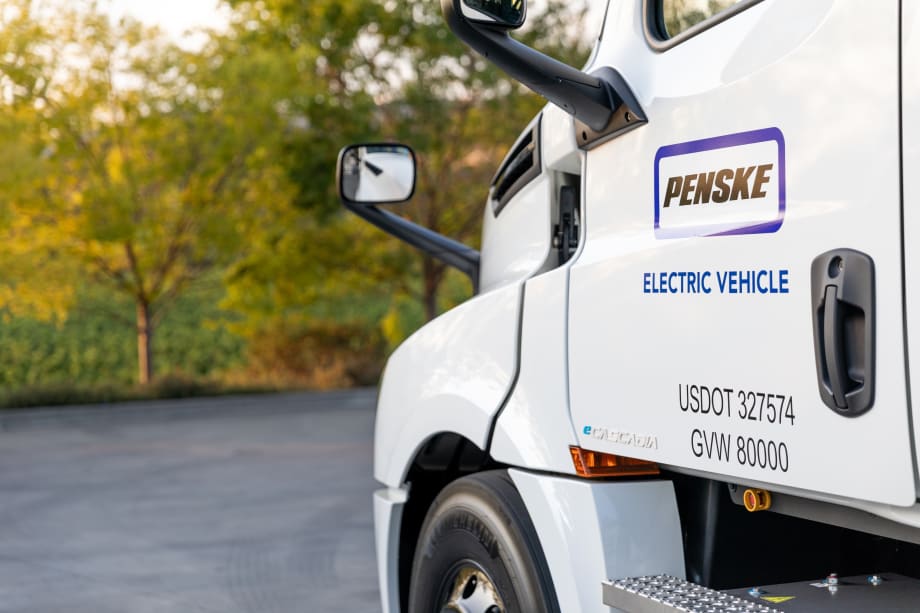
Penske's involvement with the Freightliner Electric Innovation Fleet has taught it a lot about electric truck charging.
Photo: Penske
3 min to read
Penske’s journey into the complex world of figuring out charging for medium- and heavy-duty electric trucks began a little over two years ago when it teamed up with Daimler Trucks North America for the Freightliner Electric Innovation Fleet of eCascadia and eM2 106 trucks. The keys to the first truck in the fleet were delivered in late 2018.
Mike Barnes, senior regional facilities manager for the western region for Penske Transportation Solutions, recently shared some of the lessons learned during an electric charging panel as part of the ACT Virtual event.
“We had to develop EV charging for 20 trucks in southern California,” he explained. “Space was limited at our existing facilities, so we had to find a site, it had to be in close proximity to our customer base, and the biggest challenge was locating a facility that had 480-volt three-phase. Most sites were built with 208-volt.”
Barned said it’s important to engage the utility company early in the process and keep them involved as much as possible. Do you have enough power to your facility for current and future growth?
“I can’t stress enough the importance of a strong engineer and contractor with experience working with cities and utilities,” Barnes said. The design took about eight weeks, permitting eight to 10 weeks, and utility and construction seven to 10 months. “You really want to plan ahead with the design team and contractors to avoid costly delays.”
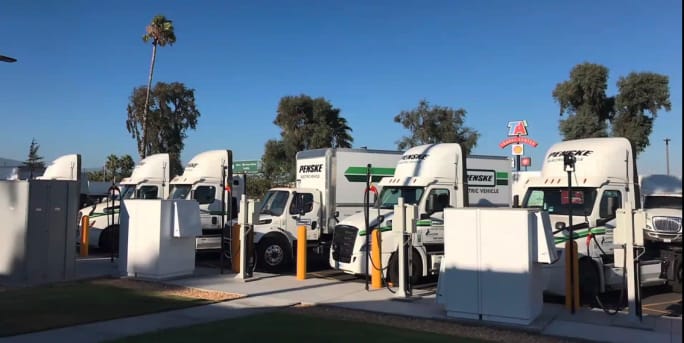
Penske opted for angle-in parking at its southern California electric charging facility.
Photo: Screenshot of Penske Presentation during ACT Virtual
He also recommended designing your facility for growth. That doesn’t mean you have to build out the full infrastructure up front, but properly sizing the main distribution panel for adding conduits for future growth will save costs in the long run, he said. “Communicate with the utility company on your planned growth 10 years out,” he said.
Penske added a battery storage unit, which will give it the ability to charge all hours of the day while keeping costs down.
The company worked with three different charger vendors to test out what was available. While there were challenges and downtime problems with all of them, “at the end of the day, each performed to the capabilities we were told," Barnes said. It’s very important to maintain a close working relationship with those vendors, he added. “We found sometimes a charger would quit charging after they performed some sort of an upgrade.”
“We chose angle parking vs. pull through; the cables are 25 feet... and you want to get the truck as close as you can to that [charging] equipment. It has to plug into the charge port in back of the cab. Know where your truck charge port is, the length of chargers you need, the charger location, and plan for that.” Penske installed a cable-management system to keep the cables off the ground and avoid trip hazards.
Networking and software is another important area to consider. “When you charge will dictate how much you spend and how fast you charge,” he said. “You really have to think through network and scheduling (to avoid peak hours).”
The software that provided charging analytics helped identify trucks that were coming back in with less of a charge left than others, Barnes said. “We found that certain drivers had different behaviors, like not using regenerative braking, so the battery would have less of a charge than someone using it correctly.” Identifying those drivers provides an opportunity for coaching in proper electric-vehicle driving techniques.
Don’t forget maintenance and repair, Barnes said. “When those chargers go down, you need a vendor on standby to service those chargers,” he said. One area that still somewhat unknown when it comes to maintenance, he said, is the availability of replacement parts. “A lot of parts are coming from overseas; how much inventory of things like cables, fans, DC power supply, do you need to have on hand?”
Subscribe to Our Newsletter
More Fuel Smarts

How Volvo Updated Its D13 for EPA 2027 [Watch]
Volvo’s updated D13 promises lower emissions without sacrificing performance or fuel economy. Take a closer look at what changed inside the engine in this HDT Spotlight video.
Read More →
Diesel Price Spike Shortens Payback for Natural Gas Trucks, Report Says
Energy Vision estimates fleets could recover the higher purchase price of an RNG-fueled Class 8 tractor in 1.3 to 2.8 years under current fuel-price scenarios.
Read More →
Calstart Becomes Catalyst Mobility, Reflecting Broader Focus
Calstart is now Catalyst Mobility, reflecting the nonprofit’s growing national role in clean transportation, including zero-emission trucks, infrastructure and incentive programs.
Read More →

Record Diesel Prices Squeeze Trucking Fleets
Average U.S. diesel prices have climbed to nearly $6 a gallon, surpassing the 2022 record as tight refinery capacity and Middle East disruptions keep fuel costs elevated.
Read More →
Sponsored•September 9, 2026
How Fuel Delivery Shapes Engine Performance
Fuel delivery depends on more than what happens at the injector. For fleet, maintenance and technical professionals, looking at the full path from pump to injector can provide useful context for understanding engine performance.
Read More →
East Coast Port Launches $45M Electric Truck Push
The Port Authority of New York and New Jersey announced millions in incentives for zero-emission drayage trucks, yard tractors, and new charging hubs near the port.
Read More →
California Bill Could Shed Light on Electric Truck Prices
Why do battery-electric Class 8 trucks remain so expensive? A California bill headed to Gov. Gavin Newsom would give fleets and state agencies more visibility into what manufacturers charge.
Read More →
Detroit Opens Orders for EPA 2027 Engines
Detroit isn’t starting from scratch to meet EPA 2027 diesel emissions standards. Its Gen 6 DD13 and DD15 engines keep much of today’s platform while updating the fuel and aftertreatment systems.
Read More →
Zero-Emission Truck Corridor Planned for West Coast
California, Oregon, Washington, British Columbia and Baja California are coordinating plans for truck charging and hydrogen fueling from Canada to Mexico.
Read More →
A Closer Look at Kenworth’s Electric T880E Vocational Truck [Video]
Learn more about Kenworth's T880E battery-electric vocational truck at the Paccar Technical Center, including its range, applications, upfitting considerations, and PTO options, in this HDT Spotlight video.
Read More →