




Volvo's 750-Horsepower Truck and Sweden's Longer, Heavier Trucks
What makes a truck and engine manufacturer want to launch a 750-horsepower engine for standard trucks? Volvo already offered its 16-liter inline six cylinder engine with overhead camshaft, four valves per cylinder and unit injectors, capable of 700 horsepower
What makes a truck and engine manufacturer want to launch a 750-horsepower engine for standard trucks? Volvo already offered its 16-liter inline six cylinder engine with overhead camshaft, four valves per cylinder and unit injectors, capable of 700 horsepower.
"With the Volvo 750-horsepower, we can offer our customers a truck with absolute top performance, good fuel efficiency and extremely low emissions, "said Staffan Jufors, president and CEO of Volvo Trucks during the September launch of the 750-horsepower version of the 16-liter powerplant.
Maybe that is not the entire explanation. Continental Europe already suffers from overcrowded highways. Traffic can be stalled for hours, not only in case of roadwork or an accident, but also because of more vehicles than the road was designed to handle.
How is Europe to meet the constant growing transport needs? Longer, heavier and more powerful trucks may be the answer, says Anders Ahlback, head of the Area of Advance for Transport, Chalmers University of Technology in Gothenburg, Sweden.
Of course, this is the same debate we're having here in the U.S.
On both sides of the Atlantic, the idea is that more freight can be carried by fewer vehicles. This in turn reduces fuel consumption and climate impact in relation to the transport work being undertaken, Ahlback says.
This would tie in well to EU's tough climate targets. The EU has decided to reduce emissions of greenhouse gases from the transport sector by 20% between 2008 and 2030.
If more countries in Europe decided to follow Sweden's and Finland's example and allowed truck rigs of up to 25.25 meters (83 feet) in length and 60 ton (132,279 pounds), one in every three semi-trailers on Europe's roads would no longer be needed, Ahlback concludes.
Runs smoothly
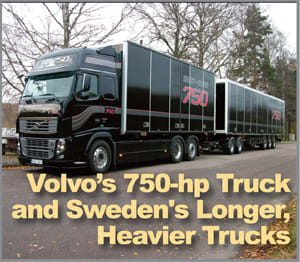
During a recent 50-miles drive in Sweden as part of a Volvo event hosting North American truck editors, I got first-hand experience on a rigid truck and drawbar trailer combination with a total length of 25.25 meters (83 feet). The combined gross weight was 60 metric tons (132,277 pounds). Actually, the trailer was a combination of a two-axle dolly with its fifth wheel hooked to an ordinary three-axle 13.6 meter (44.6 foot) semitrailer, creating a freestanding vehicle that attaches to the rigid truck.
In contrast, most of Europe sets maximum tractor and semitrailer lengths at 16.5 meters (44.6 feet) or rigid truck and drawbar trailer to 18.75 meters (59 feet), both with gross combination weights of 40 tons.
Our trip went from the Volvo Truck Corporation Vehicle Demo Center in Gothenburg, Sweden, to a truckstop in Vargarda along the E20 highway - a major truck road to the Swedish capital of Stockholm. The COE model FH16 with 750 horsepower and a maximum torque of 2,600 pounds-feet runs very quiet, although its rude power always feels present.
The Volvo I-Shift automated transmission is fitted as the only choice. It has been designed to handle the engine's high torque. There's no clutch pedal, but it is possible to press a button to maintain a high-rev power mode for high torque during a hill climb.
The FH16-750 is designed for the most demanding special-permit heavy hauling of up to 250 tons (551,155 pounds). But it's also for transporters who want or need to maintain a steady pace regardless of the topography. For these fast long-haul duties, there is a solo drive axle as a fuel-efficient alternative.
Interestingly, the drawbar trailer, in spite of the increased length, follows as well as, if not better than, as a semitrailer through bends, including roundabouts.
Sweden's longer trucks
Sweden, home of Volvo Truck Corp., is the fifth largest country in Europe and its surface is about the same as the state of California. It's a narrow but long nation with only 9 million inhabitants. Of those, two-thirds live in the southern third. If you start driving in the most southern part and headed north beyond the Arctic circle, the distance you would travel would be the same as it would if you drove south to Milan, Italy.
In this vast country, long vehicle combinations have been a long tradition. In 1966 a length limitation of 24 meters (78.7 feet) was introduced along with a 52 metric ton GCW limit (114,640 pounds). Before that year, trucks could be as long as you wanted, but in practical terms the longest were about 30 meters (98.4 feet).
Instead of tractor and semitrailer, most long-haul trucking in Sweden takes place with this type of rigid truck with drawbar trailers. Most are 24 meters (78.7 feet) long. The concept makes it possible to carry one 20-foot intermodal container on the rigid truck's 25-foot cargo space and a 40-foot container on the drawbar trailer and its 40.5 foot platform.
Volvo has been trying to get the European Union to introduce the Scandinavian 25.25-meter modular system in other European countries.
Just as in the U.S., politicians in continental Europe are resisting the longer vehicles. How is this going to affect the inner cities and small villages in rural areas? The fact is that in Sweden the rigid truck with its drawbar trailer runs days and nights on highways only. The trailer is, as said, often an regular semitrailer, hooked up on a dolly's fifth wheel.
Once arriving to its destination, the trailer is docked to a warehouse for unloading and new load, while the rigid truck is free to drive around for to-the-door deliveries and pick-ups.
Germany has made some trials with modular combinations, and the Netherlands are well on their way. Denmark allows such trucks on a big portion of its highway network and Norway has just started to try.
Another common criticism of the longer, heavier vehicles is that they will damage roadways. It is not a vehicle's total weight that is relevant when assessing the effects trucks have on road wear, it is the weight per axle. The EU's limit of 11.5 tons (23,353 pounds) of axle pressure is, therefore, more relevant when looking at the effects of road wear than limiting total vehicle weight.
The most common 25.25-meter (83 foot) modular truck systems have seven or eight axles, compared with 18.75-meter (59 foot) trucks, which have five or six axles. Consequently, the longer modular systems have a lower average weight per axle, and the total weight that a road is exposed to is considerably reduced if every third truck is removed from the roads throughout Europe.
Vehicle Spec:
Model: FH16-750 6x2R
Wheelbase: 4600 mm
Cab: Globetrotter XL (L2H3)
Engine: D16G-750 (Euro 5)
Gearbox: I-Shift (ATO3512D)
Rear Axle: RS1370HV, Hub reduction
Axle Ratio: 3.61-1
Fuel Tank: 570 Liters
Adblue (DEF): 125 Liters
Tires Steer: 355/55 R 22.5
Tires Drive: 315/70 R 22.5
Tires Tag: 385/55 R 22.5
Other: Volvo engine Brake + 375 kW , also a Voith transmission retarder
Full Dynafleet
Rigid / Dolly / Semi-Trailer - Cargo swap body
GCW: 60 tons (132,277 lb.)
More Equipment

How Volvo Updated Its D13 for EPA 2027 [Watch]
Volvo’s updated D13 promises lower emissions without sacrificing performance or fuel economy. Take a closer look at what changed inside the engine in this HDT Spotlight video.
Read More →
Michelin Tire Improves Efficiency and Durability for Regional Fleets
The Michelin X Multi Energy D2 is a regional haul drive tire engineered to help fleets improve fuel efficiency, durability and traction in demanding stop-and-go operations.
Read More →
ZF Expands Commercial Vehicle Push in North America
ZF is expanding its North American commercial-vehicle presence with new transmission applications, electrification, trailer technology and autonomous-driving systems.
Read More →
Tesla Wants a Self-Driving Semi. Are Cameras Enough?
Could Tesla’s camera-only autonomous driving technology work on an 80,000-pound Semi? In this commentary, HDT's Deborah Lockridge takes a look at Tesla, Cybercab, and how autonomous trucks see the road.
Read More →
Kodiak: Driverless Long-Haul Truck Launch on Track for 2026
Kodiak AI says its driverless long-haul safety case is 93% complete and it remains on track to begin commercial operations by year-end 2026.
Read More →
What DOT’s Automated Vehicle Strategy Means for Trucking
The U.S. Department of Transportation issued a new automated-vehicle strategy that outlines plans for driverless-truck regulations, cross-state freight corridors, and federal safety standards.
Read More →
East Coast Port Launches $45M Electric Truck Push
The Port Authority of New York and New Jersey announced millions in incentives for zero-emission drayage trucks, yard tractors, and new charging hubs near the port.
Read More →
PlusAI Going Public to Fund Autonomous Truck Launch
A SPAC deal could provide PlusAI with up to $300 million as it works toward a 2027 commercial launch of factory-built autonomous trucks.
Read More →
NHTSA Moves to Rewrite Truck Fuel-Economy Rules
The National Highway Traffic Safety Administration says it lacks authority to regulate medium- and heavy-duty truck engines separately from complete vehicles, but the existing standards have not yet been eliminated.
Read More →
Detroit Opens Orders for EPA 2027 Engines
Detroit isn’t starting from scratch to meet EPA 2027 diesel emissions standards. Its Gen 6 DD13 and DD15 engines keep much of today’s platform while updating the fuel and aftertreatment systems.
Read More →