




Using Technology to Help Cut Main CSA Violations: Speeding and Log Violations
When the Federal Motor Carrier Safety Administration rolled out its Compliance, Safety, Accountability program in late 2010, a number of carriers were surprised to find a poorer safety rating than they enjoyed under the old SafeStat

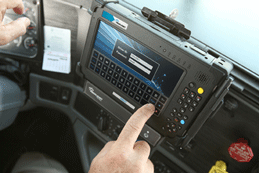
Electronic logs are touted as a high-tech solution for the two leading violations in the Fatigued Driver BASIC: driver's record of duty status is not current and a log violation in general form and manner. Photo courtesy of PeopleNet.
When the Federal Motor Carrier Safety Administration rolled out its Compliance, Safety, Accountability program in late 2010, a number of carriers were surprised to find a poorer safety rating than they enjoyed under the old SafeStat.
Fortunately, for many fleets, the areas where their safety ratings have taken the biggest hit are also areas that are among the easiest to fix, and a variety of technology vendors offer products to help.
Many fleets find their existing technology vendors can provide CSA modules or add-ons that can help monitor problem areas. Others use third-party products that integrate with their existing software. The key is to be proactive: Manage this area of your business in a way where you can find problems before they can adversely affect your safety rating.
"We like to think that fleets are looking for data outside of CSA to proactively stay in front of their scores," says Christian Schenk, vice president product marketing for Xata, Eden Prairie, Minn. Schenk says fleets should go beyond checking the CSA website once or twice a month and use products that give them the data they need to mitigate risks.
For instance, if a manager knows that driver A speeds consistently he presents a risk, even if he hasn't been pulled over by law enforcement yet. The same goes for the driver who shows a high level of hard-braking incidents or one who can't keep his logbook straight.
Jim Sassen, senior manager of product marketing for Qualcomm Enterprise Services, says their customers have been using data from their Qualcomm system along with the company's CSA product to correlate and identify which drivers are most prone to CSA-related violations and accidents.
Like Schenk, Sassen says relying on just the data from the FMCSA does not give fleet managers the information they need to effectively manage their safety efforts. "The FMCSA data that is provided can only show you what has already happened," he notes.
Most trucking management software and mobile communications/on-board computing providers offer CSA management tools as add-ons to their existing systems. Third-party vendors also offer CSA-related products. These applications can aggregate a wide variety of data. This allows fleets to spot trends, which can lead to additional coaching and training for specific drivers, revised processes in the maintenance shop or changes in dispatching.
For instance, Compli, Portland, Ore., which specializes in recruiting and HR software, also offers a stand-alone CSA product. It provides real-time integration with FMCSA data and automates key business processes resulting from inspection and violation updates. Compli CSA helps fleets review violations to prompt disciplinary action or retraining, and it creates an audit trail of all actions taken in each case.
Once fleets know the areas where they have problems, they can take steps to correct them, which is somewhat easier than was originally believed.
"The conventional wisdom was that CSA scores were hard to move," says Steve Bryan, president of Vigillo, Portland, Ore., a third-party provider of CSA scorecards. "We've found out otherwise. There are a number of carriers out there who could easily drop 10 to 30 percentage points if they focused on one or two areas. Once you know what the problem is, where it's occurring and which drivers are repeat offenders, you can have a dramatic and immediate effect on your CSA scores."
Some fleets may need to address problems in a number of areas. Again, the best strategy is to focus on the top two or three. "I like to say, 'don't try to eat the whole cow,'" says Jim Angel, senior product specialist with PeopleNet, Eden Prairie, Minn. "Focus your action plans on those top three and then check every month. You make progress on one, then go to the next area."
Many fleets will want to focus first on the Fatigued Driving and Unsafe Driving BASICs.
For the fatigued driver BASIC, the largest problems are hours-of-service violations, most for filling out the logbook incorrectly. Xata's Schenk says 42% of the HOS violations cited in the U.S. are what are called administrative errors -- "not necessarily that the driver has used too many hours, but they've recorded their duty status incorrectly."
Many argue that electronic logs will eliminate most if not all of these types of violations.
Ireland-based Blue Tree Systems, with U.S. offices in Roanoke, Va., offers a fleet management product, R:Com, that includes an electronic log that can send the driver alerts about his status, letting him know how much time he had to drive for that day.
Chip Powell, Blue Tree's director of sales in the U.S., says the company's fleet customers see the hour-of-service component of the Fatigued Driver BASIC as the "tall pole in the tent" and the one they want to address first.
Another major problem area is drivers with lead-foot tendencies. "If you look at the violation count, speeding is by far the largest problem in the industry," says Vigillo's Bryan.
Many communications and driver tracking systems now are offering carriers the ability to monitor speed violations long-distance. Typically fleet managers get a daily report in their email summarizing driver speed violations. PeopleNet last year started offering a near-real-time email alert sent when a driver triggers a speeding event, so management can address the issue promptly and knows where and when the event occurred.
Just recently, some companies, including inthinc and SpeedGauge, have even started offering the ability to track drivers who speed in areas without posted limits, such as logging roads, oil fields and ports.
Speeding not only is a problem in and of itself, but it also can lead to inspections, which can lead to more violations. Vigillo's data shows that most of the CSA points counted against a carrier come from inspections that occurred because of two prime reasons: speeding and obvious vehicle defect.
"Something like 75% of these points came from inspections that didn't need to happen," Bryan says. "If the driver hadn't been speeding, if the pre-trip had been done correctly, they wouldn't have been pulled over and that inspection never would have happened."
From the January 2012 issue of HDT.
More Fleet Management

Geotab Links Fleet Card to Vehicle Data
The new card combines fuel discounts with telematics-based purchase controls. Geotab’s analysis also points to potential savings from choosing lower-priced fuel stops.
Read More →
How MFA Helps Protect Trucking Fleets
Multi-factor authentication adds protection when passwords are stolen. Here’s how it works and where fleets should start.
Read More →
How Better Freight Data Helps Trucking Teams Get Ahead of Disruption
Trucking and logistics teams have plenty of data. The problem is getting the right information in front of the right people soon enough to act. Better-connected data can help teams spot trouble earlier and make smarter decisions before small problems become big ones.
Read More →

Trimble: Taking Artificial Intelligence in Trucking Beyond Faster Tasks
At Insight 2026, Trimble executives argued that fleets may need to redesign workflows to get more from AI as it introduced new products and enhancements. AI’s value will depend on how fleets combine automation with their people's knowledge.
Read More →
Build a bulletproof fleet: Uniting ELDs and dash cams for total compliance
An ELD can prove compliance, but it cannot always prove what happened on the road. Discover how uniting accurate ELD data with AI-powered dash cam video can help your fleet strengthen compliance, defend against liability, protect drivers and reduce operational costs.
Read More →
Nominations Open for HDT Emerging Leaders
Heavy Duty Trucking is looking for accomplished trucking fleet professionals under 40 who are making an impact and helping lead the industry forward.
Read More →
Why Private Fleets Are Taking More Freight
Private fleets are putting their own trucks on demanding customers and high-cost lanes as companies seek greater control over service, costs, and capacity.
Read More →
Color Match Smarter: Tools That Restore & Perform
For fleet managers and collision repair professionals keeping heavy-duty trucks on the road, getting the color right the first time isn't just about appearance — it's about efficiency, turnaround time, and bottom-line results. Discover how today's digital color tools are transforming the repair process from guesswork to precision.
Read More →
FMCSA Pauses Biennial-Update Enforcement Amid Motus Transition
Carriers whose updates were due on or after June 1 have more time, while FMCSA works to stabilize its new registration system and warns of phishing sites impersonating its new carrier registration system, Motus.
Read More →
2026 Blueprint for Countering Smarter Supply Chain Theft
Cargo theft is no longer just the cost of doing business. It's a multi-billion-dollar criminal enterprise exploiting vulnerabilities across your fleet, drivers, and supply chain.
Read More →