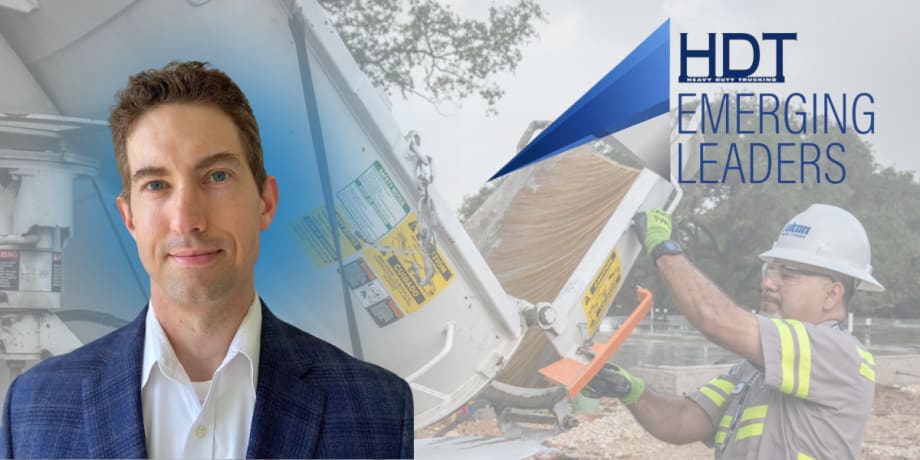
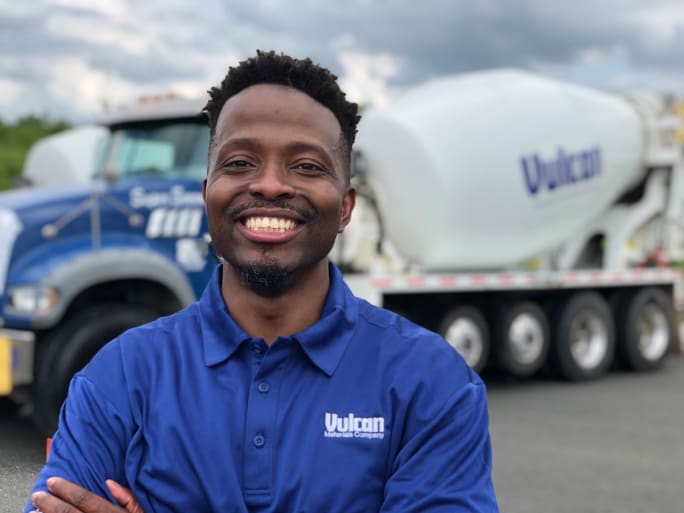
Joshua Moore is transportation/fleet safety manager for Vulcan Materials Company, based in Birmingham, Alabama.
HDT Graphic from Vulcan Materials photos
4 min to read
“it's a path I don't think I would have planned for myself, but trucking gets its hooks in you, and you sort of fall in love with it.”
After Joshua Moore graduated from Cumberland Law School in Birmingham, Alabama, he was looking for a job in estate planning or in government administrative law when he landed a position with a motor carrier safety consulting firm. For the next seven years, he jumped in with both feet, even getting a CDL permit and taking some diesel technician classes, to better understand the industry and not just the related law and regulations.
In 2016, Moore joined Birmingham-based Vulcan Materials Company, the nation’s largest producer of construction aggregates and construction materials, to guide its DOT compliance and safety efforts.
Vulcan’s a parent company for thousands of trucks under subsidiaries with multiple DOT numbers and a number of different business lines, from road construction to aggregate delivery and ready-mix concrete. Vulcan wanted to develop a more consistent safety program across its entire on-road operations.
One of the first things Moore did was initiate the adoption of in-cab cameras across the entire regulated fleet. About five years ago, “We said, we’re going to put cameras in every truck that is above 10,000 pounds GVWR across our footprint.”
Cameras are both forward- and driver-facing cameras for company drivers. (Owner-operators are just forward-facing.)
Moore is working to answer the question, "How do we make sure we continue to train a new generation of drivers?”
Photo: Vulcan Materials Co.
“We want to coach behaviors and encourage our operators to be as safe as possible,” Moore explains. “And we believe we can get ahead of different behaviors” using this technology.
“We believe, conceptually, that the line managers should be coaching, because they're the direct supervisors,” Moore says. He recognizes that some companies see coaching as primarily the safety department’s job. Vulcan uses operations-led coaching. "That means we need to be wise about how we approach that with our time and the capabilities of the system.”
Leading vs. Lagging Metrics
One of the biggest things he’s grappling with right now, Moore says, “is there's just so much technology, and there's so much data, and having a good understanding about how to use that data in making good business decisions. And those business decisions include safety decisions, because safety is a core part of running your business.”
In 2021, Vulcan launched the Fatality Prevention Program. As part of that program, Moore is exploring how he could adapt an approach used in other company operations to identify and prevent potential serious injuries or fatalities (PSIFs). He's asking, how can his fleet and the industry move away from lagging metrics to leading metrics?
“An accident rate is an accident rate,” he says. “It tells me what happened. But if you're focused on this giant accident rate, you've probably got other problems you need to solve.”
He wants to know how to use data to create leading indicators and allow the company to allocate its resources so its people can spend time valuably to make the biggest impact.
Traditional safety performance measures are backward-facing metrics. For trucking, that might be the accident rate. For the workplace, it might be lost-time and total recordable incident rates. But by paying attention to activities with higher risk potential that involve circumstances that can lead to serious injuries and fatalities, a company can recognize conditions that are known to increase the risk of an incident and address them proactively.
“So you look at incidents, at near incidents, and you say, ‘What's the potential [risk] of this?’” Moore explains.
For instance, he says, there’s a difference in risk between a driver sitting at a stoplight on his or her mobile device and using it while driving down the road at 50 mph. Yes, both include risk, but that risk, that potential for a serious incident, is different. It makes sense to spend more time and effort addressing the higher-risk behaviors.
Safety Takes a Team Effort
Moore emphasizes that the company’s success isn’t all about him.
“I have a great team that’s under me, and I'm only as good as how well they do. Really, my job is to clear barriers for them, so they can go out and do the things they need to do so we can run safely.”
From Josh Moore's Emerging Leaders nomination: 'He is a person who stands behind what he believes.'
“Josh had his work cut out for himself when he joined Vulcan Materials Company in 2016,” said Matthew Dittmer, logistics safety specialist at the company, in his nomination of Moore. “Since then, Josh has reworked and implemented numerous programs to help shape Vulcan's logistics department into a world-class organization. Projects such as the Vulcan Logistics Support Center, who oversees the 2000+ DOT driver files, and the rollout of our DriveCam program for our on-road and off-road vehicles, were all concepts of Josh’s.
“Even as Vulcan acquires entire truck companies such as U.S Concrete and its thousands of trucks, Josh is able to reduce accidents and injuries year over year.
“Even with all of the programs and policies put in place by Josh, it's the culture that Josh has created that has the largest effect on our department. He is a person who stands behind what he believes, and he believes that Vulcan can be the safest fleet out there. And that thought has rubbed off onto everyone he interacts with.”
Carriers whose updates were due on or after June 1 have more time, while FMCSA works to stabilize its new registration system and warns of phishing sites impersonating its new carrier registration system, Motus.
ZF is expanding its North American commercial-vehicle presence with new transmission applications, electrification, trailer technology and autonomous-driving systems.
Fleets have more visibility into truck health, safety events, and driver activity than ever. The next challenge is turning all that information into useful guidance for the person who has to decide what to do next.
Could Tesla’s camera-only autonomous driving technology work on an 80,000-pound Semi? In this commentary, HDT's Deborah Lockridge takes a look at Tesla, Cybercab, and how autonomous trucks see the road.
The U.S. Department of Transportation issued a new automated-vehicle strategy that outlines plans for driverless-truck regulations, cross-state freight corridors, and federal safety standards.
New York City is expanding intelligent speed assistance and pedestrian-alert systems across its municipal fleet, moving the technologies from pilot programs into vehicle procurement and retrofit requirements.
Federal regulators also are targeting more than 160 additional training providers and launching a nationwide audit of third-party CDL skills testers as part of a broader crackdown on trucking fraud.
Two pilot programs could eventually reshape hours-of-service rules, giving truck drivers options to pause their 14-hour clock or use longer split sleeper rest periods.
Hundreds of thousands of pets travel in truck cabs. A new safety guide from Volvo Trucks and the Center for Pet Safety offers practical advice for truck drivers who bring dogs and cats along for the ride.