




Trailer Report: Making Sense of Spread Tandems
There are good reasons to use 'em, and reasons not to. here's a way they'd work better or would they?

Spread tandems - the widely spaced axle configurations found mostly on flatbeds, car haulers and refrigerated trailers - exist for good reasons, all related to weight. Under various weight laws, spread or "split" tandems can legally carry more pounds per axle than close-spaced tandems. The distance between the two axles can vary if the vehicle runs within a certain state whose weight law addresses axle spacings. Anything crossing state lines has to follow the federal weight rules, and they exactly define that distance.
Under the federal B formula, the axles must be 10 feet apart (though in practice they are placed 10 feet, 1 inch apart just to be safe for the times when a zealous enforcement officer measures that distance with a tape).With the "10-1" spread, each axle is considered independent, and can carry up to 20,000 pounds, versus 17,000 for a typical 5-foot tandem. The rig still may not exceed 80,000 pounds gross (but could go to 86,000 if folks lobbying for greater productivity succeed in liberalizing the laws).
For now, the extra allowable axle weight for the trailer gives more loading flexibility, and the driver doesn't have to worry as much about balancing the load between the tractor and trailer.
If the tractor's air-ride tandem suspension has a plumbed-in gauge, the driver can load his reefer trailer's front area until the gauge reads 50 psi, or whatever it does when it's carrying just about 34,000 pounds (which he recalls from scaling the rig). Then he can load the rest of the trailer as necessary, knowing that he can cram all the produce or whatever he usually carries into the rest of the trailer without overloading its spread tandem. Its air suspension automatically equalizes the weight among the four wheel positions.
With extra-dense cargo (potatoes, maybe), or if the trailer's a flatbed, he can bias the weight slightly toward the rear and be pretty sure that he's not exceeding axle weight. Even better, he can install an air gauge on the trailer tandem and learn to interpret it. (The best idea is to install on-board scales on the tractor and trailer, but that's another matter.) With a less-than-full load, an owner-operator can choose to save a bit of wear and tear on his tractor by shifting more weight to the company's trailer.
But when being pulled through a tight turn, a spread tandem suffers from huge lateral forces. This scuffs tires, and can break wheels and suspension parts. (I once watched a hot-headed young driver, apparently frustrated at not being able to find a parking slot at a truckstop, do a 90-degree right-hand turn, then two 180-degree U-turns, all within a minute, each time roughly dragging his loaded flatbed's spread tandem across the pavement as wheels and tires hopped and groaned. I was surprised that nothing seemed to break.) Damage from such abuse usually happens away from home and converts to an expensive road call.
Managers at big fleets are aware of those problems and figure they outweigh (so to speak) any loading advantages of a spread tandem. So they usually stick with the close-spaced tandem, spec'ing it with a slider that allows moving the tandem fore or aft to alter the weight it carries. That's fine if the driver knows how to properly use the slider, if he can break it loose from accumulated rust and crud in the rails when he needs to, and if he secures the pins after adjusting the slider so it doesn't run off the end of the trailer. (There are products that reduce those problems, and they include air-powered pin releases and tapered pin heads; trailer dealers should be aware of them.)
Why not use a steerable axle with a spread tandem? Steerable auxiliary axles are used on heavy construction trucks in so-called bridge-formula states. These axles are caster-steered, and their wheels automatically swing in the direction they're pulled. When the truck backs up, the axles automatically lift off the ground so their wheels don't go all askew. Lifting is actuated by the truck's backup-light circuit, which is energized when the driver shifts into reverse. (And of course they're also raised when the truck's empty.)
Wouldn't that work on a spread-tandem trailer? Putting a steerable axle at the forward position would let it swing through a turn as the trailer pivots on its stationary rear axle - no more hopping and scuffing. Putting a steerable axle at the rear would let the trailer pivot on its stationary forward axle while the rear one follows easily along. This would also shorten the trailer's effective wheelbase and make it more maneuverable. Any off-tracking of the trailer's rear end would be minimal, and in fact some trailers in Europe have steerable axles (though not with spread tandems).
Of course, most trailers need to be backed up to load and unload. The caster-steered axle would then have to be locked in the straight-ahead position. Then there'd be some tire scuffing, etc., if it's backed through a turn. However, there's another axle product that steers in reverse as well as forward. The reverse-steering auxiliary axle uses geometry that casters in either direction. A pair of common brake chambers push or pull the mechanism, changing the geometry as needed. As with steerable lift axles, the chambers are activated by the backup-light circuit. When the driver shifts out of reverse, the light circuit is de-energized and the chambers push the steering geometry into the forward position.
"Simple!" as former presidential candidate H. Ross Perot used to say. But he wasn't in the trailer business. Those who are in the business say a steerable axle is far more complex than a stationary one, so would add considerable upfront cost and require more maintenance, and that might offset any savings from longer tire and wheel life. Also, if the axle has dual wheels on each side (most of them do), there isn't enough room between the inner duals and the trailer's frame for any appreciable amount of wheel cut.
But, sez me, single-wide wheels and tires, especially if outboard mounted on wide-track axles, would have enough room for steerable wheels to cut, and most, if not all of the scuffing, would be eliminated. And tests have shown that compared to duals, single-wide tires will reduce fuel use by what - 3 to 5 percent? - due to lower rolling resistance.
Well, you can put single-wide tires and wheels on non-steerable axles and still get the fuel savings (not to mention about 400 pounds less tare weight), and some operators already do that. And, say trailer people, truckers who use spread tandems have learned to live with the tire scuffing. (Some use dump valves to bleed air out of one axle's bags and relieve it of weight during turns. That's illegal and overloads the one axle that then carries all the load, but that's the real world.)
Forget your steerable axle idea, Berg.
Oh.
As Rosanne Rosanna Danna (remember her on the old "Saturday Night Live"?) used to say, "Never mind."
More Equipment

Kodiak Targets Dallas–Houston for Driverless Trucks
The company says its autonomous trucks are completing the I-45 run without a safety observer taking control. It plans to remove the observer by the end of 2026.
Read More →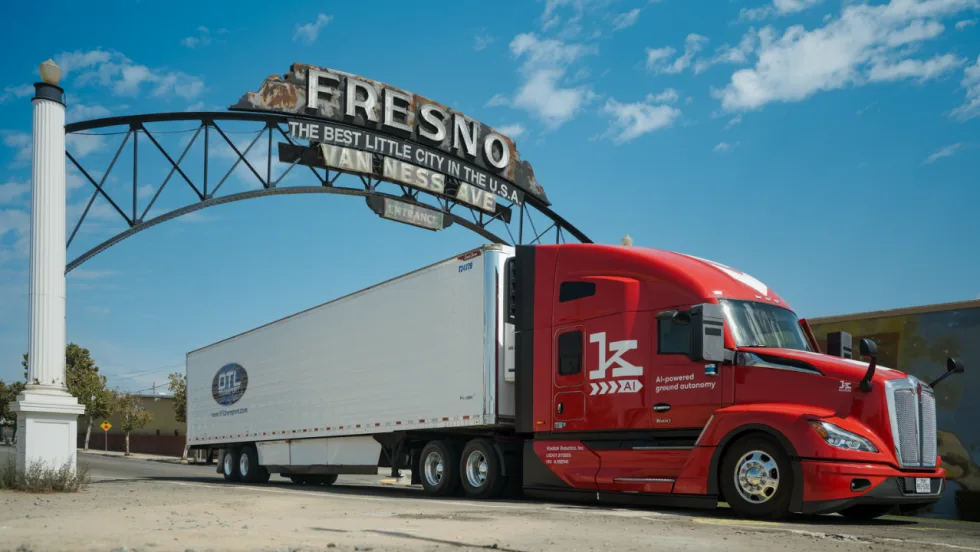
Kodiak Hauls Produce in California Autonomous Truck Pilot
Kodiak AI and DTL Transport have begun hauling produce between Fresno and Los Angeles under California’s new rules for testing heavy-duty autonomous trucks. A safety driver remains behind the wheel.
Read More →
Used-Truck Remarketing Math Is Changing
Used-truck value is no longer just a concern at trade-in. Decisions made throughout a truck’s first life can influence what it’s worth years later.
Read More →
How Volvo Updated Its D13 for EPA 2027 [Watch]
Volvo’s updated D13 promises lower emissions without sacrificing performance or fuel economy. Take a closer look at what changed inside the engine in this HDT Spotlight video.
Read More →
Michelin Tire Improves Efficiency and Durability for Regional Fleets
The Michelin X Multi Energy D2 is a regional haul drive tire engineered to help fleets improve fuel efficiency, durability and traction in demanding stop-and-go operations.
Read More →
ZF Expands Commercial Vehicle Push in North America
ZF is expanding its North American commercial-vehicle presence with new transmission applications, electrification, trailer technology and autonomous-driving systems.
Read More →
Tesla Wants a Self-Driving Semi. Are Cameras Enough?
Could Tesla’s camera-only autonomous driving technology work on an 80,000-pound Semi? In this commentary, HDT's Deborah Lockridge takes a look at Tesla, Cybercab, and how autonomous trucks see the road.
Read More →Kodiak: Driverless Long-Haul Truck Launch on Track for 2026
Kodiak AI says its driverless long-haul safety case is 93% complete and it remains on track to begin commercial operations by year-end 2026.
Read More →
What DOT’s Automated Vehicle Strategy Means for Trucking
The U.S. Department of Transportation issued a new automated-vehicle strategy that outlines plans for driverless-truck regulations, cross-state freight corridors, and federal safety standards.
Read More →
East Coast Port Launches $45M Electric Truck Push
The Port Authority of New York and New Jersey announced millions in incentives for zero-emission drayage trucks, yard tractors, and new charging hubs near the port.
Read More →