




Trailer Maintenance Tips
It’s been 14 years since repairing any trailer’s “ICC bumper” was a simple matter of cutting off the damaged section and welding on a straight piece of angle iron. Most trailers built since Jan. 26, 1998, have been equipped with more complex required rear impact guards that are not only stronger but are designed to absorb shock from a collision.
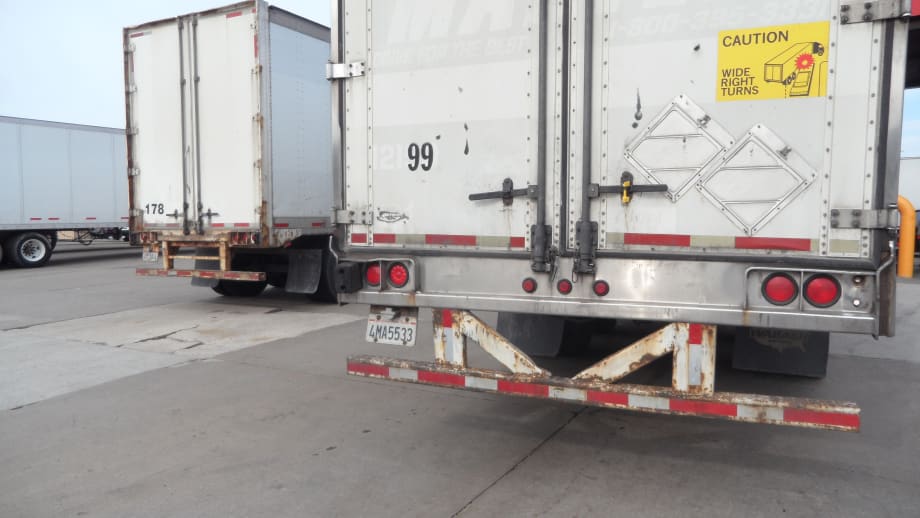
It’s difficult to find a damaged rear impact guard because owners and drivers know they must be fixed before going on the road. Surface rust and dirt shouldn’t result in a citation, but deeper corrosion and bends might. Every trailer builder’s guard is different, so parts from individual manufacturers must be used in repairs.
It’s been 14 years since repairing any trailer’s “ICC bumper” was a simple matter of cutting off the damaged section and welding on a straight piece of angle iron. Most trailers built since Jan. 26, 1998, have been equipped with more complex required rear impact guards that are not only stronger but are designed to absorb shock from a collision. The hope is that the car or light-truck that’s rear-ending the trailer won’t ride under it, and the motorists won’t be decapitated or otherwise seriously injured.
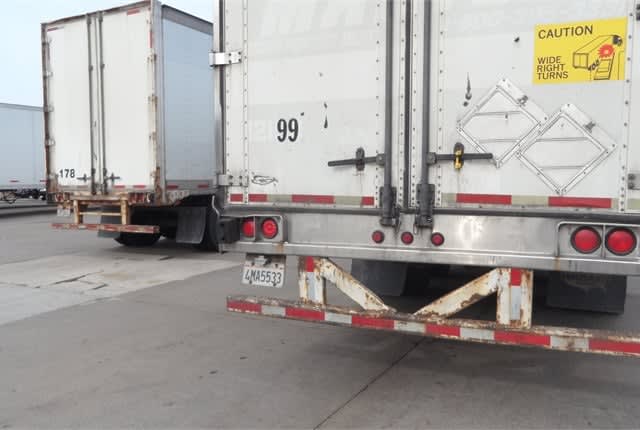
It’s difficult to find a damaged rear impact guard because owners and drivers know they must be fixed before going on the road. Surface rust and dirt shouldn’t result in a citation, but deeper corrosion and bends might. Every trailer builder’s guard is different, so parts from individual manufacturers must be used in repairs.
Rear impact guards, or RIGs, can also be damaged in less serious mishaps, and by law need to be fixed promptly. That almost always means now. No, the driver can’t finish his run or make a delivery or pick-up, at least if it’s any appreciable distance from where that mishap took place. Otherwise you’re risking a ticket.
By now every truck operator should know all this, and should also be aware that fixing a rear impact guard means returning it to as-built condition. That means using the same pieces and parts that the trailer manufacturer used.
It’s so important that a group of maintenance professionals discussed details of rear impact guard repairs at a special session during the recent annual meeting of Technology and Maintenance Council of the American Trucking Associations.
Led by Gary Fenton of Stoughton Trailers, the managers reviewed TMC’s Recommended Practice 732 that lists guidelines for repairing rear impact guards. The RP describes types of deflection damage to the horizontal, vertical and diagonal parts of an impact guard, and how they should be repaired.
A common problem is an inward or outward deflection of the horizontal member caused by impacting another object or being yanked by a dock lock, or of the member’s corner(s). If no vertical supports are damaged, a vertical deflection of this member can be cold-bended (no heat applied) back into shape.
An inward deflection is possible without damage to the horizontal or vertical members if connecting bolts are damaged or loose. Those bolts can be replaced, and if this repositions the members in their original positions, the members can remain untouched.
If a floor or floor crossmembers are damaged by an impact to the RIG, those floor parts must be repaired according to the manufacturer’s specifications and instructions. Use subassemblies from the manufacturer if possible.
Do everything correctly, or liability might come if the trailer is later involved in another rear-end accident and it’s found that the rear impact guard had been improperly repaired.
Inspections of a trailer’s rear should include close looks at the impact guard for evidence of cracks, bends or corrosion in its various members, and the welds and fasteners holding them together. The RIG must also be properly aligned to the trailer’s structure.
Fenton emphasized that rear impact guards differ among trailer builders and most parts are unique to the manufacturer, as are floor, sill and crossmember designs, which together account for 20% of a trailer’s rear. Those parts must be acquired and used in any repairs.
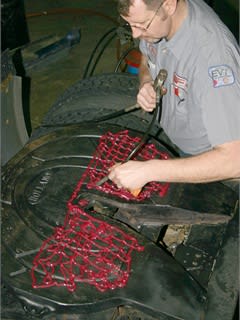
The fifth wheel top plate should be greased more heavily toward its rear. The trailer’s upper coupler face will push the grease forward during hitching.
Time to look at fifth wheels
It was a long winter in much of the country, and a delayed spring might have set back your preventive maintenance efforts. Several months’ worth of sand, gravel, aggressive salts and road debris are now bound up in all the old grease caked onto your fifth wheel. Aside from being damagingly abrasive, all that crud can interfere with the lock mechanism.
If a driver writes up a fifth wheel as hard to release, it’s a good indication that it’s also hard to hook. It’s time to clean out the mechanism so you can do a proper inspection. Exact requirements for visual and mechanical inspection vary by manufacturer, but essentially you’re looking for damage to the top plate, slack in the jaws, proper function of the jaws and the condition of the release handle.
While adjustment procedures vary across brands and models, the allowable amount of slack does not. Roadside inspectors will sideline a truck with any more than half an inch of fore/aft movement between the top plate and the trailer, while the manufacturers recommend about 1/16-inch freeplay around the kingpin. There’s some latitude there, but excessive slack is uncomfortable for the driver and will eventually wear the throat of the fifth wheel.
Corrosion could become an issue with bare metal springs, so inspect them carefully and replace as necessary. There’s no definition for wear on the springs, and as long as they are cycling properly, the springs are doing their job. Pull handles can be easily damaged or bent, and in some cases, a bent handle could impede the locking mechanism.
Check the fasteners or the slider mechanism. If 20% or more of the fasteners are missing or ineffective, the truck can be placed out of service.
Non-functioning sliders can be a huge source of frustration for drivers.
Therefore, cycle the slider periodically to keep it from seizing.
Properly lubricated fifth wheel top plates will retain peak performance for a long time, but grease is often applied incorrectly – usually too much. When the fifth wheel has been cleaned of old grease, apply a small bead of grease evenly in a back-and-forth motion. Apply a heavier coat to the rear two-thirds of the fifth wheel; the grease will be pushed forward when hooking up to a trailer. Too much grease is wasteful and messy, and it does you no good stuck to axle housing and brake pots.
While different types of greases or oils can be used, greases formulated specifically for fifth wheels provide the best lubrication. The proper thickness is crucial, as thin greases will wear away quickly during wet conditions and excessively thick grease may cause clumping - especially in the cold.
When greasing the bracket bearings – if they require grease; some do not – use a pry bar to lift the top plate slightly off the bearing, and rock the fifth wheel back and forth while applying grease. Some lubrication may be required on the underside, such as the locking mechanism, the cam track, or the pivots on the release handle. Use a light oil here.
No-lube and low-lube fifth wheels may have grease fittings on the underside to ease lubrication of the lock mechanism and to prevent excess grease from accumulating on the mating surface.
More Equipment

How Volvo Updated Its D13 for EPA 2027 [Watch]
Volvo’s updated D13 promises lower emissions without sacrificing performance or fuel economy. Take a closer look at what changed inside the engine in this HDT Spotlight video.
Read More →
Michelin Tire Improves Efficiency and Durability for Regional Fleets
The Michelin X Multi Energy D2 is a regional haul drive tire engineered to help fleets improve fuel efficiency, durability and traction in demanding stop-and-go operations.
Read More →
ZF Expands Commercial Vehicle Push in North America
ZF is expanding its North American commercial-vehicle presence with new transmission applications, electrification, trailer technology and autonomous-driving systems.
Read More →
Tesla Wants a Self-Driving Semi. Are Cameras Enough?
Could Tesla’s camera-only autonomous driving technology work on an 80,000-pound Semi? In this commentary, HDT's Deborah Lockridge takes a look at Tesla, Cybercab, and how autonomous trucks see the road.
Read More →
Kodiak: Driverless Long-Haul Truck Launch on Track for 2026
Kodiak AI says its driverless long-haul safety case is 93% complete and it remains on track to begin commercial operations by year-end 2026.
Read More →
What DOT’s Automated Vehicle Strategy Means for Trucking
The U.S. Department of Transportation issued a new automated-vehicle strategy that outlines plans for driverless-truck regulations, cross-state freight corridors, and federal safety standards.
Read More →
East Coast Port Launches $45M Electric Truck Push
The Port Authority of New York and New Jersey announced millions in incentives for zero-emission drayage trucks, yard tractors, and new charging hubs near the port.
Read More →
PlusAI Going Public to Fund Autonomous Truck Launch
A SPAC deal could provide PlusAI with up to $300 million as it works toward a 2027 commercial launch of factory-built autonomous trucks.
Read More →
NHTSA Moves to Rewrite Truck Fuel-Economy Rules
The National Highway Traffic Safety Administration says it lacks authority to regulate medium- and heavy-duty truck engines separately from complete vehicles, but the existing standards have not yet been eliminated.
Read More →
Detroit Opens Orders for EPA 2027 Engines
Detroit isn’t starting from scratch to meet EPA 2027 diesel emissions standards. Its Gen 6 DD13 and DD15 engines keep much of today’s platform while updating the fuel and aftertreatment systems.
Read More →