




TMC's Type IV Fuel Economy Test Rewritten with Aftertreatment in Mind
How does the fuel-fed regeneration of diesel particulate filters affect overall fuel economy for heavy-duty trucks?

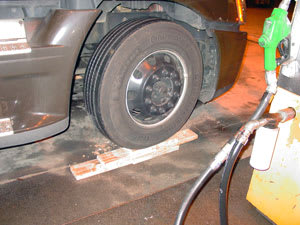
Type IV procedures are exacting, and include the need to level the truck during fueling, done here by driving a steer-axle wheel onto lumber.
How does the fuel-fed regeneration of diesel particulate filters affect overall fuel economy in heavy-duty trucks?
You can find out over time by keeping track of tank-mileage numbers and comparing them to trucks that don't have DPFs, or you can learn inside of a day by running a TMC-SAE Type IV fuel economy test.
The Type IV procedure, devised by members of the Technology & Maintenance Council of ATA and adopted by the Society of Automotive Engineers, has been around for years.
But it and the people who use it didn't have to contend with the effects of a "regen" — the burning of accumulated soot in DPFs by injecting fuel. This began with the advent of particulate filters in 2007-model diesels and continues with current engines.
Most EPA 2010-spec diesels also use diesel exhaust fluid (DEF) to dose exhaust gas during normal operations. This removes nitrogen oxide (NOx) that's passed on by the engine. DEF costs money and should be factored into a vehicle's overall cost of operation. So should fuel consumed in regeneration, and it is in the total fuel bill.
But regen fuel should be individually accounted for, especially if an operator wants to know exactly what pollution-control equipment and its operation are costing him and his company. It's not in the existing Type IV procedure, so TMC members added this and DEF accounting to the exacting set of instructions in the existing Recommended Practice 1109.
"If you can document the fuel used, you can back it out and get your economy numbers," said Chuck Blake, a senior testing engineer at Detroit Diesel. "When you're done, you can add that fuel back in and get your cost per mile.
"It's the same with the diesel exhaust fluid used. The cost varies, depending on where you buy it — at the dealer or at truckstops in bulk. There are some extremes there," ranging from $35 a gallon at some auto dealers to under $3 a gallon from bulk dispensers at truckstops.
Blake and Bob Wessels, who retired from Caterpillar a few years ago and is now a consultant, headed the effort to rewrite RP 1109 to include these new realities. They also participated in devising the original RP as members of TMC's Engine Study Group.
The New TMC Fuel-Economy Test
RP 1109B(T), as the modified version of the fuel economy test is called, includes instructions on how to record when regeneration occurs and how much fuel is used, and to record use of DEF. Work sheets and other forms are included in the 36-page RP.
As before, a pair of similar trucks, one with the equipment being evaluated and one without, is run together over a certain distance. Both drivers must do things as much alike as possible, and at mid point in the runs the drivers switch trucks to reduce their influence on the test's outcome.
Fuel is pumped into a single saddle tank on each truck and the number of gallons recorded. The trucks must be leveled so the amount of fuel needed to reach the full point — at the base of the filler neck — does not vary with any slope in the pavement.
Also carefully noted is the temperature of the fuel in the tank at the end of a run. Fuel going back to the tank in the return line usually makes the fuel in the tank warmer at this time, and it has less energy per gallon; this is compensated for in temperature calculations.
The container of diesel exhaust fluid is weighed before and after its contents are added to the truck's DEF tank. Its use is therefore recorded in pounds and volume determined from volume consumed. This compensates for temperature variations in the DEF.
Repeatability is important for the test results to be valid: The numbers obtained from each subsequent run must be within 2% of those registered the first run. This is a constant of scientific measurement that's a little hard to accept until one studies the procedure to understand why it is so.
The precise amount of fuel used during a DPF regen is known by the engine or truck manufacturer, and this data must be obtained for use in the new Type IV procedure. This is the first time that a TMC fuel economy procedure depends on a manufacturer's data, the RP states.
This fuel is then subtracted from the amount of fuel used during a run, which gives running miles per gallon. Of course it's included in determining total fuel use, as one would do in simple tank-mileage figuring.
Different Engines Mean Different DPF Regen Rates
Detroit engines use 1.8 gallons in a DPF regeneration, Blake says, but regens are needed much less often than for early 2007 products. An '07 model underwent a regen every 500 miles or so; now it's every 8,000 miles in the summer when the exhaust is hot enough to burn off soot on its own, and in winter it might be every 2,500 miles.
Other companies' engines use regen fuel at different rates, Blake said. Some have not published this data, so it's important that a user get the numbers from the maker of his engine before running a new Type IV test. Another procedure enables the testing party to learn that number on his own, but it takes much longer — eight runs instead of the two called for if the regen fuel rate is known beforehand.
A Type IV test can be run on a track or out on the road. Blake said the final proofing tests were done during regular revenue runs by Maverick Transportation.
Mike Jeffress of Maverick supplied tractor-trailers and "fantastic" drivers for these tests; the drivers had done testing before and communicated via CB radio to co-ordinate their actions so the tests would be valid. For instance, if one ran his air conditioning, he radioed the other driver so he'd turn on his A/C too; if one rolled down his window, so did the other.
Also participating was Duwayne Lippincott of United Parcel Service, who was somewhat new to such testing. Blake credits him for bringing a fresh perspective that was useful in designing the procedure's details and clarifying their descriptions in the RP.
The revised RP is now out for balloting by TMC fleet manager-members, who, in addition to voting it up or down, can also offer comments on how it should be changed and improved. It will probably get final approval at the group's Fall Meeting in September.
More Fuel Smarts

Record Diesel Prices Squeeze Trucking Fleets
Average U.S. diesel prices have climbed to nearly $6 a gallon, surpassing the 2022 record as tight refinery capacity and Middle East disruptions keep fuel costs elevated.
Read More →
How Fuel Delivery Shapes Engine Performance
Fuel delivery depends on more than what happens at the injector. For fleet, maintenance and technical professionals, looking at the full path from pump to injector can provide useful context for understanding engine performance.
Read More →
East Coast Port Launches $45M Electric Truck Push
The Port Authority of New York and New Jersey announced millions in incentives for zero-emission drayage trucks, yard tractors, and new charging hubs near the port.
Read More →

California Bill Could Shed Light on Electric Truck Prices
Why do battery-electric Class 8 trucks remain so expensive? A California bill headed to Gov. Gavin Newsom would give fleets and state agencies more visibility into what manufacturers charge.
Read More →
Detroit Opens Orders for EPA 2027 Engines
Detroit isn’t starting from scratch to meet EPA 2027 diesel emissions standards. Its Gen 6 DD13 and DD15 engines keep much of today’s platform while updating the fuel and aftertreatment systems.
Read More →
Zero-Emission Truck Corridor Planned for West Coast
California, Oregon, Washington, British Columbia and Baja California are coordinating plans for truck charging and hydrogen fueling from Canada to Mexico.
Read More →
A Closer Look at Kenworth’s Electric T880E Vocational Truck [Video]
Learn more about Kenworth's T880E battery-electric vocational truck at the Paccar Technical Center, including its range, applications, upfitting considerations, and PTO options, in this HDT Spotlight video.
Read More →
Kenworth T880E Brings EV Power to Vocational Trucks
A closer look at the Kenworth T880E’s range, charging, powertrain and upfit options — and where fleets are showing the most interest.
Read More →
Jennie Abarca Is Proving Electric Trucks Can Do the Job
HDT Truck Fleet Innovator Jennie Abarca is building confidence in fleet electrification one load at a time while openly sharing the challenges she encounters along the way as a small-fleet owner.
Read More →
Cummins Adjusts 2027 Engine Rollout After EPA Proposal
The engine maker will gradually introduce its new Model Year 2027 diesel engines while continuing to offer current models during the transition, citing the EPA's proposed emissions rule changes.
Read More →