





Don’t Fear the Blitz: How Truckers Can Own CVSA’s International Roadcheck
Tips for Inspecting Trailer Tie-down Devices
Find out what’s on the menu of violations commercial vehicle inspection officers have to choose from in cargo securement, and what you should be looking for.
February 19, 2022
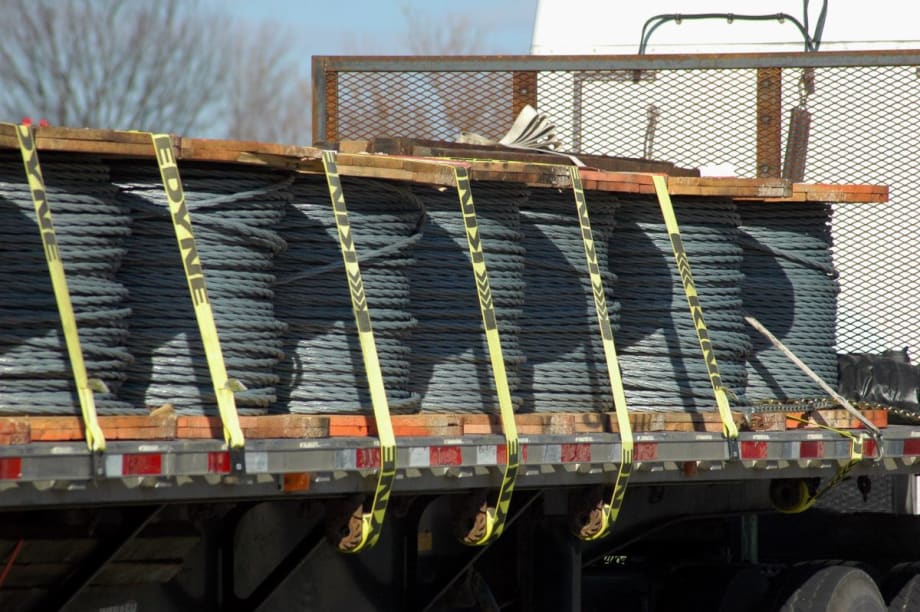
Cargo securement equipment is subject to wear and degradation with use and time. It needs to be checked periodically to ensure it remains in compliance with the regulations.
Photo: CargoSecure
6 min to read
Are you relying on your open-deck drivers to inspect and self-report the condition of their cargo securement equipment? If they are diligent and they understand the defect limits for their equipment, you’re probably safe.
But getting caught with defective equipment can mean at least a few CSA points and a citation or two. Some defects could put the truck out of service. To get it going again, you’d have to get replacement equipment to a driver parked behind an inspection station somewhere in the wild.
Worst-case scenario, defective chains and straps don’t get caught during an enforcement inspection and a driver loses the load, potentially causing a crash.
That’s why open-deck fleets need to train drivers on how to inspect their chains, straps, and other securement devices, and the consequences of not doing so. Adding cargo securement equipment to your shop’s preventive maintenance inspection list can serve as a backup.
What Trucking Enforcement Officers Look For in Cargo Securement
Commercial vehicle inspection officers have a menu of violations to choose from in cargo securement. The most common, “failure to prevent shifting cargo,” covers a multitude of sins and doesn’t offer much insight into the actual violation. It could mean, simply, that the driver hadn’t taken all the steps necessary to properly secure an article of cargo.
It could also mean that one or more of the securement devices fails to meet the standards. Maybe it’s damaged or the markings are no longer visible. That could result in having insufficient tie-downs for the cargo.
For example, a 5/16-inch grade-70 transport chain has a working load limit (WLL) of 4,700 pounds. If it’s not marked as such, or the markings are not legible, an inspector could downgrade it to the equivalent of Grade 30 chain, which has a WLL of just 1,900 pounds. If the driver had calculated the number of tie-down chains required based on the 4,700-pound WLL, an inspector could deem the cargo unsecured. If the driver has spare chain, he could put on another one and continue the run. If not, the driver would be out of service until another chain could be brought out.
Each year, inspectors write about 2,500-3,000 tickets for failure to meet minimum tie-down requirements (49 CFR 393.110), according to records released by the Commercial Vehicle Safety Alliance.
A more common violation is for damaged securement systems. Each year, about 12,000-15,000 violations are recorded for 49 CFR 393.104(b). Damaged cargo securement devices can be downgraded to a lower WLL based on the extent of the damage — even zero-rated if the damage is severe enough.
That means a violation for using a damaged device and/or a possible violation for failure to meet minimum tie-down requirements. These can be at the inspector’s discretion.
Cargo Strap Damage Can Put Truckers Out of Service
Cargo straps will wear with age, and they are subject to possible additional damage like cuts and abrasions due to poor loading practices and not using edge protectors. CVSA’s North American Standard Out-of-Service Criteria Handbook has defect classification tables for synthetic web straps. It describes how the extent of possible damage is calculated, and it’s pretty straightforward.

Each year, about 12,000-15,000 violations are recorded for damaged cargo securement devices.
Photo: CVSA
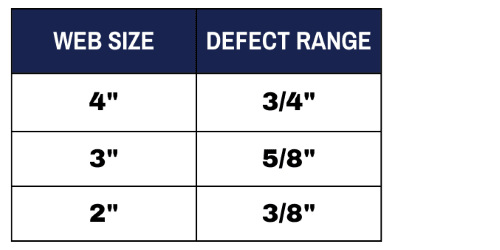
Synthetic web straps may have some cuts, holes or burns, provided they don’t exceed limit based on the width of the strap.
Cuts on the same edge of the strap are not additive, but cuts on opposite sides or across the width are additive. For example, two 1/2-inch cuts on the same edge are equal to one 1/2-inch cut. But two 1/2-inch cuts on opposite edges of the strap would be equal to a 1-inch cut. A 1/2-inch cut on one edge and a 1/2-inch hole in the center of the strap would be equal to a 1-inch cut.
Web straps used in cargo securement cannot be knotted, repaired or spliced
The strap must be marked or labeled with a working load limit rating and the manufacturer’s name. Some straps have the name and rating stenciled on the strap. Others have a tag or a label sewn on either end of the strap. If that information is missing or not legible, the strap will be downrated by inspectors to the minimum rating based on the width of the strap.
Any other fittings, such as flat hooks, D-rings, and grab hooks, must have a WLL equal to or greater than the strap itself.
Truckers Need to Watch For Cargo Chain Damage
There are defect criteria for cargo chain, as well. Inspectors look first for the grade marking on the chain and for possibly damaged links.

All chain should be removed from service if the material thickness at any location on the link is less than the listed minimum value.
Photo: CVSA
The rating, along with the manufacturer’s symbol, is stamped or embossed into a link at 1-foot intervals along the chain and is used to determine its working load limit. With age, these markings can become hard to read. If an inspector can’t find such a marking on a chain, its WLL will be downgraded to an equivalent size Grade 3 Proof Coil chain, which could be much less than half of a Grade 70 transport chain.
The mark for Grade 30 chain is 3, 30 or 300. Grade 43 chains are marked with 4, 43 or 430. Grade 70 transport chain is marked with 7, 70 or 700.
These markings also apply to the forged grab hooks, binders, and ratchets. In a tie-down assembly, the component with the weakest rating determines the WLL of the entire assembly.
Cargo chain can be damaged through overloading, dropping or slipping of the load caused by improper rigging, and bending or twisting. Links that are elongated, bent, or twisted are considered out-of-service. So will chain links that show excessive wear, signs of welding, or the use of improper repair links.
All chains and hooks should be periodically inspected for damage. The examination should look for excessive wear, elongation or deformation, and the presence of any nicks, gouges, or cracking in the hooks or load pins. Chains or hooks containing such damage should be removed from service.
Removal criteria for wear has been established for the Grade 30, Grade 43, and Grade 70 chains and are contained in the National Association of Chain Manufacturers Welded Steel Chain Specifications. All chain should be removed from service if the material thickness at any location on the link is less than the listed minimum value. There are approved types of repair links available, but they must be of an equal or greater WLL, otherwise the chain will be downgraded to the lower WLL.
Canada treats unmarked securement devices differently than the U.S. They are not downrated to a default working load limit, they are zero-rated — as if they weren’t even there. That would adversely affect the WLL calculations, so be aware of that difference if you operate in Canada.
Given what could be at stake, regular inspection of the cargo securement equipment, such as during a PM, could save a little grief at roadside, not to mention a few dollars and CSA points — or worse.
This article first appeared in the Jan/Feb issue of Heavy Duty Trucking.
Subscribe to Our Newsletter
More Equipment

Used-Truck Remarketing Math Is Changing
Used-truck value is no longer just a concern at trade-in. Decisions made throughout a truck’s first life can influence what it’s worth years later.
Read More →
How Volvo Updated Its D13 for EPA 2027 [Watch]
Volvo’s updated D13 promises lower emissions without sacrificing performance or fuel economy. Take a closer look at what changed inside the engine in this HDT Spotlight video.
Read More →
Michelin Tire Improves Efficiency and Durability for Regional Fleets
The Michelin X Multi Energy D2 is a regional haul drive tire engineered to help fleets improve fuel efficiency, durability and traction in demanding stop-and-go operations.
Read More →
ZF Expands Commercial Vehicle Push in North America
ZF is expanding its North American commercial-vehicle presence with new transmission applications, electrification, trailer technology and autonomous-driving systems.
Read More →
Tesla Wants a Self-Driving Semi. Are Cameras Enough?
Could Tesla’s camera-only autonomous driving technology work on an 80,000-pound Semi? In this commentary, HDT's Deborah Lockridge takes a look at Tesla, Cybercab, and how autonomous trucks see the road.
Read More →
Kodiak: Driverless Long-Haul Truck Launch on Track for 2026
Kodiak AI says its driverless long-haul safety case is 93% complete and it remains on track to begin commercial operations by year-end 2026.
Read More →
What DOT’s Automated Vehicle Strategy Means for Trucking
The U.S. Department of Transportation issued a new automated-vehicle strategy that outlines plans for driverless-truck regulations, cross-state freight corridors, and federal safety standards.
Read More →
East Coast Port Launches $45M Electric Truck Push
The Port Authority of New York and New Jersey announced millions in incentives for zero-emission drayage trucks, yard tractors, and new charging hubs near the port.
Read More →
PlusAI Going Public to Fund Autonomous Truck Launch
A SPAC deal could provide PlusAI with up to $300 million as it works toward a 2027 commercial launch of factory-built autonomous trucks.
Read More →
NHTSA Moves to Rewrite Truck Fuel-Economy Rules
The National Highway Traffic Safety Administration says it lacks authority to regulate medium- and heavy-duty truck engines separately from complete vehicles, but the existing standards have not yet been eliminated.
Read More →