




Related: How to Make Data Work for You
The Top 10 KPIs Every Fleet Manager Should Track
ELDs will increase the amount of useful data that fleets can use to improve safety, efficiency and compliance. While KPIs will differ by fleet size and vertical, here are the most common – the ones every fleet should be tracking.
by Pete Allen, Mix Telematics
December 20, 2017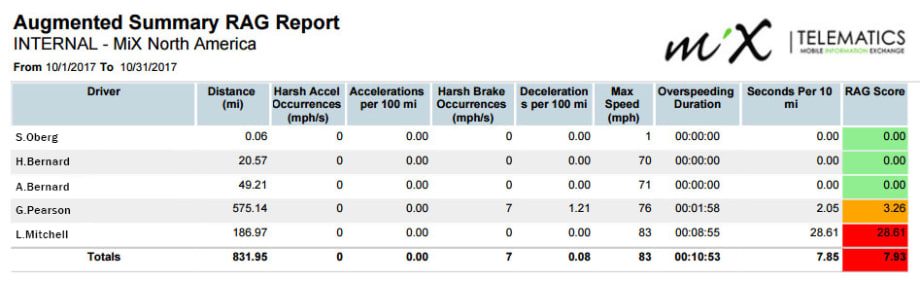
Driver safety scorecards help drivers understand where they rank in terms of safety. Fleet managers can reward the best drivers with incentives.
Source: MiX Telematics
5 min to read
Source: MiX Telematics
One big benefit of the move to electronic logging devices (ELDs) is the ease with which fleet managers can now collect data to help improve operations. The data can be overwhelming, however, and we’re fielding a lot of questions from fleet managers on what’s most important, and how to leverage the data they are now collecting.
We think about data across three broad categories: safety, efficiency and compliance. In an ELD world, the data typically comes from an on-board computer on each vehicle that tracks metrics such as speed, idling, fuel usage, driver behavior, GPS location and more. The data flows to fleet management software installed on the OBC and is then delivered to fleet managers via wifi, cellular network or satellite, in some cases in real time.
While KPIs will differ by fleet size and vertical, here are the most common – the ones we believe every fleet should be tracking.
Safety KPIs
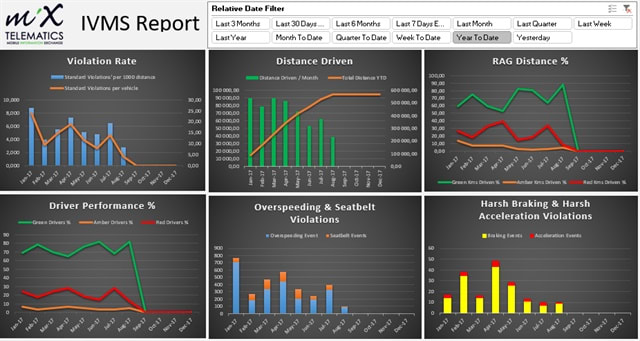
Driver behavior is the biggest category within safety – fleets that monitor driver behavior and use the data they collect for driver coaching are best poised to improve their overall safety profile.
The top KPIs for safety are all related to driver behavior, and include:
Speeding incidents
Harsh acceleration and braking incidents
Corner handling incidents
Crashes
Ideally, this data should be conveyed to fleet managers in real time – especially crashes.
In addition to collecting this data, fleet managers should also publish weekly driver scorecards – exception-based reports that include data on the frequency of these events, per driver.
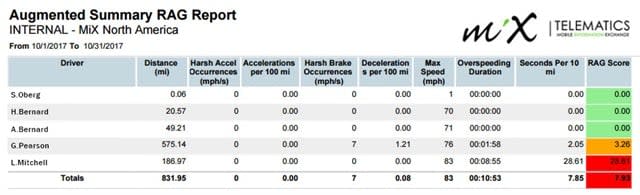
Driver safety scorecards help drivers understand where they rank in terms of safety. Fleet managers can reward the best drivers with incentives. Source: MiX Telematics
These scorecards should be posted in driver break rooms and other common areas to create completion among drivers (often fleets will give their best drivers rewards such as cash gifts or extra paid time off). Some fleets are creating safety competitions, leveraging gamification app features in their fleet management solutions.
Of course, more detailed scorecards should also be shared with individual drivers, for educational and coaching purposes. Some fleets call these RAG (Red, Amber, Green) reports, for the colors used to indicate each driver’s risk profile. Whatever you call them, they are essential element for driver coaching and improving driver behavior.
Fleets that have added in-cab video to their ELD solution can configure their systems to automatically append video to the record of each triggered event – so fleet managers and drivers can see what was happening inside and outside the cab when an event (such as a crash) occurred.
Efficiency KPIs
When it comes to efficiency, we recommend that fleets track:
Fuel economy per vehicle, including idling time
Empty miles
Fleet asset utilization
Most fleets we work with review reports on fuel economy and maintenance weekly, and empty miles and fleet asset utilization either monthly or quarterly.
Fuel economy and maintenance data can help managers identify gas-guzzling behaviors such as speeding and excessive idling, so that drivers can be trained to avoid them. Reducing those behaviors in turn reduces wear and tear on vehicles, decreasing maintenance requirements. Most importantly, all of this leads to safer driving and fewer crashes.
Obtaining a clear view of empty miles and how assets are used on a day-to-day basis can help fleets optimize asset utilization and, in some cases, allow companies to reduce the number of vehicles in their fleet – further reducing costs such as fuel, maintenance and insurance.
Compliance KPIs
For compliance, we believe fleets need to track:
Available Hours of Service (HOS)
HOS violations
Unassigned mileage by vehicle
Hours of service is most important, and is the main objective of the ELD mandate. Dispatchers should be looking at HOS at least daily. Best practice is to look at this data live, in real time as they dispatch, since HOS can change during a day.
We recommend a weekly review of violations – virtually all fleets will have them, not due to failures in their processes, but often because drivers simply don’t obey the rules. For example: if a driver is going to run out of hours in 30 minutes, but he’s 45 minutes from home, he’s going to keep going. Fleets don’t have to report these violations – but they do need to track them, in case there is a DOT audit.
Unassigned mileage by vehicle is another key provision of the ELD Mandate. The FMCSA wants ALL driving time captured. If your fleet has exceptions, you need to be aware of them (and ideally get that mileage assigned to a driver before your next audit).
Most importantly, be sure to use the data your ELDs collect
In certain sectors, there are other important KPIs. For instance, in food delivery, fleets should track on-time arrivals and monitor reefer temperature. But generally, everything you want to track will fall under safety, efficiency or compliance.
The ability to set up alerts within your chosen ELD platform will assist greatly – especially alerts for safety issues and impending HOS violations. Having insight into those events will help ensure fleets can reduce or prevent them.
Reporting is also crucial. All of these top KPIs can probably be automatically collected by your ELD solution. Pre-configured reports can make the reporting process simple and automated. Some systems offer the ability to craft your own custom report templates – especially useful for larger fleets or power users of analytics.
The ELD era will bring about a data deluge, which has a ton of potential to help fleets improve safety and operations. But if fleets don’t harness and use the data, it’s just noise.
Pete Allen is the chief client officer for Mix Telematics, a global provider of fleet and mobile asset management solutions.This article was authored and edited according to the standards of HDT’s editors to provide useful information to our readers.
Subscribe to Our Newsletter
More Fleet Management

Nominations Open for HDT Emerging Leaders
Heavy Duty Trucking is looking for accomplished trucking fleet professionals under 40 who are making an impact and helping lead the industry forward.
Read More →
Why Private Fleets Are Taking More Freight
Private fleets are putting their own trucks on demanding customers and high-cost lanes as companies seek greater control over service, costs, and capacity.
Read More →
Sponsored•September 16, 2026
Color Match Smarter: Tools That Restore & Perform
For fleet managers and collision repair professionals keeping heavy-duty trucks on the road, getting the color right the first time isn't just about appearance — it's about efficiency, turnaround time, and bottom-line results. Discover how today's digital color tools are transforming the repair process from guesswork to precision.
Read More →


FMCSA Pauses Biennial-Update Enforcement Amid Motus Transition
Carriers whose updates were due on or after June 1 have more time, while FMCSA works to stabilize its new registration system and warns of phishing sites impersonating its new carrier registration system, Motus.
Read More →
Sponsored•September 14, 2026
2026 Blueprint for Countering Smarter Supply Chain Theft
Cargo theft is no longer just the cost of doing business. It's a multi-billion-dollar criminal enterprise exploiting vulnerabilities across your fleet, drivers, and supply chain.
Read More →
Sponsored•September 1, 2026
How Telematics Improves Visibility, Control, and Performance in Refrigerated Fleets
Explore how telematics help refrigerated fleets improve visibility, uptime, efficiency, compliance, and cargo protection across connected cold chain operations.
Read More →
What the U.S.-Canada Trade War Means for Trucking
Escalating U.S.-Canada tariffs could disrupt cross-border freight, reduce truck volumes, raise costs, and create new uncertainty for carriers on both sides of the border.
Read More →
What Are Trucking’s Top Concerns for 2026?
The American Transportation Research Institute wants to know what's worrying trucking fleet managers, drivers, and other stakeholders in its annual Industry Issues survey.
Read More →
American Trucking Associations Looks for a New Leader
ATA President and CEO Chris Spear abruptly left his job at the association on August 21, at a pivotal time for the trucking industry.
Read More →
Public Wi-Fi Cybersecurity Risks: How Truck Drivers and Fleets Can Protect Their Data
Public Wi-Fi can expose truck drivers and fleets to credential theft, malware, and other cyber threats. Here’s how to reduce the risk on the road.
Read More →