




What Are Your Trailers Riding on and Why?
The choice of trailer components such as suspensions, sliders, and wheel ends, is pretty complex – and spring suspensions are making a comeback in some areas.
Source: ATA, TMC
Ever wonder what goes into the decisions behind which components come on your trailer?
For an OEM, it’s a complex evaluation that takes many factors into account. Mark Ehrlich, senior director of engineering for Wabash National, gave a Technology & Maintenance Council study group some insight into the decision-making process during a Sept. 17 session.
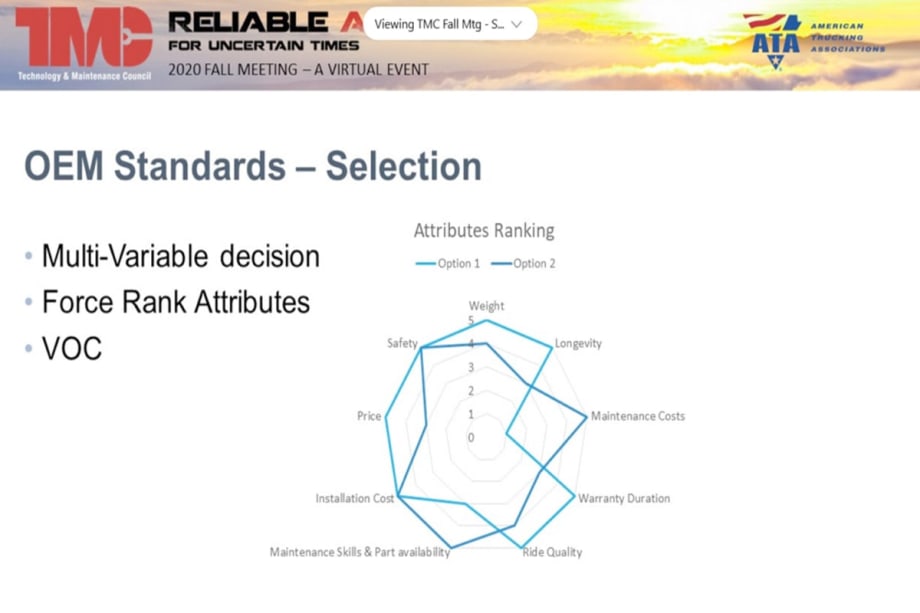
“The selection criteria is pretty intricate,” he said, referring to the evaluation of components such as suspensions, sliders, and wheel ends. “We are looking at multiple attributes in concert together to come up with the best result in terms of value.”
Those considerations include performance, safety, ride quality, weight, longevity, maintenance requirements, warranty duration, replacement part availability, and more. Data is heavily relied on by the trailer manufacturer to make those decisions.
Trailer makers also consider the complexity and cost of installation on their assembly lines.
In the case of a suspension, Ehrlich said Wabash considers the warranty and its construction. Is it corrosion-resistant? Are maintenance requirements reduced, for example, by using a mechanical fastener that doesn’t require torqueing? Are wearable parts readily available in the aftermarket?
For the slide rail, the OEM considers its longevity and examines the welds to ensure it won’t be prone to fatigue cracking. Ehrlich is wary of slide rails where welding has been done in high-stress areas.
For wheel-end components, Wabash wants to match up warranty with the life-cycle of the trailer. It wants to see long-lasting bearings and larger roller sizes. Lubrication requirements are also important, as are the wheel seals.
“They’re a very inexpensive part in comparison to the rest of the trailer but the wheel seal can cause a lot of cost later on if it fails,” Ehrlich noted.
Inner and outer bearings that are the same part number can simplify maintenance for end users.
Spring vs. Air Ride
Scott Bartlein, fleet manager for Barry Trucking, weighed the pros and cons of spring and air ride suspensions, noting it may be time to give spring ride suspensions a fresh look. If a fleet’s cargo damage claims are low, it may make sense to spec’ spring suspension trailers to save some cost.
Cargo packaging and load securement products have improved in recent years, Bartlein pointed out.
But on the other hand, air ride makes sense for cargo that’s fragile or lightweight, especially if it has come off a potentially rough sea journey.
Spring ride suspensions have the benefit of being lighter-weight, so payload can be increased. But then there are some customers who demand air ride suspensions be used to carry their freight. Will they pay extra for the benefit?
Spring suspensions are easier and two to four times less expensive to maintain, Bartlein noted. And if you’re pulling doubles, they’ll put less demand on your air system. Trailers with spring suspensions are also easier to examine during a pre- and post-trip inspections, which could help reduce roadside failures.
“I’m not bashing air ride,” Bartlein said. “I think there’s a need for them. All I’m saying is, as fleets we want to keep an open mind. One size doesn’t fit all and we need to take a fresh look at technologies.”
James Menzies is the editor of Today's Trucking, where this article originally appeared. This content was used with permission from Newcom Media as part of a cooperative editorial agreement.
More Equipment

How Volvo Updated Its D13 for EPA 2027 [Watch]
Volvo’s updated D13 promises lower emissions without sacrificing performance or fuel economy. Take a closer look at what changed inside the engine in this HDT Spotlight video.
Read More →
Michelin Tire Improves Efficiency and Durability for Regional Fleets
The Michelin X Multi Energy D2 is a regional haul drive tire engineered to help fleets improve fuel efficiency, durability and traction in demanding stop-and-go operations.
Read More →
ZF Expands Commercial Vehicle Push in North America
ZF is expanding its North American commercial-vehicle presence with new transmission applications, electrification, trailer technology and autonomous-driving systems.
Read More →
Tesla Wants a Self-Driving Semi. Are Cameras Enough?
Could Tesla’s camera-only autonomous driving technology work on an 80,000-pound Semi? In this commentary, HDT's Deborah Lockridge takes a look at Tesla, Cybercab, and how autonomous trucks see the road.
Read More →
Kodiak: Driverless Long-Haul Truck Launch on Track for 2026
Kodiak AI says its driverless long-haul safety case is 93% complete and it remains on track to begin commercial operations by year-end 2026.
Read More →
What DOT’s Automated Vehicle Strategy Means for Trucking
The U.S. Department of Transportation issued a new automated-vehicle strategy that outlines plans for driverless-truck regulations, cross-state freight corridors, and federal safety standards.
Read More →
East Coast Port Launches $45M Electric Truck Push
The Port Authority of New York and New Jersey announced millions in incentives for zero-emission drayage trucks, yard tractors, and new charging hubs near the port.
Read More →
PlusAI Going Public to Fund Autonomous Truck Launch
A SPAC deal could provide PlusAI with up to $300 million as it works toward a 2027 commercial launch of factory-built autonomous trucks.
Read More →
NHTSA Moves to Rewrite Truck Fuel-Economy Rules
The National Highway Traffic Safety Administration says it lacks authority to regulate medium- and heavy-duty truck engines separately from complete vehicles, but the existing standards have not yet been eliminated.
Read More →
Detroit Opens Orders for EPA 2027 Engines
Detroit isn’t starting from scratch to meet EPA 2027 diesel emissions standards. Its Gen 6 DD13 and DD15 engines keep much of today’s platform while updating the fuel and aftertreatment systems.
Read More →